
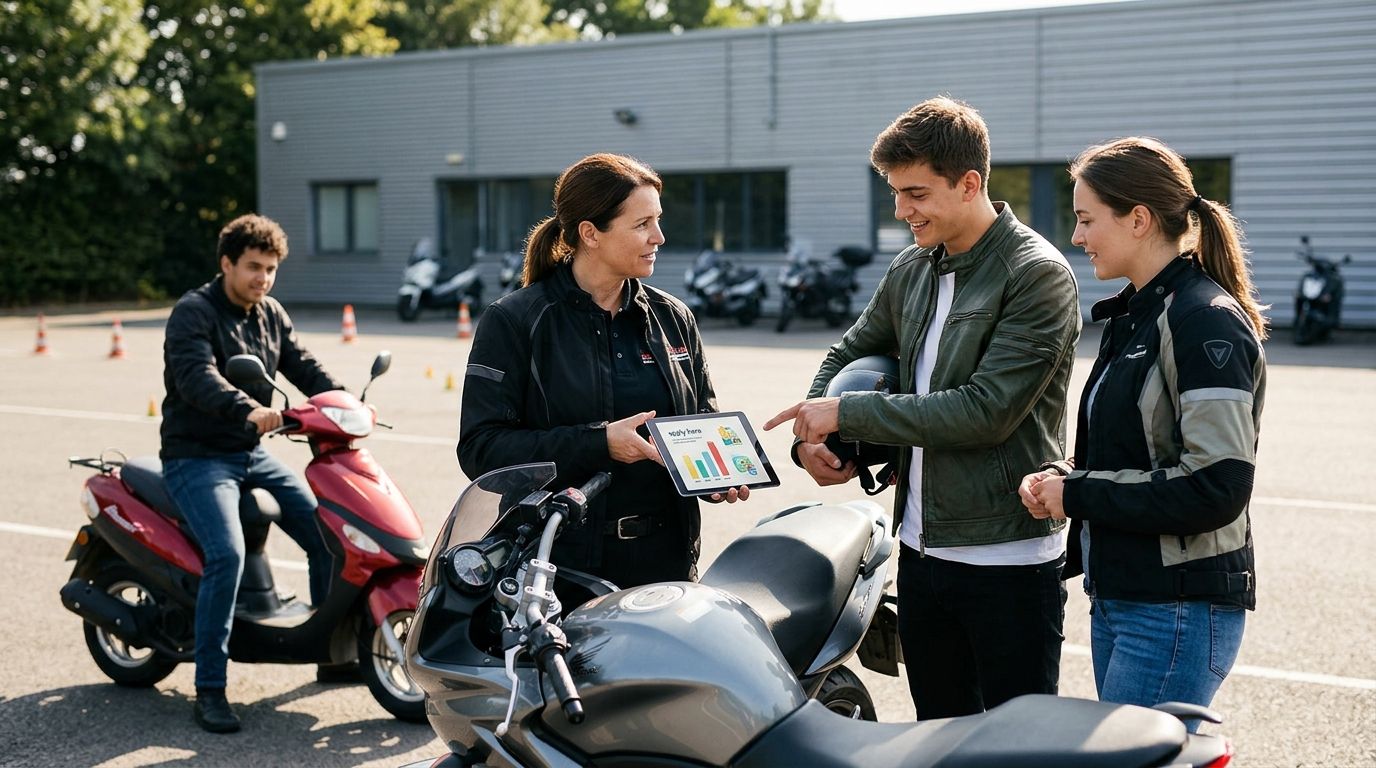
Motorcycle and scooter training school finance is an interest-free instalment option added at course booking, aimed at getting students onto A1, A2 and full A-licence packages without one lump-sum hit to their bank account. CBT is usually a single low-ticket day; DAS and full-licence packages bundle multiple lessons, bike hire and test fees into one higher invoice, and that's exactly where a payment plan turns a hesitant enquiry into a confirmed booking.
- Motorcycle training school finance spreads CBT, A2 and DAS course costs interest-free instead of one upfront payment.
- Full-licence packages cost more than a single CBT day, so instalments convert more hesitant bookings.
- Manual options like invoicing work but slow cash flow; BNPL from PayItMonthly gets the school paid upfront.
- Vetting affordability before confirming a test date avoids missed instalments the week before the exam.
- Advertising 'spread the cost' without clear wording risks ASA scrutiny during peak riding season.
Why this matters
A training school's cash position depends on collecting course fees before the instructor's diary is booked and the DVSA test slot is paid for. When a student can't cover a full A2 or DAS package in one go, the booking either stalls or gets split into a deposit-plus-chase arrangement that eats admin time. PayItMonthly exists to remove that gap: the school gets paid in full at booking, the student repays in interest-free monthly instalments.
Schools running one-day CBT courses feel this less, because the ticket size is small and most students can cover it outright. The pressure shows up on A1, A2 and full A-licence bundles, where lesson blocks, bike hire and test fees stack into a single invoice that's harder to justify paying in one hit — particularly for the 17-24 age group that makes up most new-rider enrolments in 2026.
Why motorcycle training school finance matters for training schools
Training schools sell a service that's front-loaded on cost and back-loaded on outcome: the student pays before they've passed, and the school has already committed instructor hours and a bike before the invoice clears. That structure makes course fees feel riskier to a student than a retail purchase of equal size, even when the total is lower than a used scooter.
The segment also splits into two very different buyers. A CBT-only rider wants a quick, cheap route to a 125cc licence and rarely needs finance. A student booking a full DAS package, or upgrading from A2 to a full A licence, is committing to a multi-week course with a bigger total — that's the booking where a payment plan changes the outcome, not the one-off CBT slot.
Map your course pricing before you offer finance
Before adding any instalment option, separate your course catalogue by ticket size so you know where finance actually moves the needle.
- List CBT, A1, A2, DAS and full-licence packages as separate line items, not one blended "training" price
- Flag which packages bundle bike hire, kit hire or test fees into the invoice
- Note which courses are typically paid in full versus paid as a deposit plus balance
- Identify repeat customers upgrading licence categories, since they're more likely to book a second higher-ticket course
Set up the manual payment option first
Start with what you can run without new software, because it tells you how much demand for spreading cost already exists.
- Offer a deposit-plus-balance arrangement with a fixed date for the second payment
- Take standing order instructions for repeat corporate or fleet training clients
- Record how often balance payments are late or chased more than once
- Track which course types generate the most payment plan requests
Add an interest-free instalment option at checkout
Once the manual process shows demand, an instalment option removes the admin without removing the cash flow benefit. This is where PayItMonthly fits: the school is paid the full course fee at booking, and the student repays over fixed monthly instalments with no interest added.
- Offer instalments on A2, DAS and full-licence packages first, where ticket size justifies it
- Keep CBT as a straight one-off payment unless demand data says otherwise
- Show the instalment option at the point of booking, not buried in a follow-up email
- Confirm the student sees the total cost and repayment schedule before confirming a course date
Train instructors and booking staff to mention finance early
Finance only converts bookings if the front desk or the instructor answering enquiry calls actually mentions it before the student walks away to "think about it."
- Script the finance mention into the standard enquiry call, not as a fallback objection-handler
- Put the instalment option on the booking page next to the course price, not on a separate page
- Brief instructors so they can answer basic questions about how repayments work
- Review call recordings or booking notes monthly to check the option is actually being offered
Vet students for affordability before confirming a test date
A missed instalment is worse in this segment than in retail, because a cancelled or unpaid booking can knock out a DVSA test slot that took weeks to secure. Running an affordability check before confirming the course protects both the school's cash flow and the student's test date.
- Confirm income or employment status is captured at application, not assumed
- Set a repayment schedule that finishes before, not after, the scheduled test date
- Flag applications where the repayment term overlaps a known busy period, like exam season for 17-19 year olds
- Keep a clear escalation process for a missed instalment that doesn't cancel the booked test slot automatically
Advertise finance offers within ASA guidelines
Motorcycle training bookings peak in spring and summer, which is exactly when schools push finance messaging hardest — and exactly when compliant wording matters most.
- State clearly that the plan is interest-free, not "low interest" or vague
- Avoid implying guaranteed approval in any ad copy or social post
- Include representative examples of repayment terms where required
- Keep website and printed course brochures using the same wording as paid ads
Comparing finance options for motorcycle and scooter schools
| Option | Best for | Key limitation |
|---|---|---|
| Manual invoicing / standing order | Schools with repeat corporate or fleet clients | No automation — staff chase balance payments by hand |
| Modular "pay per stage" billing | Schools running staged A1/A2/DAS packages | Doesn't remove the upfront cost barrier for a full course commitment |
| Interest-free instalments via PayItMonthly | Schools wanting same-week payment and higher completion on full-licence packages | Needs an affordability check and application step at booking |
Verdict: manual invoicing works for small volumes of repeat clients but doesn't scale past a handful of students a month; interest-free instalment finance through PayItMonthly is the option that converts more A2 and DAS enquiries without the school carrying the payment risk.
Common mistakes motorcycle and scooter schools make with finance
- Charging the full course fee upfront on every package — losing 17-19 year old A1 bookings to schools that offer a payment plan on the same course
- Treating CBT and DAS the same way — a one-day CBT rarely needs finance, but a multi-week DAS package almost always benefits from it
- Skipping affordability checks — chasing a missed instalment the week before a booked test date is worse than chasing it on a retail order
- Vague finance ad wording — "spread the cost" without stating it's interest-free invites ASA complaints during the spring booking rush
- Leaving finance out of the enquiry call — if instructors and booking staff never mention it, the option only reaches students who already know to ask
Add instalment finance to your bookings
Get paid in full at booking while students repay interest-free.
FAQ
What is motorcycle training school finance?
Motorcycle training school finance is an instalment payment option that lets students pay for CBT, A1, A2 or DAS courses over several months instead of one upfront fee. The school is typically paid in full at booking while the student repays in fixed instalments.
Can 17-year-olds get finance for CBT or A1 licence training?
Finance eligibility depends on the provider's own affordability and application checks, and applicants are usually assessed on income or a guarantor rather than age alone. CBT is a lower-ticket, one-off booking, so most students under 18 pay it outright rather than financing it.
Is motorcycle training school finance interest-free?
With PayItMonthly, the instalment plan is interest-free — the student repays the exact course price split into equal monthly payments. Always confirm this is stated clearly in any ad or checkout page you compare it against.
Does offering finance affect a training school's own credit rating?
No. The school is paid the course fee upfront by the finance provider, so it isn't extending its own credit or carrying the repayment risk. Only the student's application is assessed for eligibility.
How does motorcycle school finance compare to driving school finance?
Both sit in the training and education finance category, but motorcycle course tickets vary more by package — CBT is low-ticket while DAS and full-licence courses are higher-ticket. Driving schools tend to have a more uniform course price, so the finance case is stronger for motorcycle schools on their upper-tier packages specifically.
What happens if a student misses an instalment before their test date?
A missed instalment is handled by the finance provider, not the school, so the booked test slot isn't automatically cancelled. Schools should still set repayment schedules that finish before the scheduled test date to avoid last-minute admin.
Do you need an FCA credit licence to offer instalment finance?
No — when a regulated finance provider like PayItMonthly runs the credit agreement, the training school doesn't need its own FCA credit licence. The provider handles the regulated lending and the affordability checks.
How much does BNPL cost a training school to set up?
Setup costs and fees vary by provider and are best confirmed directly with the finance provider rather than estimated. Check current terms on the provider's site before committing a course catalogue to instalment pricing.
One last thing
The biggest completion-rate gain in 2026 won't come from putting finance on every course — it'll come from putting it only on the packages where the ticket size actually creates hesitation. Offer instalments on A2, DAS and full-licence upgrades first; leave CBT as a straight one-off payment until your own booking data says otherwise.


