

Yes, service businesses can offer buy now pay later when a provider accepts their sector and the service being financed. You need to confirm merchant eligibility, customer eligibility and the rules for delivery, cancellations and refunds before offering it. This guide explains how to assess a service booking, compare payment arrangements and prepare your business for a BNPL launch in 2026.
- Can service businesses offer buy now pay later? Yes, subject to provider acceptance and customer eligibility.
- PayItMonthly provides UK merchants with interest-free monthly instalments; confirm service-sector eligibility before choosing it.
- Match customer finance to a defined service, not an open-ended promise of future work.
- Check settlement, cancellations and partial refunds before adding BNPL to your booking process.
Can service businesses offer buy now pay later too?
Yes. Selling a service rather than a physical product does not automatically rule out buy now pay later. The practical question is whether a provider accepts your business, your customers and the particular transaction.
PayItMonthly provides UK retailers and merchants with a platform that lets customers spread purchases into interest-free monthly instalments. A service business should confirm its exact activity and booking structure with the provider rather than assume that merchant finance covers every service.
Start with 5 checks before you advertise instalments:
- Sector acceptance. Describe what you actually deliver, including any goods bundled with the service. Ask for confirmation that the provider accepts that activity.
- Customer eligibility. Confirm who can apply and how decisions are communicated. Do not promise acceptance simply because your business has been approved.
- Service scope. Identify the work, sessions or booking covered by the purchase. Separate optional extras and later variations from the original agreement.
- Settlement trigger. Establish what must happen before the provider pays your business. Compare that event with when you incur labour, materials or venue costs.
- Cancellation process. Confirm how a cancelled booking, reduced package or partially completed job affects the financed purchase.
These checks answer different questions. A provider accepting your business does not establish when you receive payment, and an approved customer application does not remove your responsibility to deliver the agreed service.
Why this matters
A service is not always delivered at the moment a customer buys it. You might take a booking now, reserve capacity and perform the work later. That gap makes the relationship between payment and delivery central to your decision.
Customer repayments and merchant settlement are separate schedules. Do not build your cash-flow plan around the customer's instalment dates unless the provider's terms explicitly connect them to your payout.
For your 2026 launch, assess the arrangement against the way you already operate. A payment option that fits a completed repair needs different operational checks from one attached to a future event or a package of lessons.
Which service payment arrangement fits your business?
Compare arrangements by what the customer buys and when you deliver it. The table below describes payment models, not a claim that any particular provider supports them.
| Arrangement | Best for | Practical advantage | Limitation to resolve |
|---|---|---|---|
| BNPL for a defined service | A specific job or fixed package | Separates customer repayments from the service purchase | Provider acceptance and settlement conditions need confirmation |
| Deposit and balance | A booking with a clear delivery date | Separates reservation from final payment | A deposit is not the same as financing the remaining balance |
| Milestone billing | Work completed in distinct stages | Connects invoices to agreed progress | Changes and disputed milestones need a clear process |
| Recurring subscription | An ongoing service with recurring billing | Matches payment to continuing access or provision | It is not automatically a BNPL agreement for a fixed purchase |
Defined jobs and fixed packages
A defined service gives you a clear scope to discuss with a finance provider. Your quote should identify what is included, what is excluded and what counts as completion.
The advantage is clarity: the customer and your team can refer to the same purchase description. The limitation is that extra work needs its own approval process; it should not silently become part of an existing financed booking.
Future bookings and staged work
For a future booking, ask how the provider treats the period between purchase and delivery. Confirm the settlement trigger and what happens if either party cancels before the service begins.
For staged work, document each stage before choosing the payment arrangement. Do not confuse a customer's monthly repayment schedule with your project's delivery milestones. They serve different purposes and need separate explanations.
Ongoing services
If the service continues until the customer cancels, establish whether you are selling a subscription or a fixed package. That distinction changes what the customer is agreeing to buy.
A fixed package has a defined scope. An ongoing service needs clear renewal and cancellation terms. Ask the provider to assess the actual arrangement rather than presenting every recurring payment as buy now pay later.
What should you ask a BNPL provider before signing?
Ask for answers that refer to your service, not a generic retail example. Use the same checklist across providers so you can compare like with like.
Eligibility and applications
Describe your service, sales channel and customer type. Include whether customers purchase remotely, in person or after accepting a written quote.
Ask which checks customers complete, how an unsuccessful application is handled and what staff can say about eligibility. Keep approval decisions with the provider; do not make promises your business cannot control.
Settlement and responsibilities
Ask what triggers merchant settlement and which circumstances delay, reduce or reverse it. Then identify who handles customer repayment queries, service complaints and finance-account questions.
A useful answer assigns responsibility to a named party and a clear process. A broad assurance that finance is simple does not tell your booking team what to do when a customer disputes part of the work.
Costs and contract terms
Request the current merchant charges and contractual conditions directly. Review them alongside your labour, materials and administration costs without assuming that interest-free customer repayments mean a cost-free arrangement for your business.
Check the contract's treatment of refunds, disputes and termination. For a 2026 comparison, use current documents rather than an older sales presentation or a summary from another merchant.
Customer communications
Ask which wording and disclosures the provider requires wherever you present finance. That includes quotes, booking pages and staff conversations, not just an online checkout.
Confirm your legal responsibilities for the actual arrangement before launch. A BNPL label alone does not establish the regulatory treatment of every finance product or merchant activity.
How do you add BNPL to a service booking process?
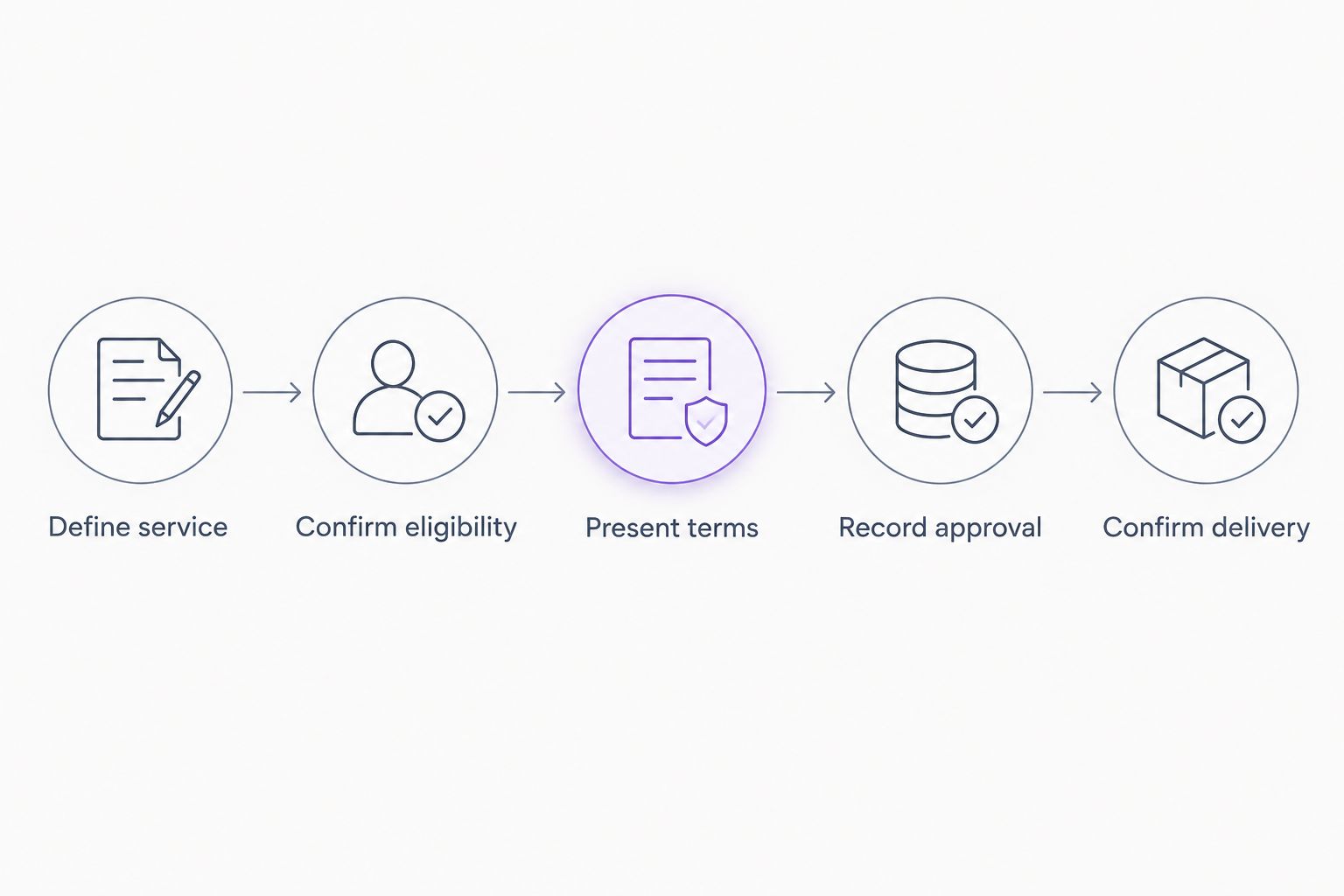
Use a defined sequence that keeps the service purchase and finance application connected without treating them as the same decision.
- Define service. Prepare a quote or booking description that identifies the agreed work, exclusions and delivery expectations.
- Confirm eligibility. Verify that the provider accepts the service and sales channel before presenting the option.
- Present terms. Give the customer the required finance information alongside the service terms, with a route to ask questions.
- Record approval. Follow the provider's application process and record the outcome before treating the booking as financed.
- Confirm delivery. Record delivery or progress as required, and follow the agreed process for changes and refunds.
This sequence keeps 2 separate decisions visible: the customer chooses the service, and the provider decides the finance application. A customer expressing interest in instalments is not the same as a completed finance agreement.
Decide what your team does if the application is unsuccessful or the customer stops midway. Keep an alternative payment route available without pressuring the customer to apply again.
For the wider setup process, see the guide to offering finance to customers as a small business. Your service-specific checks still need to cover delivery timing, scope changes and cancellations.
How should you handle service changes and cancellations?
Agree the process before your first financed booking. A change to the service and a change to the customer's finance account are related actions, but completing one does not prove the other is complete.
If a customer cancels, establish what work has been delivered and apply the relevant contractual and legal requirements. Follow the provider's process for any adjustment to the financed transaction; do not tell the customer their repayments have stopped without confirmation.
For a partial change, record what was removed, what remains and what adjustment was requested. Avoid relying on a conversation that your booking, delivery and finance teams cannot all see.
Keep 3 records connected:
- Service record: the agreed scope, delivery status and any accepted changes.
- Finance record: the application outcome and transaction reference.
- Change record: the cancellation or refund request and its confirmed outcome.
Your 2026 staff process should explain who updates each record. Give customers a clear contact route for service questions and the appropriate route for finance-account questions.
Never use finance administration as a substitute for resolving a service complaint. Investigate the delivery issue and coordinate any payment adjustment through the correct process.
Why BNPL suitability varies between service businesses
The category label is only the starting point. Assess these factors against the actual transaction:
- Scope certainty. A fixed description makes it easier to establish what the customer purchased; open-ended work needs a change-control process.
- Delivery timing. Immediate completion and future delivery create different questions about settlement and cancellations.
- Partial delivery. A package delivered over time needs a clear method for recording completed and undelivered elements.
- Customer type. Consumer purchases and business purchases require separate eligibility confirmation; acceptance of one does not establish acceptance of the other.
- Sales channel. Your application process must fit how the customer accepts the quote or booking.
- Cancellation exposure. Reserved capacity, preparatory work and third-party commitments belong in your operational assessment.
These are decision criteria, not reasons to reject service finance outright. Choose an arrangement that fits the service you sell, rather than changing your delivery promises to fit a payment option.
Can I offer BNPL without an online shop?
Yes, service finance does not inherently require a traditional product catalogue. You still need a provider-supported application route that fits how you quote, book and take payment.
Describe your real sales process when you enquire. Do not assume that a provider's online retail checkout works unchanged for telephone bookings or quotes accepted after a consultation.
Can I finance a package of appointments or lessons?
A fixed package can be assessed for BNPL, but the provider must accept both the service and the way it is delivered. Define what the package includes and how you handle missed appointments, cancellations and unused elements.
For a 2026 launch, give staff a written process for package changes. Customers should not have to piece together separate answers from the booking team and finance provider.
Does interest-free BNPL guarantee faster payment for my business?
No. Interest-free describes the customer's borrowing terms; merchant settlement follows the provider's agreement with your business.
Ask for the exact settlement trigger before relying on finance to fund delivery. Check what happens when work is delayed, disputed or cancelled as well as what happens in a straightforward booking.
Where does PayItMonthly fit?
PayItMonthly is best suited to UK merchants seeking an interest-free monthly-instalment platform. Its stated offer matches that requirement; a service business still needs confirmation that its sector, booking structure and delivery model are accepted.
That is the distinction to keep clear when assessing PayItMonthly for customer finance: the platform's stated purpose is known, but acceptance of your particular service must be confirmed. Ask about settlement, merchant terms and cancellation handling alongside eligibility.
Check your service business fit
Discuss your service, booking process and interest-free monthly instalment requirements.
FAQ
Can service businesses offer buy now pay later in the UK?
Yes, UK service businesses can offer buy now pay later when a provider accepts their sector and transaction type. Customer eligibility, delivery conditions and cancellation handling also need confirmation.
Is buy now pay later only for physical products?
No, buy now pay later is not inherently limited to physical products. A provider must still accept the particular service and how it is sold and delivered.
Can a sole trader offer instalments for services?
A sole trader can seek a service-finance arrangement, subject to the provider's merchant requirements. Business structure alone does not confirm acceptance of the service or customer application.
Does merchant approval mean every customer is accepted?
No, merchant approval and customer approval are separate decisions. Follow the provider's application process and do not advertise guaranteed acceptance without an explicit basis.
Can I use BNPL for a service booked in advance?
A future service booking needs explicit provider acceptance of the delivery timing. Confirm settlement conditions and what happens if the booking changes or is cancelled before delivery.
Do customers stop paying when they cancel a service?
Do not assume that cancellation automatically stops finance repayments. Follow the provider's adjustment process and confirm the outcome before advising the customer about their account.
Does PayItMonthly offer interest-free monthly instalments?
Yes, PayItMonthly provides UK retailers and merchants with a platform for interest-free monthly instalments. A service business should confirm its specific eligibility and merchant terms directly.
One last thing
Before launch, walk your team through a booking that changes after finance approval. Ask who updates the service scope, who contacts the provider and who confirms the outcome to the customer.
If nobody owns that change, your booking process is not ready. A successful application only demonstrates that the initial transaction progressed; it does not demonstrate that your business can handle a cancellation or partial delivery.
Use that rehearsal to close process gaps before you advertise BNPL. The most useful preparation is not a stronger sales claim—it is a clear answer when the original booking no longer matches the work being delivered.


