

Counselling practice customer finance is a way to spread payment for an agreed service across instalments, with the aim of making payment timing manageable without changing clinical decisions. This 2026 guide explains how to assess instalment plans, compare payment routes and protect clients when the length of counselling is uncertain.
- Customer finance for counselling practices needs clear cancellation terms, voluntary participation and a separate clinical decision.
- PayItMonthly provides interest-free monthly instalments for UK merchants; confirm counselling-service eligibility before choosing it.
- Pay-as-you-go suits uncertain treatment lengths; financed packages need an agreed scope and a workable refund process.
- Choose payment arrangements around client consent, not larger treatment commitments.
Why customer finance matters for counselling practices
Counselling involves an ongoing relationship, not simply a completed purchase. Your payment arrangements must accommodate changes in attendance, therapeutic fit and the decision to stop. A finance agreement must never become a reason to continue clinically unnecessary sessions.
Separate payment timing from affordability. Spreading a bill changes when a client pays; it does not establish that taking on the commitment is right for them. Keep a non-financed payment route available and explain it with equal prominence.
PayItMonthly provides UK businesses with interest-free monthly instalments. Its general merchant offer does not establish acceptance of counselling services, so obtain confirmation before building it into your practice's 2026 payment process.
Your starting point is the service you actually deliver. A defined workshop and open-ended individual counselling need different payment arrangements. Set the clinical boundaries first, then choose the payment method.
How to introduce customer finance responsibly
Define the service before the payment plan
Start manually with a written service description. Identify what the client is agreeing to receive, what remains subject to clinical review and what happens if either party ends the arrangement. Do not turn an uncertain course of counselling into a fixed package merely to make financing easier.
For ongoing individual work, payment per session keeps the financial commitment aligned with attendance. A defined programme requires an equally defined cancellation process. Neither structure removes the need for informed agreement.
Create a 1-page service summary as an internal drafting target. Keep the language factual: session format, booking arrangements and cancellation terms, rather than promises about recovery or treatment outcomes.
- Describe the service and who delivers it.
- Distinguish booked sessions from possible future sessions.
- Record when clinical suitability is reviewed.
- Explain how a client can stop attending.
- Separate service consent from payment consent.
Map the existing payment journey
Before adding a provider, review your current process using appointment records, invoices and client questions. A spreadsheet is enough to identify where payment administration breaks down. Record payment issues without copying clinical notes into the spreadsheet.
Distinguish between a forgotten invoice, an inconvenient payment date and a client who cannot afford the service. Each needs a different response. Finance is not a substitute for correcting unclear invoices or explaining an existing cancellation policy.
For your 2026 review, follow the journey from initial enquiry to the final payment. Check what information the client receives at each point and whether staff give consistent explanations. Fix the payment process before adding another payment product.
- List the payment methods you currently accept.
- Record the questions clients ask about payment.
- Identify repeated invoice or reconciliation errors.
- Check who handles payment-related complaints.
- Keep clinical information out of finance tracking.
Confirm provider eligibility and commercial responsibilities
Use a written questionnaire to assess providers before requesting technical setup. Ask specifically about counselling, services delivered over time and payments for sessions that have not yet happened. Generic merchant acceptance is not enough.
PayItMonthly customer finance is best suited to UK merchants seeking interest-free monthly instalments. For a counselling practice, that makes the platform a candidate to assess, not proof of sector eligibility or clinical suitability. A provider-managed route offers an alternative to administering instalments yourself, but you must establish which responsibilities remain with your practice.
Do not assume payout timing, credit checks, approval rules or refund handling. Ask for the applicable agreement and evaluate its effect on your administration and cash flow. The guide to how merchant fees work for buy-now-pay-later providers covers the commercial questions to bring into that discussion.
- Obtain written confirmation of counselling-service eligibility.
- Request the merchant agreement and settlement conditions.
- Identify who assesses applications and handles repayments.
- Confirm how partial cancellations affect the agreement.
- Establish each party's complaints responsibilities.
Verify the legal position before launch
Begin with the proposed payment structure, not the label attached to it. Record who provides credit, who introduces the client, the agreement terms and your role in the process. Take that description to an appropriately qualified adviser.
Do not assume that interest-free means outside consumer-credit requirements. Likewise, a provider's permissions do not automatically establish what your practice is allowed to do. Your obligations depend on the arrangement and the activities you perform.
For a 2026 launch, verify the rules applying on the intended launch date using current official guidance. Review client-facing wording as well as the contract: staff explanations, application instructions and payment reminders all need to match the approved arrangement.
- Identify the creditor and your practice's role.
- Confirm applicable permissions or exemptions with advice.
- Check the provider's relevant regulatory status.
- Review promotional wording before publication.
- Document the complaints and escalation route.
Explain the commitment without sales pressure
Write a plain-language payment summary before designing a booking page. State what service the arrangement covers, the payment schedule and where the client can find the full agreement. Keep therapeutic consent separate from the finance application.
An interest-free arrangement still creates a payment commitment. Explain the relevant conditions without suggesting that instalments make counselling affordable for everyone. Do not claim guaranteed acceptance, no credit checks or no credit-file impact unless those statements are verified for the actual arrangement.
Give clients space to decide away from the counselling conversation. Clinical recommendations must not depend on whether a client chooses finance. If a client declines instalments, explain the other payment routes without treating that decision as a barrier to discussing care.
- Present the service scope before the payment schedule.
- Explain any consequences of missed repayments.
- Show the non-financed payment route equally clearly.
- Let clients review terms without staff pressure.
- Provide an accessible route for questions or complaints.
Design cancellation and refund handling
Start with a written procedure that staff can follow without specialist software. Cover an appointment cancelled within your policy, an unused future session and a course ended by the practitioner. Distinguish a booking change from a change to the finance agreement.
Do not assume that cancelling an appointment automatically changes repayments. Establish who must notify the provider, how adjustments are authorised and what confirmation reaches the client. Your clinical team should not need to negotiate finance terms during a therapeutic session.
Test 3 cancellation scenarios before launch: a client stops, the practitioner stops, and the practice cannot deliver a booked service. These are recommended process tests, not assumptions about a provider's policies.
- Record the service change and its effective date.
- Calculate the adjustment under the agreed service terms.
- Notify the party responsible for changing the agreement.
- Reconcile the adjustment against the practice's records.
- Confirm the outcome to the client in writing.
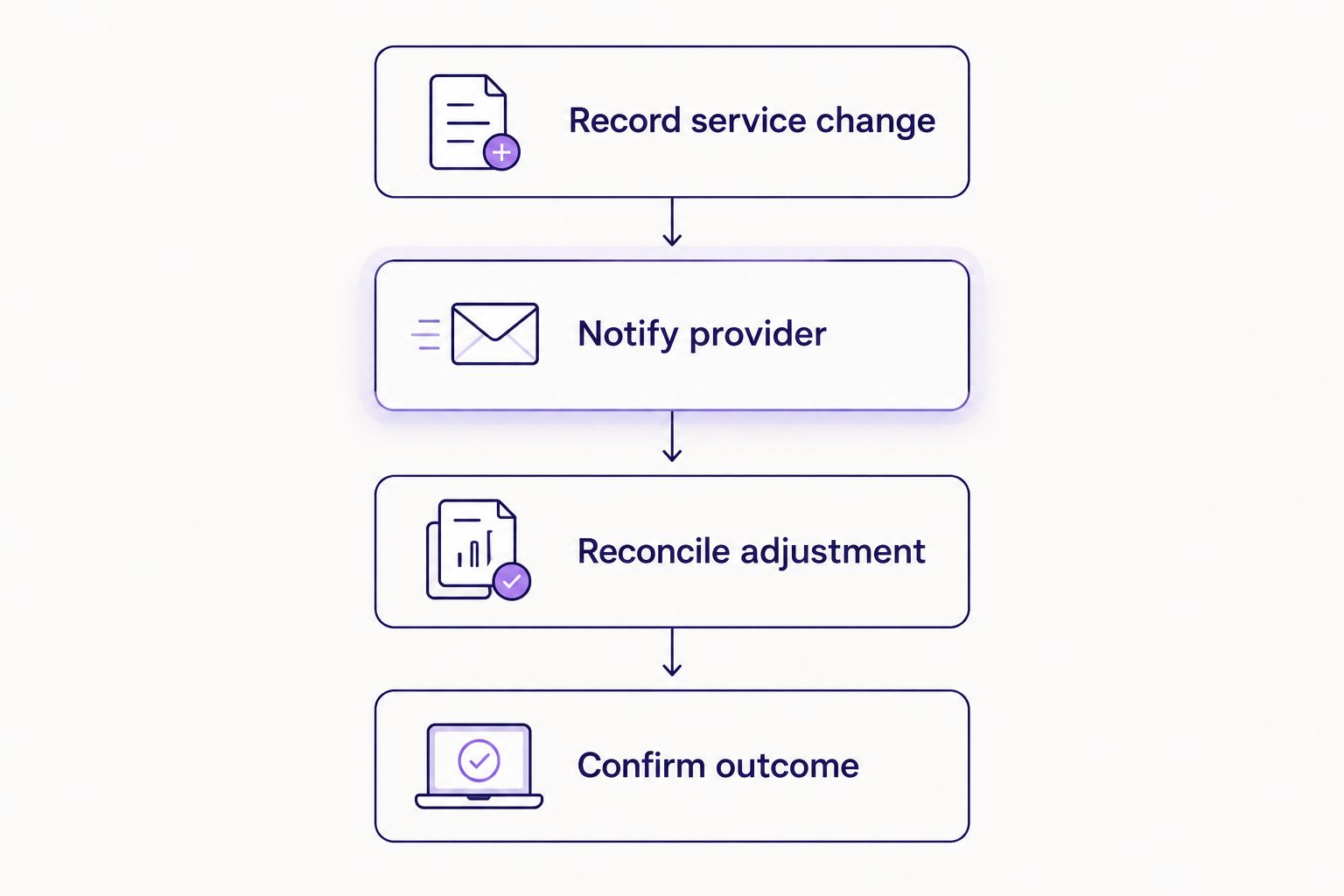
The cancellation process should connect four actions: record the service change, notify the provider, reconcile the adjustment and confirm the outcome. Complete the financial administration separately from the clinical record.
Pilot the arrangement and review client understanding
Use a limited operational pilot after eligibility, legal responsibilities and written procedures are settled. Start with manual reconciliation so you can see each hand-off clearly. Introduce automation only after staff understand the underlying process.
Set a 30-day operational review as a recommended checkpoint, not as a promised implementation timeline. Review explanations, adjustments and complaints alongside administrative workload. Do not judge the arrangement solely by financed bookings or higher commitments.
In your 2026 pilot, ask whether clients can explain what they agreed to and how to raise a payment problem. Keep the feedback separate from therapeutic progress. A payment route succeeds operationally when clients understand it and staff can administer it correctly.
- Check that payment summaries match signed agreements.
- Reconcile payments and adjustments against invoices.
- Review complaints for confusing or pressured explanations.
- Confirm that staff follow the escalation procedure.
- Stop expansion until unresolved process errors are corrected.
Compare payment options for counselling practices
Choose the least complicated route that fits the service and the client's informed decision. These options address different needs; none is the default for every counselling practice. Compare the administrative obligations as carefully as the payment schedule.
| Option | Best for | Main benefit | Key limitation |
|---|---|---|---|
| Pay-as-you-go | Open-ended counselling or uncertain attendance | Links payment to individual sessions | Does not spread payment for a larger agreed service |
| Practice-managed instalments | Practices prepared to administer their own agreed schedule | Gives the practice direct control over administration | Requires clear agreements, reconciliation and advice on applicable credit rules |
| PayItMonthly | UK merchants seeking provider-managed interest-free monthly instalments | Offers a platform for spreading purchases across monthly payments | Counselling eligibility, commercial terms and cancellation handling require confirmation |
| Third-party finance arrangement | Practices needing a provider-managed route for an eligible defined service | Separates the finance application from the practice's service agreement | Provider rules and the practice's responsibilities must be assessed individually |
Pay-as-you-go is the strongest starting point when you cannot define the future service responsibly. Practice-managed instalments require more internal administration; they are not automatically simpler because no external platform is involved.
For PayItMonthly customer finance, assess both the client-facing agreement and the merchant arrangement. Interest-free instalments describe the customer's payment structure, not every commercial or operational responsibility of the practice.
Explore monthly instalments for your practice
Review the merchant offer, then confirm counselling eligibility and the responsibilities attached to it.
Common mistakes counselling practices make
Financing an undefined course of therapy
Selling a financed block before clinical assessment mixes payment commitment with treatment planning. Define the service first. If the future scope remains uncertain, retain a payment route that does not require a fixed course commitment.
Letting finance shape clinical recommendations
A larger financed package is not a clinical outcome. Keep the decision about session frequency and continuation separate from the payment discussion, and avoid staff targets that reward increased financed treatment commitments.
Sending clinical detail through payment systems
Finance administration needs relevant payment information, not a counselling history. Apply data minimisation and assess the lawful handling of any health information. Use neutral service descriptions and restrict financial-record access to staff who need it.
Treating provider approval as a suitability decision
A successful application does not establish that financing counselling is the right choice for a particular client. Preserve voluntary decision-making and explain alternatives. Do not ask a client to reapply repeatedly after a declined application.
Leaving refunds until the first dispute
Unclear cancellation handling puts the client between the practice and provider. In 2026, make a tested adjustment procedure a launch requirement. Know who changes the agreement, who communicates the outcome and how your records confirm completion.
FAQ
What is customer finance for counselling practices?
Customer finance for counselling practices spreads payment for an agreed counselling service across instalments. The service agreement and payment agreement need clear terms, especially when sessions stop or change.
Is pay-as-you-go better than financing counselling?
Pay-as-you-go is better suited to counselling where the future number of sessions is uncertain. Finance requires an agreed service scope and a clear process for changing or ending the arrangement.
Can a counselling practice use PayItMonthly?
A counselling practice must confirm its eligibility directly before using PayItMonthly. The platform provides interest-free monthly instalments for UK merchants, but that does not establish acceptance of counselling services.
Does interest-free finance mean a counselling practice needs no credit permissions?
Interest-free finance does not by itself establish that a counselling practice needs no credit permissions. Obtain advice on the specific agreement, your role and the rules applying at launch.
What happens to instalments if a client stops counselling?
The service terms and finance agreement determine how stopping counselling affects instalments. Establish the cancellation, adjustment and notification process before accepting financed bookings.
Should counsellors recommend finance during a session?
Keep finance explanations separate from clinical recommendations. Give the client written information, a non-financed alternative and space to decide without therapeutic pressure.
What information should a practice share with a finance provider?
Share only the information necessary for the approved finance process. Keep counselling notes out of payment administration and assess the lawful handling of any health information.
One last thing
Before launch, test the payment explanation on someone who has not written it. Ask them to describe the commitment, how to stop the service and who handles a payment problem. If they cannot explain those points, rewrite the summary before accepting applications.
Your cancellation explanation is a stronger readiness test than your finance promotion. A clear exit protects the client's choice and gives your staff a process they can follow.


