

Private GP clinic customer finance is a way to spread a patient's bill into instalments with the aim of making planned private care easier to budget for. This 2026 guide explains how to assess payment options without confusing credit approval with clinical suitability or committing patients to care they do not need.
- Customer finance for private GP clinics needs clear service boundaries, patient explanations and cancellation processes before launch.
- PayItMonthly offers UK merchants interest-free monthly instalments; private GP clinics must confirm service eligibility before proceeding.
- Keep clinical recommendations separate from patient finance applications and repayment decisions.
- Compare payment collection, refunds and administrative work—not just the monthly instalment.
Why customer finance matters for private GP clinics
A private GP clinic sells a clinical service, not a fixed retail product. An appointment can lead to further investigations, a referral or no additional treatment at all. Your payment process must accommodate that uncertainty without presenting future care as a foregone conclusion.
Instalments change when a patient pays; they do not establish whether a service is necessary or affordable. Offer finance as a payment choice, never as a reason to recommend more care. Keep the full service charge visible alongside any repayment information.
For your 2026 payment review, distinguish a single consultation from a defined package and an ongoing membership. Each has different delivery and cancellation questions. Do not apply the same finance arrangement to all three simply because your booking system groups them together.
Start with the patient explanation. This guide to explaining interest-free finance terms to customers supports the payment conversation; clinical suitability remains a separate decision.
How to introduce patient finance safely
Define the services you want to cover
Start manually with a service list and a spreadsheet. Record what the patient receives, when the service is delivered and which charges sit outside the booking. You do not need a finance platform to establish these boundaries.
Choose a clearly defined service for assessment rather than adding finance across the whole clinic. A consultation with a known scope is different from an open-ended investigation pathway. If additional tests depend on the consultation outcome, treat those decisions separately instead of financing an assumed treatment journey.
Separate recurring arrangements from one-off purchases. A membership is not automatically an instalment purchase: patients need to understand whether they are paying for continuing access or repaying a bill for an agreed service. Document that distinction before discussing providers.
Close the scope review with these actions:
- List the services proposed for finance and their delivery points.
- State which tests, prescriptions and external referrals are excluded.
- Separate one-off bookings from recurring memberships.
- Identify who approves changes to the financed service.
- Write down what happens when the clinician changes the care plan.
Establish your responsibilities before choosing a provider
Use a written checklist first. Map who introduces the payment option, who provides credit, who assesses applications and who handles complaints. Then obtain qualified advice on the rules applying to your proposed arrangement.
Interest-free does not mean responsibility-free. The agreement structure and the clinic's role matter. For a 2026 launch, confirm the current requirements for credit introductions, customer communications and any permissions or exemptions relied upon. Do not treat a provider's general marketing page as advice specific to your clinic.
Health information needs a separate check. UK GDPR treats health data as special category personal data. Design the finance journey so booking or clinical systems do not disclose diagnoses, consultation notes or other unnecessary clinical details to a payment provider.
Before approval, complete these checks:
- Document the clinic's role and the provider's role.
- Obtain advice on the exact agreement and introduction process.
- Approve finance wording before reception staff use it.
- Map the personal information shared at each stage.
- Identify the owner of payment complaints and privacy queries.
Compare providers against your clinic workflow
Build a comparison sheet manually before arranging demonstrations. Ask each provider the same questions about healthcare eligibility, patient applications, merchant settlement, cancellations and disputes. Request written answers tied to the services you intend to finance.
PayItMonthly provides UK businesses with a buy-now-pay-later platform for interest-free monthly instalments. PayItMonthly is best suited to UK merchants seeking interest-free monthly instalments. For a private GP clinic, the next step is to confirm that the proposed services and booking workflow are eligible—not assume that a retail finance platform accepts every healthcare service.
A provider-managed platform is the route to assess when you want to move beyond clinic-run instalment administration. Confirm which tasks the provider actually performs; do not assume it handles every collection, refund or patient query.
Use these selection checks:
- Confirm private GP service eligibility in writing.
- Ask who collects repayments and handles missed payments.
- Establish when settlement occurs and what can delay it.
- Check how partial cancellations and refunds are processed.
- Confirm the supported booking and payment workflow.
Write a patient explanation that stands on its own
Create a plain-language explanation manually, then test it with someone outside the clinic team. The reader should understand what they are buying, what they owe and where to ask questions without a receptionist supplying missing context.
Keep the clinical service description and the finance explanation distinct. The clinician explains care; the payment information explains the agreement. A patient should not leave believing that a successful application guarantees an appointment outcome or that declining finance affects the clinician's recommendation.
Use provider-approved wording for application checks, eligibility and repayment consequences. Never promise guaranteed acceptance, no credit checks or no effect on a credit file unless those statements are verified for the exact arrangement. Interest-free describes interest; it does not explain every other term.
Prepare these patient-facing details:
- Name the service and show its full charge before finance information.
- Explain the repayment schedule using confirmed provider terms.
- Identify the provider and the clinic's payment responsibilities.
- Explain cancellation, refunds and missed-payment contacts.
- Present any available non-finance payment route without pressure.
Test cancellations and changed care plans
Use a written walkthrough before asking patients to use the process. Test 3 booking scenarios: cancellation before the appointment, a change in service scope and a partial refund after some agreed services have been delivered. These are test cases, not assumptions about your clinic's policies.
For each scenario, trace the booking record, the provider agreement, the clinic's accounts and the patient message. Assign an owner to each action. A booking cancellation and a finance adjustment are separate tasks; verify that both are completed rather than assuming one triggers the other.
Do not instruct a patient to stop repayments while a refund is being reviewed. Obtain the provider's instructions for that situation and communicate them accurately. Your clinic also needs a clear route for separating complaints about care from complaints about the finance agreement.
Complete these operational tests:
- Record who initiates each cancellation or refund.
- Check how delivered and undelivered services are distinguished.
- Confirm how the patient receives an updated payment explanation.
- Reconcile the finance adjustment with the clinic's accounts.
- Document an escalation route when records do not match.
Pilot the process and measure the right outcomes
Start with a spreadsheet-based pilot at 1 clinic location, or one defined booking workflow if you operate remotely. Review it after 4 weeks as an initial operational checkpoint. These are suggested pilot boundaries, not promised implementation times or performance benchmarks.
For the 2026 pilot, track more than finance take-up. Record completed applications, abandoned applications, payment questions, cancellations, refund issues and staff time. Compare like-for-like services; a changing appointment mix makes a simple before-and-after revenue comparison misleading.
Review patient understanding as well as administrative work. A process that produces more applications but creates repayment confusion needs correction before expansion. Keep clinical decisions outside commercial targets and give staff a clear way to report pressure or uncertainty.
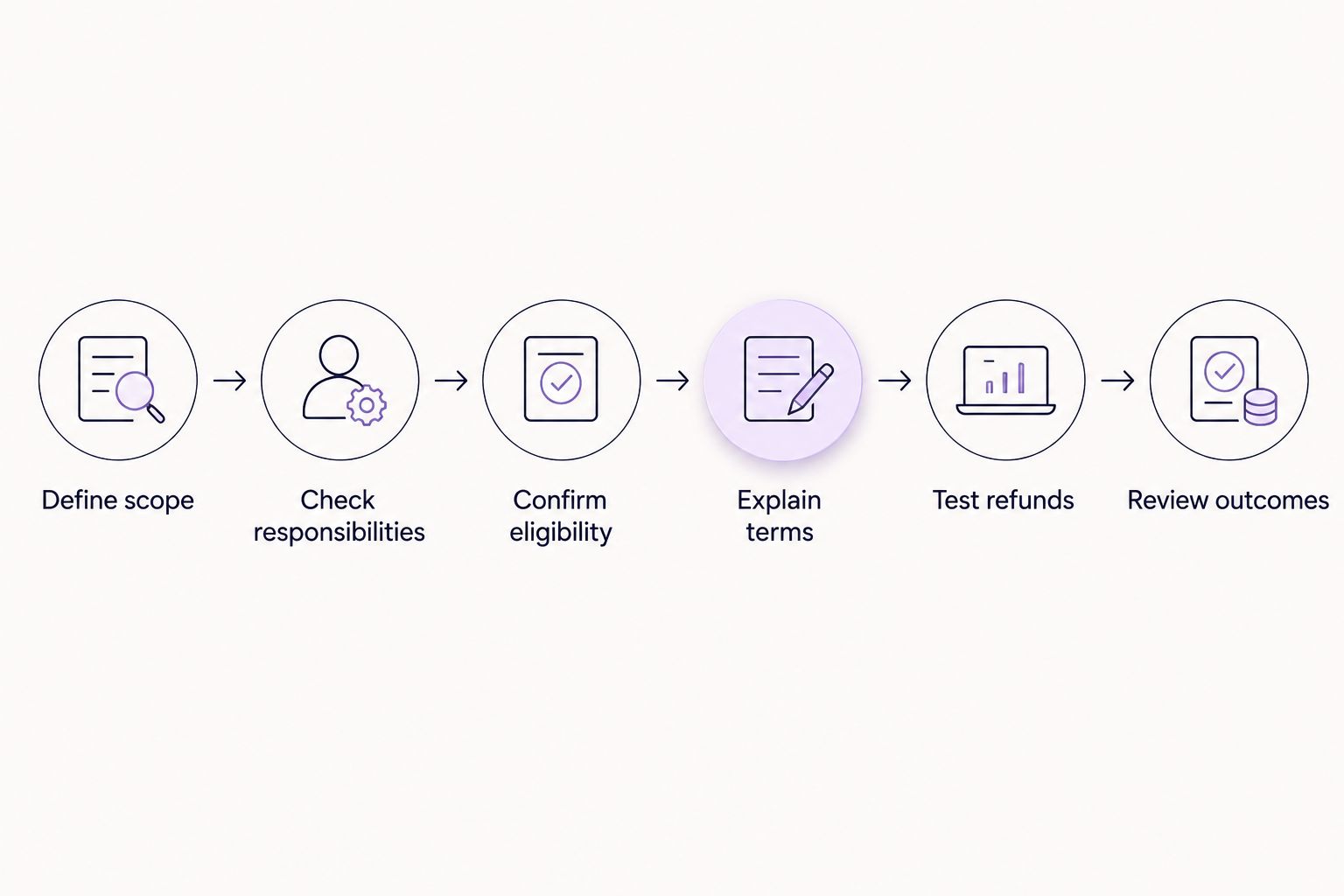
Use this launch sequence:
- Define scope.
- Check responsibilities.
- Confirm eligibility.
- Explain terms.
- Test refunds.
- Review outcomes.
The sequence puts service boundaries and responsibilities before applications. Use it as a sign-off route, with a named clinic owner confirming that each stage is complete.
Compare payment options for private GP clinics
Choose the arrangement around the service, not the reverse. This 2026 comparison distinguishes ways to collect payment; it does not establish eligibility for any particular clinic or patient. Compare written terms and your actual administrative workload before selecting an option.
| Option | Best for | Main benefit | Key limitation |
|---|---|---|---|
| Payment in full | Patients who prefer to settle the bill without a new instalment agreement | No new finance agreement is needed for the clinic's payment option | Does not spread the clinic bill over time |
| Clinic-managed instalments | Clinics prepared to administer an agreed payment schedule themselves | The clinic directly manages its collection process | Requires collections work and a review of the agreement's legal position |
| Provider-managed patient finance | Clinics seeking an external provider for an eligible finance arrangement | Moves defined finance tasks to the provider under its terms | Service acceptance, patient eligibility and responsibilities require confirmation |
| PayItMonthly interest-free instalments | UK merchants seeking a buy-now-pay-later platform | Customers can spread purchases into interest-free monthly instalments | Private GP eligibility, settlement and refund terms must be confirmed |
| Recurring clinic membership | Patients buying continuing access under a defined membership | Matches payment to an ongoing service arrangement | Is not interchangeable with financing a one-off consultation bill |
For a one-off clinical service, assess a defined payment arrangement rather than disguising repayment as membership. For genuine ongoing access, assess membership on its own terms. Combining the two without a clear explanation makes cancellation and outstanding obligations harder to understand.
PayItMonthly's stated offer is interest-free monthly instalments for UK businesses. Its fit for your clinic depends on confirmed acceptance and terms. Do not describe it as a healthcare-specific product without evidence for that claim.
Common mistakes private GP clinics make
Financing an undefined clinical pathway
Do not finance tests or follow-up appointments solely because they might be recommended later. Specify the service being purchased now. If the clinical plan changes, reassess the payment arrangement instead of adding services automatically to an existing agreement.
Treating a finance decision as clinical approval
Credit approval and clinical suitability answer different questions. Keep application outcomes out of clinical recommendations and avoid staff scripts that imply finance makes a procedure appropriate. Reception teams explain payment choices; clinicians decide what care to recommend.
Advertising only the monthly repayment
A monthly figure without the service scope and full obligation is an incomplete explanation. Show what the patient is buying and use confirmed repayment terms. Do not build a campaign around an attractive instalment while leaving exclusions or additional clinical charges unclear.
Cancelling the appointment but not adjusting finance
A cancelled booking does not prove that the finance record has been corrected. Assign responsibility for checking both records and confirming the outcome to the patient. Include partial service delivery in the process, not just straightforward pre-appointment cancellations.
Sharing clinical information to explain a payment issue
Keep unnecessary medical detail out of finance communications. Use the booking reference and payment information needed to resolve the issue, with appropriate access controls. If a case requires additional personal information, establish the purpose and lawful handling before sharing it.
FAQ
What is customer finance for private GP clinics?
Customer finance for private GP clinics lets patients spread payment for an agreed clinical service through an instalment arrangement. The clinic must define the service, explain the agreement and keep finance decisions separate from clinical recommendations.
Can a private GP clinic use PayItMonthly?
A private GP clinic must confirm its service eligibility directly with PayItMonthly before offering the platform. PayItMonthly provides UK businesses with interest-free monthly instalments, but that general offer does not establish acceptance of a particular healthcare service.
Is interest-free patient finance automatically outside credit regulation?
No—interest-free wording alone does not determine the legal position. Obtain qualified advice on the exact agreement, the clinic's role and the current requirements before introducing finance.
Is a clinic membership the same as patient finance?
No—a membership for continuing access is different from repaying a bill for a defined clinical service. Explain what the patient receives, when obligations arise and how cancellation works for the actual arrangement.
Should reception staff recommend finance to every patient?
Reception staff should explain an available payment option without pressuring patients to apply. Use approved wording and keep payment discussions separate from decisions about necessary care.
What happens if a financed appointment is cancelled?
The clinic must follow its applicable cancellation terms and the provider's finance-adjustment process. Confirm the booking record, refund position and repayment instructions rather than assuming that cancelling an appointment cancels the agreement.
How should a private GP clinic test patient finance before launch?
Test cancellation before an appointment, a changed service scope and a partial refund after some services have been delivered. Assign owners for booking changes, provider communication, account reconciliation and patient updates.
One last thing
Test a refund before you promote finance. Ask your shortlisted provider to walk through a changed clinical plan from booking amendment to patient confirmation. That exercise checks the operational detail a simple application demonstration leaves out.
For your 2026 launch decision, require written service eligibility, approved patient wording and a completed cancellation walkthrough. Expand only after the pilot shows that patients understand the arrangement and staff can administer it accurately.


