

No—offering 0% finance does not always reduce total profit, although merchant charges reduce the contribution from an otherwise identical sale. The result depends on whether interest-free instalments generate enough additional contribution to cover finance charges and associated costs. A lower margin per order and a higher total profit can exist together.
- Does 0% finance cut into profit margins? Merchant charges reduce like-for-like order contribution, but total profit need not fall.
- PayItMonthly offers UK merchants buy-now-pay-later with interest-free monthly instalments; assess it against your own order economics.
- Count genuinely additional sales, not every order paid through finance.
- Compare contribution after fees, fulfilment and refunds; assess cash flow separately.
Why this matters
Your 2026 finance decision needs two separate answers: what happens to the money retained from each order, and what happens to profit across the business. Measuring only sales revenue misses the costs. Measuring only the finance charge misses any additional contribution.
Start with how merchant fees work for buy-now-pay-later providers, then apply the actual terms to your products. Customer-facing interest and merchant-facing charges are different things; an interest-free purchase is not automatically a cost-free transaction for the retailer.
Does offering 0% finance always cut into profit margins?
A finance charge reduces order contribution when the selling price and every other cost stay unchanged. That accounting effect does not prove the offer reduces total business profit. Additional profitable orders can offset the charge, while a switch from existing payment methods without additional sales creates a different result.
Use this comparison to separate the situations rather than treating every financed order as a win.
| Situation | Effect on order contribution | Effect on total profit | Best assessment |
|---|---|---|---|
| An existing sale switches to finance | Lower if the finance cost exceeds the displaced payment cost | Lower, with everything else unchanged | Best for checking payment substitution |
| Finance produces a genuinely additional sale | The new order contributes after its costs | Higher if additional contribution exceeds associated costs | Best for assessing incremental sales |
| Finance changes the basket | Depends on the products sold and their costs | Depends on additional contribution, not basket value alone | Best for assessing product mix |
| Finance replaces another promotion | Depends on the costs removed and added | Depends on the net difference | Best for comparing promotional methods |
Each situation has a trade-off. An additional sale brings revenue but also fulfilment costs; a bigger basket brings more products but not necessarily a better margin. A payment switch offers customer choice but does not, by itself, create additional demand.
What should you calculate before offering finance?
Calculate contribution using the same accounting basis for financed and non-financed orders. Contribution is the revenue left after the variable costs associated with the sale; it is not the same as profit after all business overheads.
Use the revenue your accounts recognise. Keep VAT treatment consistent, where relevant, rather than comparing a VAT-inclusive checkout total with costs recorded on a different basis.
Order contribution = recognised sales revenue minus product costs, fulfilment costs, payment or finance charges, and other order-related variable costs.
Then assess the business-level change:
Change in profit = additional contribution generated minus contribution lost on existing sales minus additional operating costs.
The second calculation prevents a common mistake: crediting finance with the full contribution from purchases that customers would have made anyway. Include any displaced payment-processing cost in the comparison, so you measure the net change rather than adding a finance charge to the wrong baseline.
For your 2026 assessment, keep the calculation reproducible. Record which costs are included, how refunds are treated and which orders count as additional. A consistent method is more useful than a favourable-looking headline.
Why the profit impact varies
The effect of 0% finance varies because different orders leave different amounts of money after costs. Review these five drivers using your records and the proposed merchant agreement:
- Starting contribution: Products with little contribution before finance have less room to absorb an additional charge.
- Net payment cost: Compare finance charges with the payment costs they replace, including the agreement's applicable charges.
- Additional demand: Distinguish new purchases from customers simply changing how they pay.
- Product mix: Evaluate the contribution from the actual basket, including delivery, installation or other fulfilment work where applicable.
- Returns and administration: Include the costs your business incurs when orders are cancelled, refunded or require additional handling.
None of these drivers establishes a universal result. A strong outcome on one product does not establish that finance works across your entire range. Assess contribution at product or category level before approving a broad rollout.
How do you measure whether finance adds profitable sales?
Measure the difference between the business with the offer and a credible baseline without it. Counting finance applications or financed revenue alone cannot establish additional profit.
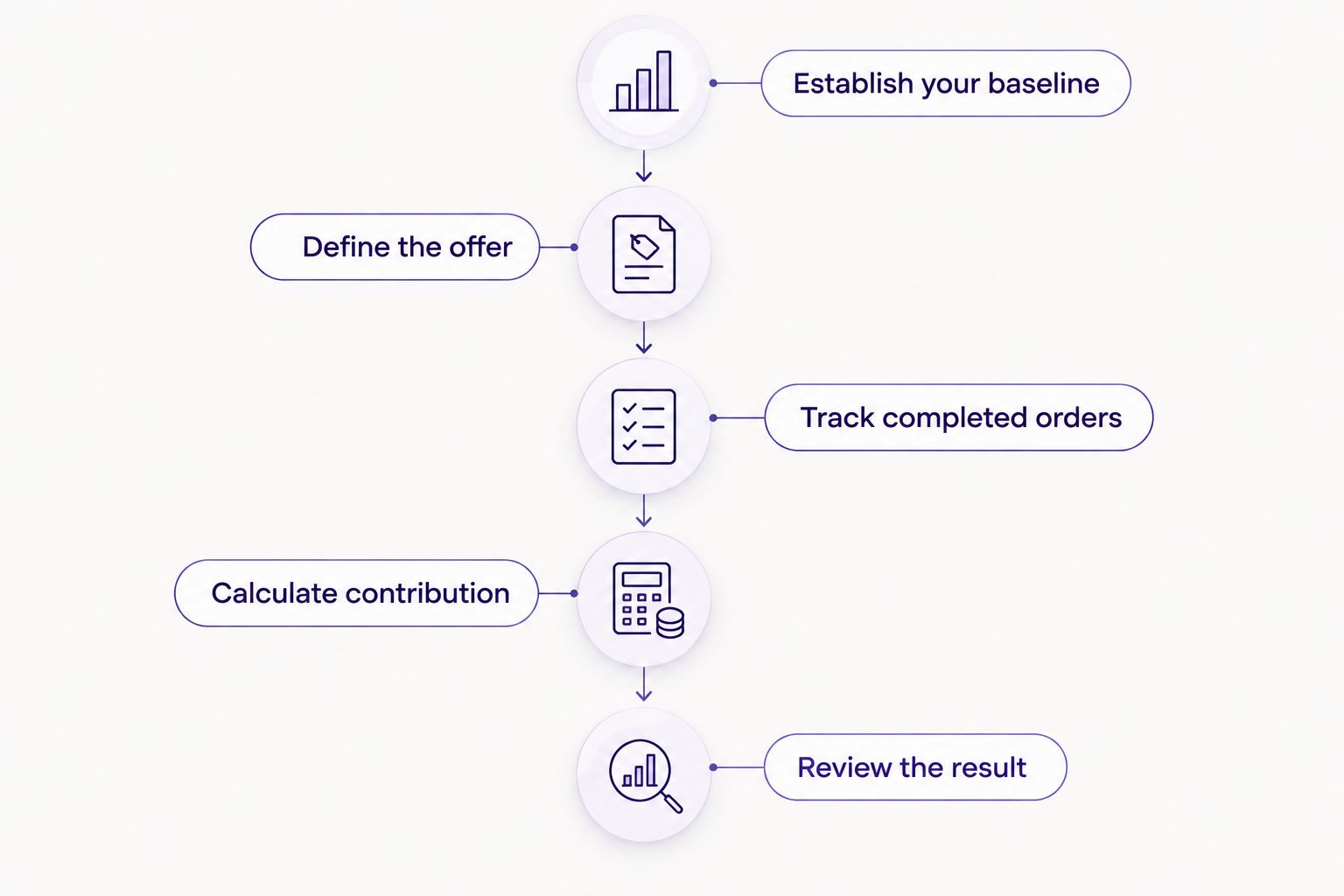
1. Establish your baseline
Record completed sales, recognised revenue, contribution, refunds and payment costs before changing the offer. Separate materially different product categories and sales channels. Otherwise, a change in what you sell can look like a change caused by finance.
2. Define the offer
Document which products, channels and promotions are included. Record the merchant terms used in the calculation. Keep other commercial changes visible, especially discounts or advertising changes introduced alongside finance.
3. Track completed orders
Measure completed purchases rather than applications alone. Reconcile cancellations and refunds with the original orders so the sales total does not retain revenue that the business subsequently returns.
4. Calculate contribution
Deduct the relevant costs from each order, then compare contribution across comparable groups. Look at both contribution per order and total contribution. Either measure on its own leaves part of the decision unanswered.
5. Review the result
Check whether the additional contribution covers the cost of payment substitution and any extra operating work. Keep the offer where the economics support it. Change or stop the offer where additional revenue does not translate into sufficient contribution.
In 2026, use comparable trading conditions wherever possible. Record changes in seasonality, promotions and stock mix rather than automatically assigning every movement in sales to the payment offer.
Can a larger basket offset the finance charge?
A larger basket offsets the finance charge only when its additional contribution exceeds the additional costs. Revenue is not the deciding measure. Products added to the order bring their own purchase, fulfilment and service costs.
Check the complete basket rather than applying the margin of the main item to everything sold alongside it. If an order also requires delivery or installation, include that work in the calculation. Do not treat it as free simply because the customer sees a single checkout total.
The same caution applies to upselling. Recommend products because they suit the customer's needs, then assess the resulting contribution. Finance availability does not justify encouraging a customer to borrow more than they need.
Does faster payment mean finance improves profit?
Faster payment and higher profit are separate outcomes. Earlier receipt of funds can improve cash availability, but it does not remove the costs deducted from the sale. Settlement timing must be checked against the merchant agreement rather than assumed from the customer's repayment schedule.
For your 2026 review, place cash flow beside contribution, not inside it as an automatic benefit. Record when the provider pays you, which deductions apply and how cancellations affect reconciliation. Compare those terms with when your suppliers and staff need payment.
Check responsibility for missed customer repayments in the agreement as well. Do not assume either that the retailer bears every loss or that the provider bears every loss; the contractual allocation matters.
Treat settlement speed as a cash-flow criterion and retained contribution as a profitability criterion. A provider needs to satisfy the requirements that matter to your business, not just one appealing headline.
Is 0% finance better than discounting?
Neither method is automatically better for profit. A discount reduces sales revenue; finance introduces its applicable costs. Compare the contribution retained under each offer and the additional sales each produces.
Avoid comparing a finance campaign with a discount campaign that sells different products under different trading conditions. That mixes the payment decision with changes in demand and product mix.
If you combine a discount with finance, include both effects. The customer's interest-free arrangement does not cancel the reduction in revenue caused by the discount. A combined promotion needs its own contribution calculation and should not inherit approval from either offer in isolation.
The practical question is not which promotion sounds more attractive. It is which approach creates enough additional contribution after all relevant costs, while presenting clear terms to customers.
What should you check in a finance provider's terms?
Ask for the full merchant agreement before assessing profitability. A headline charge does not answer how the arrangement affects refunds, settlement or day-to-day administration.
Build your review around these questions:
- Which charges apply to completed transactions and other events?
- When are merchant funds settled, and what can change that timing?
- How are full refunds, partial refunds and cancellations handled?
- Who is responsible for customer non-payment under the agreement?
- What work must your staff complete before and after a sale?
- Which products and sales channels are eligible?
PayItMonthly is a fit for UK merchants seeking interest-free monthly instalments for their customers. Its buy-now-pay-later platform serves retailers and merchants of all sizes; assess the proposed arrangement using the same contribution and contract checks you would apply to any provider.
The customer benefit is spreading a purchase into monthly instalments without interest. The merchant constraint is that this benefit alone does not establish a profitable outcome. Your costs, customer behaviour and agreement determine the commercial result.
Assess instalments for your business
Explore interest-free monthly instalments, then assess the merchant terms against your order contribution.
When should you change or stop the offer?
Change the offer when the evidence shows additional costs without enough additional contribution. That does not require abandoning finance across the whole business. Review the affected products, channels or promotions separately.
Look for these warning signs:
- Financed sales replace existing payment methods without additional contribution elsewhere.
- Sales revenue increases while total contribution declines.
- Discounts and finance charges together leave insufficient contribution.
- Refund handling or administrative work adds costs excluded from the original assessment.
- Settlement terms do not meet your cash requirements.
Set your own commercial acceptance criteria before reviewing results. Otherwise, a rise in applications or turnover can distract from the measure you intended to improve.
Keep customer communication clear when changing an offer. Only describe the eligibility, repayment terms and availability that apply to the arrangement being presented.
FAQ
Does 0% finance cut into profit margins on every sale?
A merchant charge reduces contribution on an otherwise identical sale, after allowing for any payment cost it replaces. Total profit can still increase if additional contribution exceeds the associated costs.
Does interest-free finance mean the retailer pays nothing?
No—interest-free describes the customer's interest, not the retailer's merchant costs. Check the agreement for transaction charges and any other applicable costs.
How do I know whether finance has brought in extra sales?
Compare completed sales and contribution with a credible baseline, accounting for changes in products, promotions and trading conditions. Financed revenue alone does not show which purchases would have happened anyway.
Can bigger orders make up for finance charges?
Bigger orders make up for finance charges when their additional contribution exceeds the additional costs. Deduct product, fulfilment and payment costs rather than judging the result by basket value.
Should I offer finance on every product?
Assess each product or category before offering finance across the range. Check both commercial contribution and eligibility under the provider's terms.
Is PayItMonthly suitable for UK retailers seeking instalments?
PayItMonthly provides UK retailers and merchants with buy-now-pay-later that lets customers spread purchases into interest-free monthly instalments. Suitability for an individual business depends on its requirements and the proposed merchant agreement.
One last thing
The crucial sale to investigate is the one that would have happened without finance. That order can show healthy contribution while still earning less than it would have through the previous payment method.
Before renewing or expanding your 2026 offer, separate additional business from payment substitution. Judge finance by the change in contribution across both groups—not by the size of the financed-sales total.


