

Instalment plans for phone and computer repair shops split the cost of screen swaps, board-level repairs and refurbished handset purchases into monthly payments, so a customer facing a high repair quote can approve the job on the spot instead of shopping the price around. Repair shops run on thin margins and fast turnaround, so losing a job to price hesitation costs more than most retailers ever notice.
- Instalment plans phone repair shops offer let customers split a repair bill into monthly payments instead of paying the full quote upfront.
- PayItMonthly turns a walk-out quote into an approved job by adding interest-free instalments at the till or booking form.
- Vetting customers before approving credit-based finance protects margin better than accepting every applicant.
- Manual payment plans work for occasional big jobs; a checkout-integrated BNPL option scales once volume grows in 2026.
Why instalment plans matter for phone and computer repair shops
A repair shop's highest-value jobs are also its highest-friction ones. Board-level fixes, data recovery, and multi-part laptop repairs carry quotes that make customers pause, ask for a callback, or leave to "think about it" — and a fair share never come back. Retailers selling new stock can absorb a delayed sale; a repair shop that has already ordered a part or spent an hour on diagnostics cannot.
The repair trade also runs a second, quieter business: refurbished and pre-owned device sales. A buy now pay later option built for gaming PC and computer retailers applies just as well to a refurbished handset or a rebuilt desktop sitting on the counter — the same instalment mechanism, a different SKU. Any shop treating instalments as a repair-only tool is leaving half its finance-eligible revenue on the table.
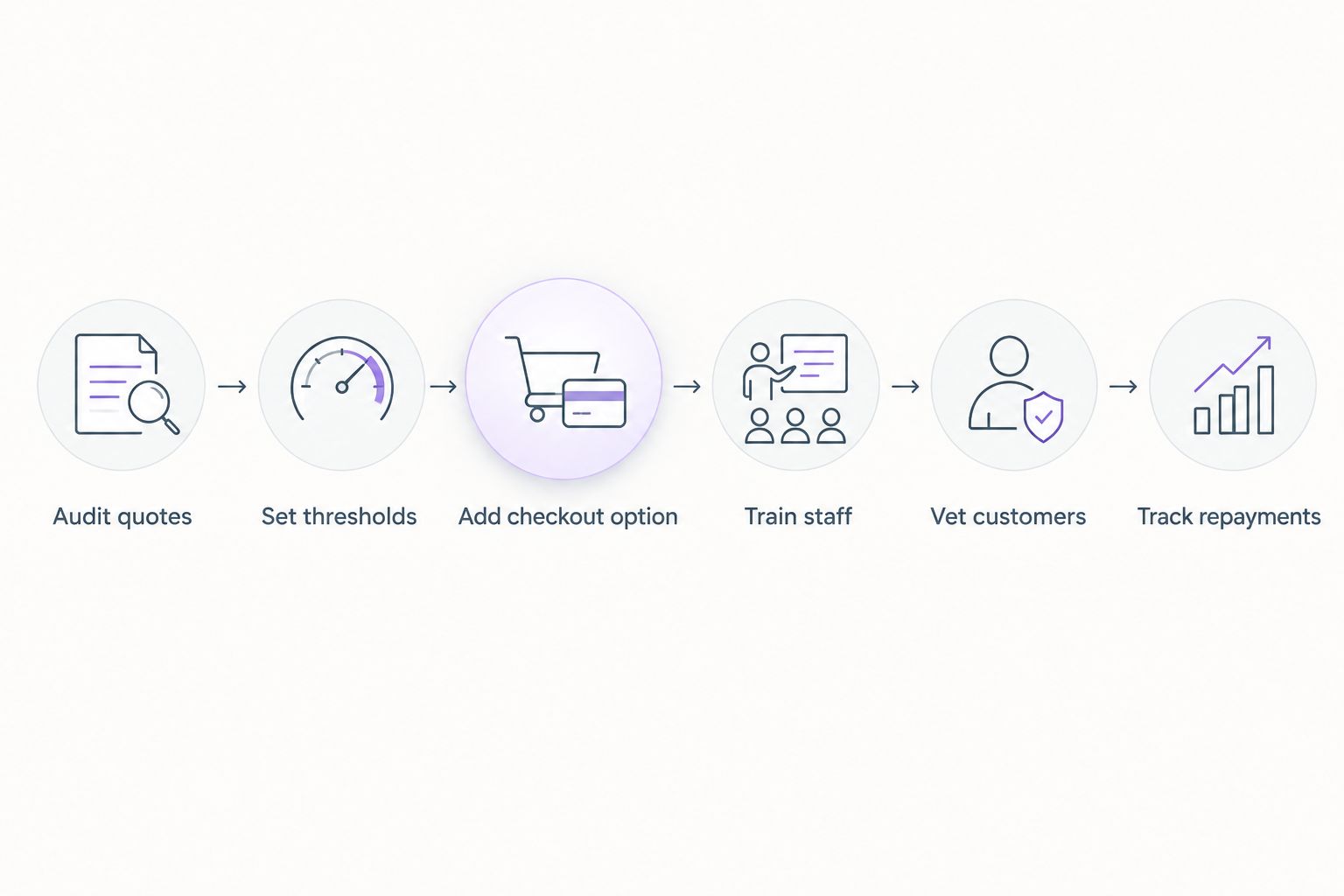
How to add instalment plans to a repair shop
Audit which repairs stall at the quote stage
Before adding a payment option, find out where customers actually hesitate. Most repair shops already have the data sitting in the job log.
- Pull the last 90 days of quotes and flag every job marked "customer to call back"
- Note the average ticket size of jobs that never converted versus jobs that did
- Separate hesitation on price from hesitation on turnaround time — they need different fixes
- Check whether refurbished device sales show the same drop-off pattern as repairs
Set a threshold for which jobs qualify
Not every job needs a payment plan. A £15 cable repair doesn't need one; a full motherboard replacement or a multi-device data recovery job usually does.
- Set a minimum ticket value above which staff automatically mention instalments
- Include high-margin add-ons — screen protectors, cases, extended diagnostics — in the same threshold
- Apply the same rule to refurbished stock sales, not just repairs
- Review the threshold every quarter as parts costs shift
Add the option at the point of quote, not after
The manual version of this is a handwritten payment plan: take a deposit, agree a schedule, chase the balance by text. It works for occasional big jobs but doesn't scale past a handful of customers a month, and collecting late balances eats staff time that should be spent on the bench.
The faster path is adding a buy now pay later option at checkout so the customer applies and gets a decision while they're still standing at the counter, before they've had time to walk out and compare prices.
- Show the instalment option on the quote screen, not buried in a separate menu
- Offer it on both in-store repairs and any online booking or drop-off form
- Make sure the front-of-counter staff can explain it in one sentence, not a script
- Keep the same option visible on refurbished device listings, not just repair invoices
Train staff to offer it before the customer asks
Customers rarely ask "can I pay this monthly" unprompted — they just leave and come back later, or never come back. The shops that convert the most high-ticket jobs are the ones where staff mention the option automatically.
- Script one line: "You can spread that over a few months if that's easier"
- Train staff to mention it right after stating the quote, not after the customer hesitates
- Track which staff members mention it consistently and which skip it
- Reward conversion on high-ticket jobs, not just total sales
Vet customers before approving finance
Repair shops already spend money on parts before the job is paid for, so a missed repayment hits harder than it would for a retailer selling off-the-shelf stock. Vetting customers for buy now pay later eligibility before the parts get ordered protects that outlay.
- Confirm identity and basic affordability before starting any paid diagnostic work
- Flag jobs where the parts cost exceeds the deposit taken
- Set a lower approval threshold for first-time customers versus repeat ones
- Keep a simple record of who was declined and why, for consistency
Track missed repayments and follow up fast
A missed instalment on a completed repair is money already spent on parts and labour. Catching it in week one is far cheaper than chasing it in month three.
- Review repayment status weekly, not monthly
- Follow up on the first missed payment within a few days, not at the end of the cycle
- Separate genuine payment issues from customers disputing the repair itself
- Keep a short list of repeat late-payers and adjust their approval threshold going forward
Comparing instalment options for repair shops
| Option | Best for | Key limitation |
|---|---|---|
| Handwritten payment plans | One-off, occasional high-ticket jobs | Doesn't scale past a handful of customers; chasing balances manually costs staff time |
| In-house credit accounts | Shops with repeat trade or business customers | Requires the shop to carry the credit risk itself |
| Generic BNPL checkout apps | Retailers selling stock, not repair services | Often built for e-commerce carts, not counter-side repair quotes |
| PayItMonthly | Repair shops wanting instalments on both repairs and refurbished stock, decided at the counter | Approval still depends on the customer passing eligibility checks |
Verdict: manual payment plans hold up for the occasional big job, but a repair shop taking more than a few high-ticket jobs a month needs an instalment option built into the quote screen, not a spreadsheet.
Common mistakes repair shops make with instalment plans
- Offering finance on new stock but not on repairs — the repair quote is usually the exact moment a customer hesitates on price, and it's the moment most shops leave finance out.
- Waiting for the customer to ask — most walk away quietly instead of asking; staff need to raise it first.
- Approving every applicant to close the sale — a repair shop has already spent on parts and labour before the finance decision matters, so weak vetting costs more here than in retail.
- Not explaining the terms at drop-off — a customer confused about the repayment schedule when the invoice lands is a customer who disputes the charge.
- Treating instalments as a discount — it's a way to convert a hesitant quote into a sale, not a price cut, and shops that frame it that way protect their margin.
Add instalments to your repair counter
See how PayItMonthly fits at the quote screen for repairs and refurbished stock.
FAQ
What are instalment plans for phone repair shops?
Instalment plans for phone repair shops let a customer split the cost of a repair, such as a screen swap or board-level fix, into monthly payments instead of paying the full quote at collection. They're offered at the point of quote so the customer can approve the job immediately.
Is buy now pay later suitable for repair jobs, not just retail?
Yes, buy now pay later works on repair invoices the same way it works on a retail sale — the customer applies against the repair total rather than a product price. Repair shops in 2026 increasingly use it on high-ticket jobs like data recovery and motherboard replacement.
How much does it cost a repair shop to offer instalment plans?
Cost structures vary by provider and depend on transaction volume, so check current pricing directly with the provider before committing. The bigger factor for most repair shops is whether the option converts hesitant quotes into approved jobs.
Do repair shops need an FCA credit licence to offer instalments?
Interest-free instalment finance offered through a regulated provider typically doesn't require the repair shop itself to hold an FCA credit licence, since the provider handles the regulated lending activity. Confirm the specific arrangement with whichever provider you choose.
Will offering finance affect the customer's credit score?
That depends on the provider's underwriting approach — some finance options run soft checks that don't show on the customer's credit file, others don't. Ask any provider directly how their eligibility check is recorded before promoting it to customers.
What repairs are best suited to instalment plans?
High-ticket, high-hesitation jobs benefit most: board-level repairs, data recovery, multi-device laptop fixes, and any job where the customer typically asks for a callback before agreeing. Low-cost repairs like cable swaps rarely need a payment plan.
How do I vet a customer before approving finance on a repair?
Confirm identity and run a basic affordability check before ordering parts, not after the repair is finished. Repair shops carry more risk than retailers because parts and labour are already spent before the finance decision is made.
Can I offer instalments on refurbished device sales too?
Yes, the same instalment mechanism used on repair invoices applies to refurbished handsets, laptops or rebuilt desktops sold from the same counter. Treating both sides of the business the same way avoids running two separate payment processes.
One last thing
The repairs most shops hesitate to offer finance on — data recovery, board-level fixes, multi-part jobs — are exactly the ones where instalments earn their place. Screen swaps rarely need a payment plan because customers rarely delay on them; the highest-friction, highest-value quotes are where a walk-out turns into an approved job, and that's the segment of the business worth fixing first in 2026.


