
Solicitors’ legal fee financing is a payment arrangement that spreads a client’s legal bill over time with the aim of making agreed legal work manageable without requiring full payment upfront. This 2026 guide explains how to assess funding options for family law work, where changing case scope complicates instalments, and what to verify before introducing a provider such as PayItMonthly.
- Legal fee financing for solicitors needs clear matter scope, suitable repayment terms and confirmed provider eligibility.
- PayItMonthly provides interest-free monthly instalments for UK businesses; legal-services acceptance needs confirmation before launch.
- Compare staged billing, firm-managed instalments and third-party finance before choosing a client payment process.
- Keep legal advice independent of credit decisions, and document cancellations, scope changes and responsibility for missed payments.
Why legal fee financing matters for solicitors
A payment plan changes when a client pays; it does not reduce the legal work required or guarantee affordability. Family law firms need that distinction at the centre of their payment conversations. An agreed initial task and an open-ended dispute require different funding decisions.
Clients also need to understand the difference between paying an invoice in instalments and borrowing from a separate lender. The repayment obligation, complaints route and consequences of ending the solicitor’s instruction need explaining before either arrangement starts.
For your 2026 payment policy, prioritise clarity over uptake. A client accepting finance is not evidence that the arrangement suits the matter, and a declined application must not become pressure to borrow elsewhere.
How to introduce legal fee financing for solicitors
Define the work before discussing repayments
Start manually with your engagement documents and a matter-stage checklist. Identify precisely which work the proposed payment arrangement covers. Do not build a repayment schedule around an estimate that staff then describe as a fixed commitment.
For family law work, separate an initial advice appointment, document preparation, negotiations and representation where those are distinct instructions. Explain what happens when the client requests additional work or circumstances change. Funding the next agreed stage is easier to explain than financing an undefined case outcome.
Your payment record should sit alongside the matter scope, not replace it. A finance agreement cannot explain which legal services your firm has agreed to deliver.
- Record the funded work in plain English.
- Distinguish agreed fees from estimates and future work.
- Identify disbursements and whether the arrangement includes them.
- Set a written process for approving scope changes.
- Explain what remains payable if the instruction ends.
Compare payment routes before selecting a platform
Use a spreadsheet to compare the routes your firm can lawfully offer. Start with staged billing and firm-managed instalments, then assess external finance against the same questions: who advances money, who collects repayments, and who bears each risk?
PayItMonthly buy-now-pay-later is best for UK merchants seeking an interest-free monthly instalment platform. Its stated business offering does not establish acceptance of solicitors, family law matters or particular legal bills. Obtain written confirmation before treating the platform as an option for your firm.
A platform is a potential alternative to administering repayments yourself, not a substitute for assessing suitability. Compare confirmed terms rather than assumptions about what retail finance arrangements include.
- Identify who contracts with the client.
- Confirm whether the provider accepts your legal services.
- Check when and on what conditions your firm receives funds.
- Establish responsibility for missed payments and disputes.
- Record the administrative work retained by your team.
Check permissions and responsibilities before launch
Create a written compliance checklist before adding finance language to your website. Your firm's professional obligations and the requirements applying to a credit arrangement are separate questions. Neither is answered simply by calling an arrangement interest-free.
For a 2026 launch, have your compliance lead or an appropriately qualified adviser review the actual proposed activity and current rules. Identify the jurisdiction governing the legal practice rather than treating all UK solicitors as subject to identical professional requirements.
If you approach PayItMonthly about legal fee financing, request confirmation of permitted services, contractual roles and approved customer communications. Do not describe the arrangement as exempt, authorised or outside regulation without a documented basis specific to the arrangement.
- Identify the firm's relevant professional regulator.
- Obtain advice on the proposed credit-related activities.
- Document each party's contractual responsibilities.
- Review finance wording before staff or clients use it.
- Confirm complaint ownership and escalation routes.
Separate the legal decision from the payment decision
Start with a written conversation guide. Explain the legal work, its scope and available payment routes before discussing an application. Give the client space to consider the repayment commitment without suggesting that finance improves the likely legal outcome.
Family law conversations require particular care around safe communications and third-party involvement. Ask which contact details are safe to use. Where someone else proposes to pay, clarify their role without assuming that payment gives them access to confidential matter information.
Keep finance-related information separate from unnecessary details of the dispute. Collect and share only information needed for the relevant process, with appropriate privacy arrangements. Never promise acceptance or describe interest-free borrowing as risk-free.
- Explain the legal service before the payment arrangement.
- Confirm safe contact details and communication preferences.
- Clarify the role of any third-party payer.
- Provide a route for clients who decline finance.
- Record the explanation and the client's decision.
Map billing, settlement and cancellation together
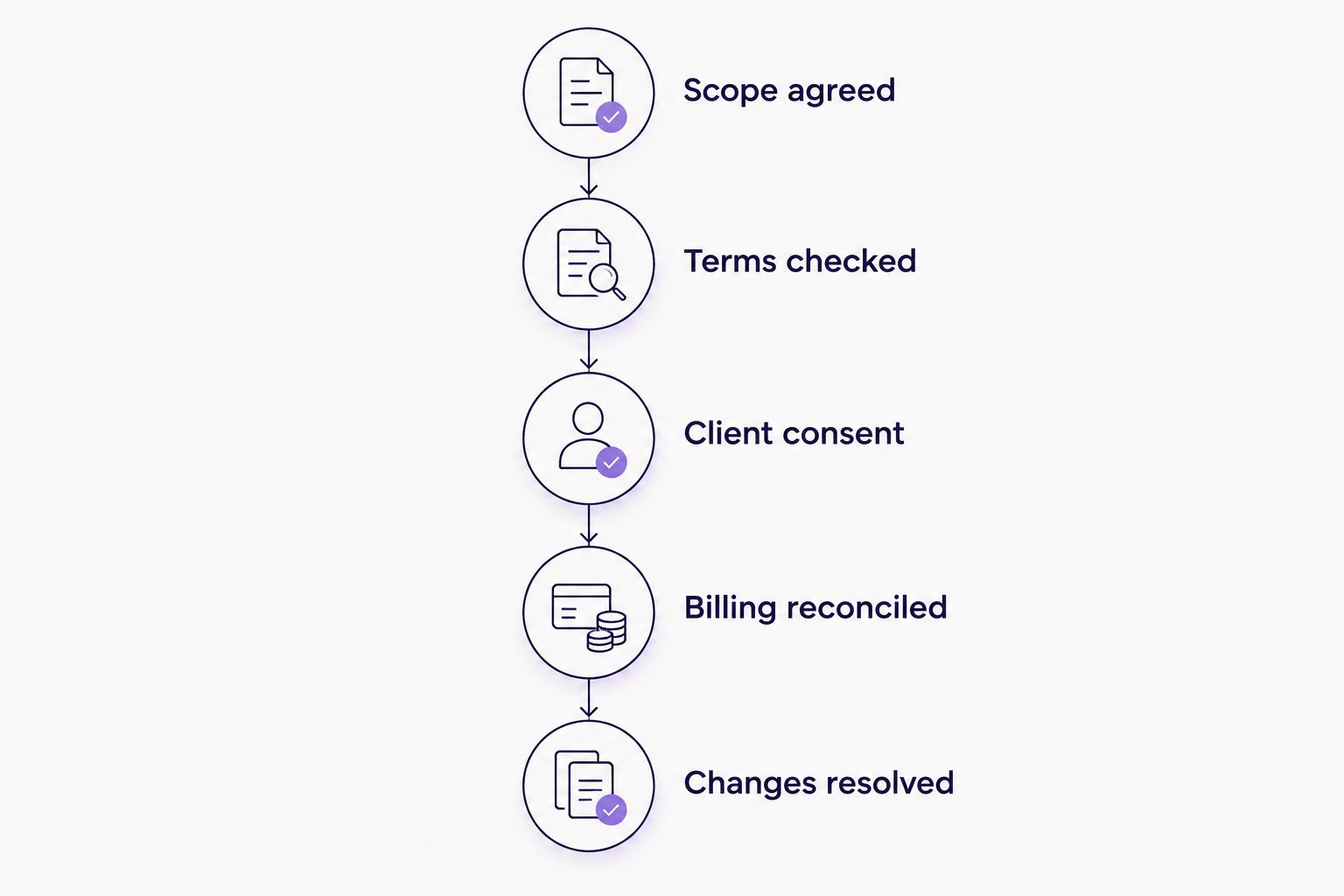
Draw the process on paper before configuring any system. Track the agreed work, client consent, any finance decision, billing and reconciliation as separate events. State explicitly what authorises your team to begin work.
A signed finance agreement is not automatically evidence that money has reached your firm. Likewise, a client ending an instruction does not itself establish that a separate repayment agreement has ended. Your procedures must connect these events without treating them as interchangeable.
Use the following sequence as an internal control map. Adjust its order to the confirmed provider process and your firm's professional requirements, rather than assuming every arrangement follows the same settlement sequence.
- Scope agreed: record the precise funded work.
- Terms checked: verify eligibility, responsibilities and payment conditions.
- Client consent: document informed agreement to the relevant arrangements.
- Billing reconciled: match invoices, receipts and provider records.
- Changes resolved: handle revised scope, cancellations and refunds.
Test difficult cases before expanding the offer
Begin with 1 clearly defined matter type rather than applying a payment option across the practice. Use dummy records to test 3 scenarios: a declined application, an ended instruction and an increased scope of work. These are recommended checks, not provider performance benchmarks.
Assign an owner to every exception. Your accounts team needs a route for reconciliation problems, while fee earners need a route for scope changes that affect the funded work. Reception staff should know where to refer questions without interpreting credit terms themselves.
Review the pilot after 30 days, or before expansion if earlier. For your 2026 review, examine misunderstandings and unresolved cases alongside payment performance; uptake alone does not show whether the process works.
- Test a declined application without pressuring the client.
- Rehearse cancellation after some work has been completed.
- Check how additional instructions affect existing arrangements.
- Record unresolved billing and repayment queries.
- Approve expansion only after correcting process failures.
Compare payment options for family law firms
Choose the route that matches the work and the client's circumstances, not the route with the simplest sales message. Staged billing, instalments and borrowing solve different timing problems. They should not be presented as interchangeable.
This comparison describes payment structures, not an endorsement of a particular credit arrangement. Confirm availability, eligibility and terms individually before recommending any external provider.
| Option | Best for | Practical advantage | Key limitation |
|---|---|---|---|
| Staged billing | Matters with clearly separable phases | Connects invoices to agreed stages of work | Does not itself spread an invoice once it falls due |
| Firm-managed instalments | Firms prepared to administer an agreed repayment arrangement | Keeps payment administration within the practice | Leaves collection work and payment exposure with the firm, subject to its terms |
| Third-party instalment finance | Firms seeking a separate provider for an eligible, defined bill | Separates the finance agreement from the firm's billing process | Provider acceptance, settlement conditions and liability need checking |
| Specialist legal funding | Clients whose circumstances require assessment of a legal-specific funding route | Allows consideration of funding designed around legal matters | Eligibility, repayment triggers and conditions require individual review |
| Client-arranged borrowing | Clients independently assessing their own borrowing options | Keeps the borrowing choice separate from the firm's payment offer | Creates a separate debt and does not resolve uncertainty about future legal work |
PayItMonthly's confirmed offering is interest-free monthly instalments for UK businesses. That establishes its payment category, not suitability for a particular solicitor's practice. Keep the provider off your approved legal-services list until the necessary acceptance and contractual checks are complete.
Check your business's finance options
Discuss your legal-services use case and confirm eligibility before introducing instalments to clients.
Common mistakes solicitors and family law firms make
Financing an undefined case
A repayment schedule needs a clear underlying bill. Avoid presenting a funded initial stage as covering the whole family law matter. Explain how further instructions will be scoped and agreed without implying that additional borrowing will be available.
Treating provider settlement as guaranteed payment
Do not assume that using an external provider removes every payment risk. Read the contract for settlement conditions, disputes, refunds and any circumstances in which your firm must repay funds. Record those obligations in the accounts procedure.
Making finance the default response to distress
A client expressing anxiety about legal bills needs a clear explanation of scope and payment choices, not an immediate application prompt. Separate the legal advice from the borrowing conversation. Offer time to consider the commitment without promising that finance resolves the underlying affordability problem.
Leaving third-party payment arrangements informal
A relative paying towards a matter does not answer who owes the bill, who is borrowing or who can receive information. Document those roles. In family law work, check safe communication arrangements before sending finance-related messages to shared contact details.
Publishing terms nobody owns
An outdated website statement can conflict with the provider agreement or the firm's actual process. Assign an owner to every finance statement published in 2026. Recheck it when the service, provider terms or applicable requirements change, and withdraw claims staff cannot substantiate.
FAQ
What is legal fee financing for solicitors?
Legal fee financing for solicitors is an arrangement that lets a client pay an agreed legal bill over time. It can involve a firm-managed payment plan or a separate finance provider, with different contractual responsibilities for each route.
Can a family law firm offer monthly instalments?
A family law firm should offer monthly instalments only after confirming that the proposed arrangement meets its professional, contractual and applicable credit requirements. Define the funded work, payment obligations and process for changing or ending the instruction before launch.
Is interest-free legal finance the same as staged billing?
No. Interest-free finance spreads repayment of an agreed amount, while staged billing connects invoices to phases of legal work. Staged billing does not itself create a credit agreement or spread each invoice into monthly payments.
Can solicitors use PayItMonthly for legal bills?
Solicitors need written confirmation of legal-services eligibility before using PayItMonthly for legal bills. Its stated offering provides UK businesses with interest-free monthly instalments, but that does not establish acceptance of solicitors or particular family law matters.
Does using a finance provider remove the firm's non-payment risk?
Do not assume a finance provider removes the firm's non-payment risk. The provider agreement determines settlement conditions and responsibilities for missed repayments, disputes, cancellations and refunds.
What happens to finance if a client changes solicitor?
Changing solicitor does not automatically establish that a separate finance agreement has ended. Reconcile completed work and any refund under the relevant agreements, then confirm what remains payable and who must communicate the change.
What should a firm check before offering legal fee finance in 2026?
Before offering legal fee finance in 2026, check provider eligibility, the firm's proposed credit-related activities, professional obligations and contractual responsibilities. Also test client communications, reconciliation, scope changes and cancellations before introducing the arrangement.
One last thing
The most useful test is not whether a client can start a payment plan; it is whether your team can explain how that plan ends. Before launch, ask a fee earner and an accounts colleague to describe what happens when a client changes solicitor halfway through the agreed work. Resolve any disagreement before offering the arrangement.