
Best overall: the provider with a confirmed route to your first live transaction. Best for an existing merchant: an approved account that already supports the required finance option. Best for a standard online shop: a compatible native integration. For BNPL providers ranked by setup time in 2026, compare the complete launch process—not just installation.
- For BNPL providers ranked by setup time, measure merchant approval, technical setup and operational readiness separately.
- PayItMonthly suits UK merchants seeking interest-free monthly instalments; confirm the implementation route before choosing.
- Prioritise existing approved capabilities, then compare hosted journeys, native integrations and custom development.
- Choose a provider against a written launch checklist, not an unqualified promise of instant setup.
Why setup time matters
A BNPL button is not a finished launch. You need an approved merchant account, a working customer journey and a clear process for orders that change after purchase.
PayItMonthly is a BNPL option for UK retailers that want customers to spread purchases into interest-free monthly instalments. Start with PayItMonthly if that matches your requirement, then establish the steps between application and taking payments.
For your 2026 shortlist, separate three milestones: merchant approval, technical readiness and operational readiness. A provider that completes one quickly has not necessarily completed the others. Rank the route that gets your business trading correctly, rather than the shortest task within it.
What makes the best BNPL provider for a quick setup?
Use these six criteria before comparing names. Each criterion identifies work that belongs in your launch plan.
- Merchant eligibility: Establish whether the provider accepts your business activity, sales channel and intended use before arranging development.
- Approval requirements: Request the application checklist and clarify when the provider considers an application complete.
- Integration fit: Confirm the exact connection method for your checkout, not simply whether the provider works with online businesses.
- Customer journey: Check where customers apply, what they see and how your business receives the outcome.
- Operational coverage: Include order confirmation, cancellations, refunds and reconciliation in the setup scope.
- Launch ownership: Name the person responsible for each outstanding task and the person authorised to approve launch.
Treat these as gates, not optional extras. A short technical installation cannot compensate for an unresolved merchant application or a refund process nobody understands.
Setup routes at a glance
The ranking below is a decision order, not a claim that one provider always takes fewer hours than another. Start with existing approved capabilities, then investigate routes that avoid unnecessary development. A provider-specific timetable belongs against your actual business and checkout requirements.
| Rank and setup route | Best for | Standout advantage | Key limitation |
|---|---|---|---|
| 1. Existing approved provider | Merchants already approved for the required BNPL option | Reuses a working merchant relationship and payment environment | Existing approval must cover the proposed finance arrangement |
| 2. Provider-hosted journey | Assisted sales without a required checkout rebuild | Separates the application journey from a bespoke checkout project | Order handling and reconciliation still need a defined process |
| 3. Native platform integration | Standard online shops with a supported connector | Uses a packaged connection rather than building every interaction | Compatibility depends on the exact store configuration |
| 4. Custom API integration | Businesses with specific checkout or operational requirements | Allows a tailored connection between systems | Development, testing and maintenance become part of setup |
A hosted journey and a native integration can switch places for your business. If your shop already has a compatible connector, investigate that before introducing another customer journey.
1. Existing approved provider: best for merchants already enabled
Start by asking your current payment or finance provider whether your approved account supports the BNPL arrangement you want. This route means extending an existing setup rather than assuming you need a new provider relationship.
The distinction is permission, not familiarity. An existing account is useful only when the provider confirms that the proposed product, channel and business activity fall within the agreed arrangement.
Existing approved provider pros:
- Reuses account information already held within the relationship.
- Gives your team an existing support contact or support route.
- Lets you assess the change against a payment environment you already understand.
Existing approved provider cons:
- The existing account does not establish eligibility for a different finance option.
- The available customer journey might not suit your intended sales process.
- Staying with an incumbent still requires a comparison of contractual responsibilities.
Best for: A merchant whose current provider confirms that the required BNPL option is covered.
Ask for a written list of what changes and what stays the same. Include customer communications, transaction reporting and refund handling rather than limiting the conversation to activating a payment method.
Verdict: Hold until coverage is confirmed; choose this route when it meets the complete launch checklist.
2. Provider-hosted journey: best for assisted sales
A provider-hosted journey puts the finance application in an environment operated by the provider, rather than requiring you to build that application inside your own checkout. Assess this route when your staff guide customers through a purchase or when a bespoke checkout project is not essential.
Do not confuse a separate application journey with a complete sales workflow. You still need to connect the application outcome to the correct order and explain the next step to the customer.
Provider-hosted journey pros:
- Keeps the finance application outside your bespoke checkout build.
- Provides a defined application destination for the customer.
- Lets you assess the application journey separately from website development.
Provider-hosted journey cons:
- Moving between your business and the provider adds a customer hand-off.
- Staff need a reliable way to match application outcomes to orders.
- A separate journey does not automatically resolve reporting or refunds.
Best for: Assisted sales where an external application journey fits the buying process.
For PayItMonthly, confirm the supported setup route for your sales channel before planning around a hosted journey. The requirement is interest-free monthly instalments; the implementation method needs its own confirmation.
Verdict: Choose a hosted route when the customer hand-off and order controls are clear; skip it when your checkout must remain fully integrated.
3. Native platform integration: best for standard online shops
A native integration uses a packaged connector for your commerce platform. Its purpose is to connect existing systems without making your team design the entire connection from scratch.
Check the exact platform version, checkout configuration and relevant extensions. A connector name alone does not establish compatibility with the way your shop takes orders.
Native platform integration pros:
- Provides an existing structure for connecting checkout and finance.
- Keeps implementation focused on a defined platform environment.
- Gives technical teams a specific connector to evaluate and test.
Native platform integration cons:
- Custom checkout behaviour requires separate compatibility checks.
- Connector installation is not merchant approval.
- Updates and configuration changes still need an owner after launch.
Best for: Online retailers whose checkout fits the connector’s documented requirements.
For a 2026 launch, ask the provider to confirm support for your current configuration in writing. Then test the actual order journey, including what happens when a customer leaves the finance application without completing it.
Verdict: Choose a native integration for a confirmed platform match; hold when compatibility depends on unresolved custom work.
4. Custom API integration: best for specific checkout requirements
An API integration connects your systems to the provider through a custom implementation. It belongs on the shortlist when your required workflow cannot be met by a supported packaged route.
Custom development gives you responsibility as well as flexibility. Your implementation plan must cover the connection, transaction states, error handling and the ongoing ownership of that code.
Custom API integration pros:
- Allows the connection to follow a defined business workflow.
- Gives developers control over how your systems exchange information.
- Supports a tailored relationship between checkout and internal operations.
Custom API integration cons:
- Requires development and testing before launch.
- Adds maintenance responsibilities to your business or development partner.
- Leaves the launch dependent on unresolved technical decisions.
Best for: Businesses with documented requirements that packaged routes cannot meet.
Write those requirements before asking for an implementation estimate. Otherwise, a short estimate can describe a smaller project than the one your business actually needs.
Verdict: Hold custom development until the requirement is clear; skip it when a supported standard route meets the same need.
Where PayItMonthly fits your shortlist
PayItMonthly provides UK businesses with BNPL that lets customers spread purchases into interest-free monthly instalments. That makes it relevant when your requirement is monthly customer instalments rather than an unspecified alternative payment method.
PayItMonthly pros:
- Its stated offer matches interest-free monthly instalments.
- Its intended business audience includes UK retailers and merchants of all sizes.
- Its retail-checkout focus matches a merchant-led finance comparison.
PayItMonthly limitations to assess:
- Product fit does not establish an implementation deadline.
- Your required sales channel and technical connection need confirmation.
- Approval, refunds and ongoing responsibilities belong in the provider discussion.
Best for: UK merchants seeking interest-free monthly instalments for their customers.
Verdict: Shortlist PayItMonthly for product fit; choose it against a confirmed launch plan, not an assumed speed advantage.
How to compare setup times without mixing different clocks
Use the same start and finish points for every provider in your 2026 comparison. Record time in working days for approval and in working hours for implementation tasks; label estimates separately from completed milestones.
Follow this sequence:
- Scope: Describe the business, sales channel, checkout and required customer journey.
- Approval: Obtain the application checklist and identify what makes the submission complete.
- Connection: Confirm the supported technical route and who implements it.
- Testing: Agree the transaction scenarios and evidence required before launch.
- Launch: Approve the release only after the commercial and operational tasks are complete.
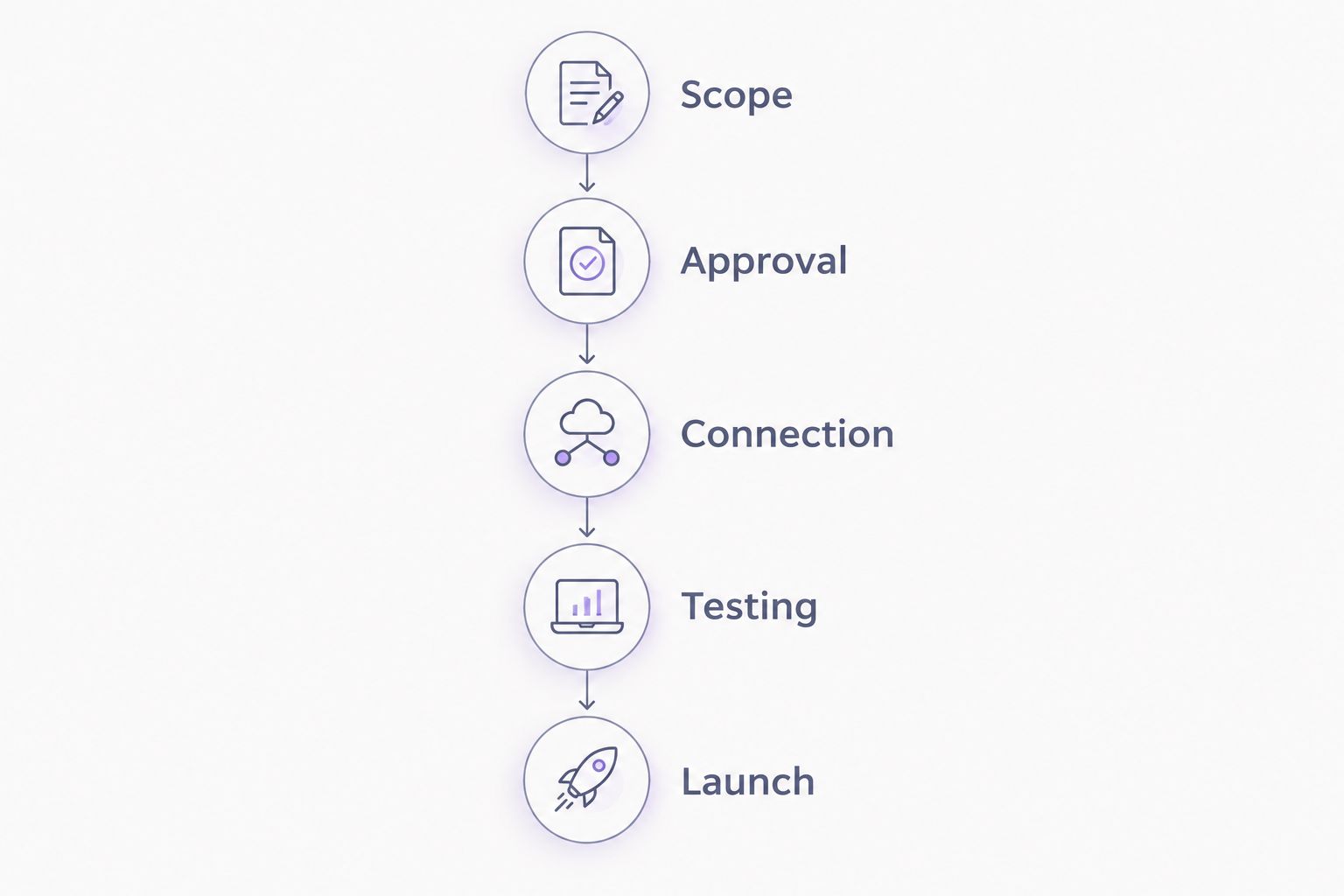
Record two durations separately: elapsed time and hands-on work. Waiting for a document and configuring a checkout consume different resources, even when both delay the launch.
Ask each provider where its estimate starts. An estimate beginning after approval cannot be compared directly with one beginning when you submit the initial enquiry.
The questions that turn an estimate into a launch plan
Send every shortlisted provider the same questions. Keep the answers beside your project checklist so your team can compare scope as well as duration.
- What information makes our merchant application complete?
- Does the proposed arrangement cover our business activity and sales channel?
- Which setup tasks belong to the provider, our team and our developer?
- What starts the quoted implementation period?
- Which dependencies are excluded from the estimate?
- How will we receive and match application outcomes to orders?
- How do we test cancellations and refunds before launch?
- Who confirms that we are ready to take the first live transaction?
Choose the estimate with explicit dependencies over the shorter estimate with an unclear scope. A useful deadline tells you what must happen before it can be met.
Discuss your instalment requirements
Explain your sales channel and ask which setup route fits your business.
How the setup routes are ranked
This guide ranks routes by the work to investigate first: reuse confirmed capabilities, assess a separate application journey, check a packaged connection, then consider custom development. Merchant eligibility, integration fit and operational readiness govern the decision throughout.
This is not a measured provider speed league table. A provider wins your setup comparison when it commits to the complete scope your business needs. Reassess that scope whenever the checkout or launch requirements change.
Which BNPL provider should you choose?
For your 2026 launch, choose the provider with a confirmed product fit, a supported implementation route and an agreed readiness checklist. Start with an existing approved option if it meets those conditions; otherwise compare the least complex supported routes before commissioning custom development.
For an undecided UK retailer seeking interest-free monthly instalments, the next move is a scoped provider conversation. Take your sales channel, checkout details and launch requirements into that conversation—not just a request for the fastest possible setup.
FAQ
Which BNPL provider is fastest to set up in the UK?
The fastest suitable provider is the one that can complete approval, connection and launch readiness for your specific business first. Compare written estimates with identical start and finish points rather than comparing installation claims alone.
Can I launch BNPL as soon as I install a checkout connector?
Installing a connector does not by itself establish that you are ready to launch BNPL. Confirm merchant approval, the customer journey and operational handling before enabling live transactions.
Is a hosted BNPL journey better than a native integration?
A hosted journey fits a separate application process, while a native integration connects through a packaged platform route. Choose according to your sales workflow and confirmed compatibility, not the route name.
Does PayItMonthly offer interest-free monthly instalments?
PayItMonthly provides UK retailers and merchants with BNPL that lets customers spread purchases into interest-free monthly instalments. Confirm the setup route and launch requirements for your business directly.
Does merchant approval mean my checkout is ready?
Merchant approval and checkout readiness are separate milestones. Your team still needs to confirm the connection, customer communications and order-handling process.
What should I ask before accepting a BNPL setup deadline?
Ask when the deadline starts, what tasks it includes and which dependencies it excludes. Get named owners for merchant approval, technical work, testing and launch approval.
Should I choose a custom BNPL API integration for a quick launch?
Choose a custom API integration when your documented requirements need it, not simply because you want a quick launch. Assess supported standard routes before adding development and maintenance work.
One last thing
Make the refund walkthrough a launch requirement. Ask the provider and your team to explain how an order change reaches the finance arrangement, who acts and what the customer receives. A checkout is not operationally ready if taking the payment is clear but reversing the order is not.