
Choose PayItMonthly if you run a UK business and want to offer interest-free monthly instalments at checkout; choose 118 118 Money if you are an individual seeking a personal loan or credit card rather than a retailer-provided payment plan. This 2026 comparison separates merchant buy-now-pay-later services from personal borrowing, so you choose the right category before comparing terms.
- PayItMonthly vs 118 118 Money compares merchant buy-now-pay-later with personal borrowing, not interchangeable checkout platforms.
- PayItMonthly is the better fit for UK merchants offering interest-free monthly instalments.
- 118 118 Money is the better fit for individuals comparing personal loans or credit cards.
- Compare merchant obligations separately from customer repayment terms before choosing retail finance.
Why this matters
A business choosing customer finance and a shopper choosing personal credit are making different decisions. One needs a way to offer instalments on sales; the other needs a borrowing agreement that fits their circumstances. Confusing those jobs produces the wrong shortlist.
PayItMonthly is the better buy-now-pay-later fit for UK merchants offering interest-free monthly instalments. That is a product-fit verdict, not a claim about acceptance rates, settlement speed or sales growth.
For your 2026 decision, start with who signs up and what they need. A merchant payment service belongs in a checkout review. A personal lender belongs in a borrower's credit comparison. Neither category automatically wins on affordability or total cost.
At a glance
| Dimension | PayItMonthly | 118 118 Money |
|---|---|---|
| Best for | UK businesses offering customer instalments | Individuals seeking personal borrowing |
| Standout feature | Interest-free monthly instalments for retail purchases | Personal loans and credit cards |
| Purchase funding | Finance offered in connection with a merchant sale | Borrowing arranged by the individual |
| Checkout ownership | Merchant-provided BNPL option | Personal borrowing outside the retailer's instalment offering |
| Pricing model | Interest-free customer instalments; assess merchant terms separately | Consumer credit terms attached to the chosen loan or card |
| Repayment planning | Monthly instalments linked to a purchase | Loan schedule or credit-card repayment obligations |
| Affordability | Customer must assess the commitment | Borrower must assess the commitment |
| Refund handling | Check how an order refund affects the finance agreement | Check how a purchase refund affects the separate borrowing |
The table compares the services' purposes, not individual eligibility. Do not read a category match as a promise of approval, a particular repayment period or a particular commercial agreement.
Merchant BNPL wins for retailers; personal credit wins for borrowers
If you own a shop, your question is how to let customers spread purchases. You need a merchant relationship, clear customer communications and an operating process your team can follow. A consumer's personal loan does not give your business that checkout service.
If you are buying for yourself, the question changes. You need to decide whether a purchase-linked instalment agreement, a personal loan or a credit card suits your finances. The retailer's commercial arrangements are not your selection criteria.
- Best for a retail owner: a merchant BNPL platform when the goal is to offer instalments on sales.
- Best for an individual borrower: 118 118 Money when the goal is to compare its personal borrowing products.
The limitation runs both ways. A merchant-focused instalment platform is not a substitute for general personal borrowing, and personal credit is not a substitute for adding a finance option to your checkout.
Interest-free purchase instalments and personal credit solve different jobs
The client's stated offer is specific: UK businesses can let customers spread purchases into interest-free monthly instalments. That gives a merchant a clear proposition to explain alongside a purchase. It does not establish every operational or contractual detail.
118 118 Money's personal loans and credit cards address individual borrowing. A loan and a card also differ from each other: a loan has an agreed repayment structure, while card borrowing involves a credit account with its own repayment requirements. Compare the actual product, not just the provider name.
The standout difference is the purpose of the agreement. Purchase-linked instalments organise payment for a sale. Personal credit gives an individual a separate borrowing relationship.
For merchants, the benefit is a relevant payment proposition. The constraint is that you still need to establish supported sales channels, customer eligibility and your responsibilities before offering it.
Personal borrowing wins when funding must sit outside checkout
An individual who wants to arrange borrowing separately from a retailer should compare personal credit rather than merchant software. That is the genuine scenario in which 118 118 Money belongs on the shortlist. The borrower selects a credit product instead of asking a retailer to supply an instalment option.
A personal loan, once agreed and advanced, is borrowing under its own agreement. Spending that money on a purchase does not turn the loan into the retailer's finance arrangement. Permitted uses and the lending terms still matter.
Purchase-linked BNPL takes a different route: the customer considers instalments in connection with the merchant's sale. It is the more relevant category when your business wants to present a payment choice, rather than rely on shoppers arranging funding elsewhere.
The trade-off is separation. Independent borrowing removes the need for that retailer's instalment offer, but leaves the borrower managing credit beyond the purchase itself.
Merchant BNPL wins when your business needs a checkout option
A retailer choosing finance needs more than a familiar lending name. Your team must know how customers encounter the option, what happens during an application and how a financed order moves through your business. Those are merchant operating questions.
For a 2026 rollout, ask for a demonstration using your actual sales process. Do not assume compatibility from a provider's category or from the existence of an integration-related article.
Use this checklist:
- Sales channel: confirm support for the way you take orders.
- Customer journey: see the information and steps customers encounter.
- Order handling: establish when your team should fulfil an order.
- Exceptions: document declines, cancellations and support responsibilities.
Read the guide to adding a buy-now-pay-later option at checkout when planning the implementation.
A personal credit product does not answer these merchant questions. Its strength lies in serving the borrower, not in providing your business with a customer-finance operating process.
Pricing: compare merchant terms separately from borrowing terms
Interest-free customer instalments do not establish the merchant's commercial terms. Assess the business agreement separately from the repayment proposition shown to shoppers. Mixing them obscures who pays what and which obligations your business accepts.
For the merchant BNPL option, request the current commercial terms and ask how charges, settlement, cancellations and refunds interact. Establish which obligations are fixed and which depend on transactions or events. Do not assume a particular charging structure.
For 118 118 Money, assess the current agreement for the specific personal loan or credit card. A loan provides an agreed repayment structure; a card requires attention to spending, repayments and the account terms. Neither should be judged from a brand-level description alone.
The 2026 pricing decision is therefore not a single like-for-like comparison. Merchants need commercial predictability and acceptable responsibilities. Borrowers need a clear view of repayment commitments and the consequences of how they use credit.
There is no supported overall cost winner across these different jobs. Choose the category first, then examine the agreement relevant to you.
Purchase instalments win for purchase-specific repayment planning
A monthly instalment proposition links the customer's payment plan to a purchase. That is useful when your team needs to explain what the customer is buying and how repayments relate to it. Keep the explanation tied to the agreement, not a headline monthly amount alone.
A personal loan also has repayment obligations, but the borrowing relationship sits separately from the retail transaction. A credit card introduces another distinction: repayments depend on the account terms and how the borrower uses it.
For every option, the customer should understand:
- When payments fall due.
- How long the commitment lasts.
- What happens if a payment is missed.
- How an early repayment or refund is treated.
The purchase-linked model wins for explaining finance alongside a particular sale. Its limitation is equally clear: an easy-to-understand schedule does not prove that the customer can afford it.
Do not promise that either provider offers a particular duration or payment flexibility without checking the applicable terms.
Neither option wins on affordability from its label alone
Interest-free describes interest, not the customer's household budget. Personal credit describes a borrowing category, not suitability for every applicant. Neither label establishes that a new commitment is manageable.
For your 2026 customer communications, separate the sale from the borrowing decision. Explain the payment obligation clearly and leave customers room to consider it. Do not describe finance as guaranteed, suitable for everyone or harmless to a credit record.
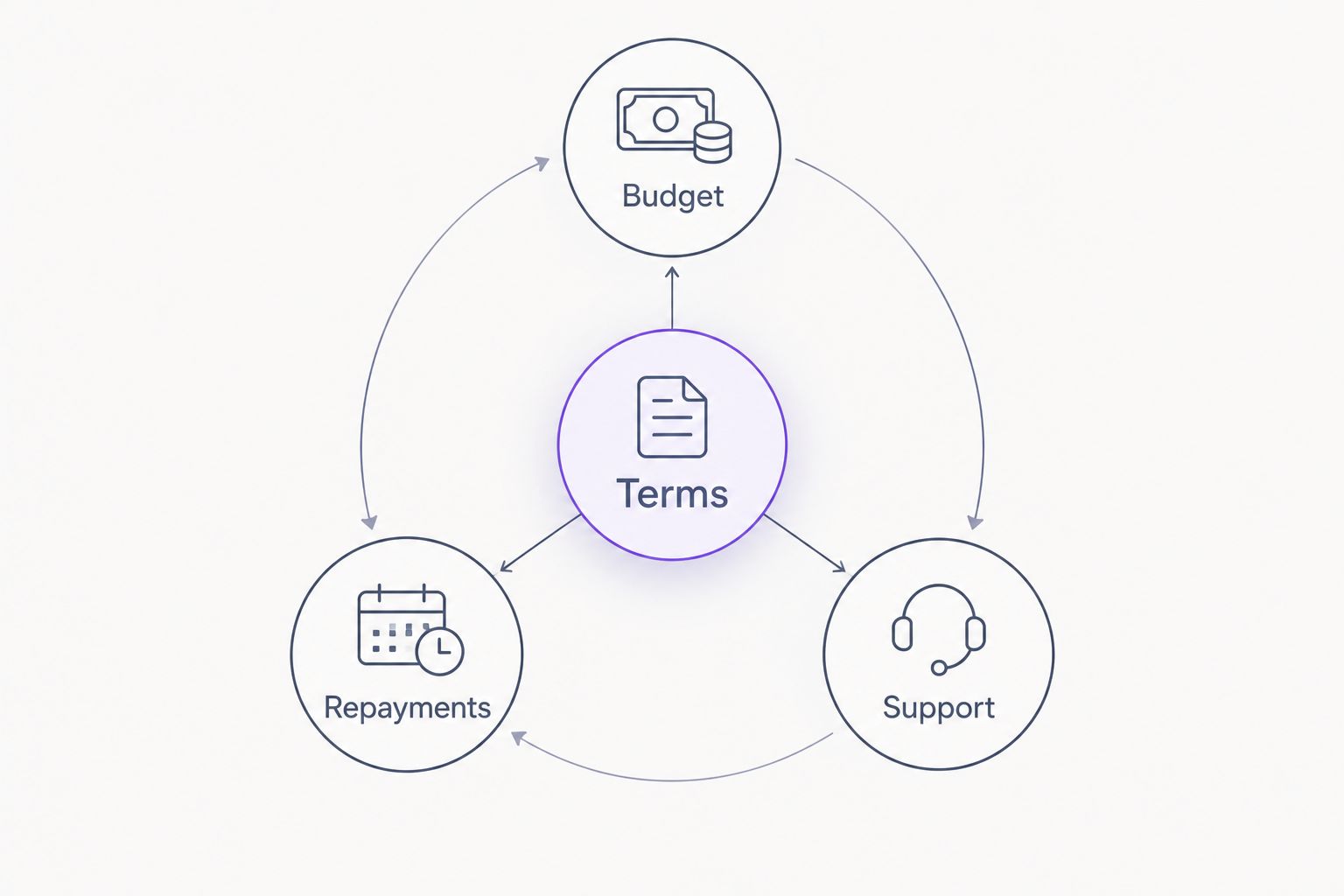
A practical review covers these areas:
- Budget: can the customer meet the commitment alongside existing obligations?
- Repayments: does the customer understand the schedule and consequences?
- Terms: are the relevant conditions clear before agreement?
- Support: does the customer know where to raise questions?
This is an honest tie: both routes require a considered borrowing decision. It is not a claim that the providers use identical checks or apply identical eligibility rules.
Neither route removes the need to manage refunds correctly
A returned purchase and a credit agreement are related issues, but they are not automatically the same administrative action. Your team needs a written process rather than an assumption that cancelling an order resolves every payment obligation.
For purchase-linked finance, establish who records a cancellation, how a partial refund is handled and what the customer is told about repayments. Confirm the sequence before staff use it with a real order.
For separately arranged borrowing, a retail refund does not itself instruct a lender to close a loan or credit account. The borrower must follow the relevant credit agreement and repayment process.
Neither option wins by making refund responsibilities disappear. The distinction is where your business participates in the finance process and where the customer's separate borrowing relationship begins.
Ask for an end-to-end example covering a full cancellation and a partial return. A clear answer is more useful than a general promise of convenient finance.
Final verdict: choose by role, not by brand familiarity
Choose PayItMonthly if you are a UK merchant offering instalments
Winner: PayItMonthly for merchant buy-now-pay-later. You want to let customers spread purchases into interest-free monthly instalments, rather than direct them towards independently arranged personal borrowing.
Before committing, confirm the commercial agreement, supported customer journey and operating responsibilities. The category fit is clear; the detailed business case belongs in those checks.
Choose 118 118 Money if you are comparing personal borrowing
Winner: 118 118 Money for the individual considering its loans or credit cards. Your goal is a personal credit agreement, not a merchant checkout platform.
Compare the chosen product's current terms with your needs and budget. This verdict identifies the relevant service category; it does not recommend borrowing for every purchase.
One-glance scorecard
| Dimension | Winner |
|---|---|
| Best for | Merchant platform for retailers; personal credit for borrowers |
| Standout feature | Purchase instalments for retail finance; loans or cards for personal borrowing |
| Purchase funding | 118 118 Money for borrowing arranged separately from checkout |
| Checkout ownership | PayItMonthly for a merchant-provided instalment option |
| Pricing model | No overall winner; compare the relevant agreements |
| Repayment planning | Purchase-linked instalments for explaining a specific retail commitment |
| Affordability | Tie: neither category establishes individual suitability |
| Refund handling | Tie: both require a clear process |
Explore instalments for your business
Review interest-free monthly instalments for your UK retail customers.
FAQ
Is PayItMonthly better than 118 118 Money for a UK retailer?
PayItMonthly is the better category fit for a UK retailer wanting to offer interest-free monthly instalments. 118 118 Money serves individuals seeking personal borrowing rather than supplying the same merchant checkout proposition.
Are merchant BNPL and personal loans the same thing?
No. Merchant BNPL offers payment instalments in connection with a sale, while a personal loan is borrowing under a separate lending agreement.
Which option should I compare if I need a personal loan?
118 118 Money belongs in a personal-loan comparison. Assess the current product terms and your repayment budget rather than comparing it with merchant checkout services.
Does interest-free finance mean the retailer has no costs?
No. Interest-free describes the customer's interest arrangement and does not establish the retailer's commercial terms. Review the merchant agreement separately.
Can I assume either option guarantees customer approval?
No. Do not treat either provider name or the finance category as a guarantee of acceptance. Check the applicable eligibility and application terms.
Does a purchase refund automatically cancel a personal loan?
No. A purchase refund does not itself cancel a separately arranged personal loan. The borrower must follow the lending agreement and any repayment or closure requirements.
What should a merchant check before offering instalments in 2026?
A merchant should check commercial terms, sales-channel support, the customer journey and operating responsibilities. Document cancellations, refunds and support routes before launch.
One last thing
Test the cancellation journey before you test the sales pitch. Ask what happens when a customer returns part of an order after a repayment has been made. That question forces the discussion beyond the headline offer and into the responsibilities your staff and customers need to understand.