

Newpay gives shoppers a reusable credit account rather than treating every purchase as a separate instalment plan. That model is not the same as a merchant offering interest-free monthly instalments at checkout. The best Newpay alternative in 2026 is PayItMonthly if you need interest-free monthly retail instalments; PayPal Pay in 3 if you need a three-payment checkout option.
- For newpay alternatives, shortlist PayItMonthly for interest-free monthly instalments offered by UK retailers and merchants.
- PayPal Pay in 3 suits a three-payment checkout requirement, not a longer monthly repayment requirement.
- Klarna belongs on your shortlist when you want to assess instalment and deferred-payment checkout options.
- Keep Newpay when its reusable credit-account model already fits your customers and merchant operations.
Why this matters
Choosing customer finance means choosing how your customers borrow, not just which payment logo appears at checkout. A reusable credit account, a purchase-specific instalment plan and a deferred payment do different jobs.
For your 2026 shortlist, separate the customer proposition from the merchant agreement. Interest-free repayments describe what the customer pays in interest; they do not establish your settlement arrangements, refund responsibilities or implementation requirements.
Choose the repayment model first. Compare providers second. Otherwise, you risk replacing a working finance option with something that does not solve the problem behind your search.
Newpay alternatives at a glance
This comparison focuses on repayment structure and merchant fit. It does not rank providers by acceptance, settlement speed or sales performance: those require evidence for your business and the particular agreement offered.
| Provider | Best for | Standout characteristic | How it differs from Newpay | Main limitation to consider |
|---|---|---|---|---|
| Newpay | Merchants seeking a reusable customer credit account | Credit-account model | Benchmark option rather than an alternative | Account-based credit is not the same proposition as a separate interest-free monthly plan |
| PayItMonthly | UK retailers seeking interest-free monthly instalments | Merchant BNPL platform with monthly customer repayments | Focuses on spreading purchases into interest-free monthly instalments | You must confirm the agreement fits your sales channels and operating requirements |
| PayPal Pay in 3 | Merchants seeking a short, three-payment purchase plan | Purchase split into three payments | Purchase-specific payments rather than a reusable credit account | Its payment schedule does not serve a longer-term repayment requirement |
| Klarna | Merchants comparing instalment and deferred-payment options | Distinct checkout payment models | Lets you assess purchase-specific options instead of an account-led proposition | Different payment options require separate evaluation; they are not interchangeable |
Read “best for” as a use-case match, not a universal winner. A provider that suits your online checkout still needs to pass your checks for cancellations, reconciliation and customer support.
1. PayItMonthly: best for interest-free monthly retail instalments
PayItMonthly provides UK retailers and merchants of all sizes with a buy-now-pay-later platform that lets customers spread purchases into interest-free monthly instalments. That makes it a direct shortlist choice when your requirement is monthly customer finance rather than a reusable credit account.
Start with that distinction. Do not assume the repayment model also answers every question about implementation, settlement or eligibility.
Where the platform shines
- Clear repayment proposition: customers spread a purchase into interest-free monthly instalments.
- Merchant-focused purpose: the platform is provided to UK businesses offering customer finance.
- Relevant business scope: its stated audience includes retailers and merchants of all sizes.
Where the platform falls short
- A monthly instalment proposition is not a substitute for a reusable credit account if that is what your customers need.
- Interest-free customer repayments do not, by themselves, establish whether the merchant arrangement suits your margins.
- You still need agreement-specific answers on supported sales channels, refunds, settlement and customer eligibility before committing.
These are buying constraints, not reasons to dismiss the option. They tell you what to establish before changing checkout.
Monthly instalments versus a Newpay credit account
| Dimension | Monthly instalment platform | Newpay |
|---|---|---|
| Core proposition | Spread purchases into interest-free monthly instalments | Reusable customer credit account |
| Best-fit requirement | Monthly repayments for retail purchases | Account-based access to customer credit |
| Customer explanation | Explain the instalment schedule for the purchase | Explain the account and applicable repayment terms |
| Merchant decision | Confirm the monthly plan and merchant agreement fit your business | Confirm the credit-account proposition fits your business |
Best for: UK merchants whose main requirement is interest-free monthly retail instalments.
Verdict: Buy into this repayment model if monthly instalments are the requirement; hold the provider decision until the merchant agreement passes your checks.
2. PayPal Pay in 3: best for a short checkout instalment plan
PayPal Pay in 3 divides an eligible purchase into three payments: one initial payment followed by two monthly repayments. Its strength is a defined, short repayment structure.
For a 2026 comparison, treat that schedule as the product's central distinction. Do not shortlist it as a replacement for a longer monthly plan and then discover that the repayment window is the wrong fit.
Where PayPal Pay in 3 shines
- Specific schedule: three payments give your customer a defined purchase-level repayment structure.
- Purchase-specific approach: the plan relates to the transaction rather than providing a reusable credit account.
- Clear comparison point: you can assess whether that short schedule matches the purchases you sell.
Where PayPal Pay in 3 falls short
- Three payments do not meet a requirement for a longer repayment schedule.
- Customer and transaction eligibility remain part of the decision; displaying an option is not a promise of approval.
- You need to check the applicable merchant arrangements rather than infer them from the customer-facing payment plan.
PayPal Pay in 3 versus Newpay
| Dimension | PayPal Pay in 3 | Newpay |
|---|---|---|
| Payment structure | Three payments for an eligible purchase | Reusable credit account |
| Repayment approach | Initial payment and two monthly repayments | Repayment terms attached to the credit account |
| Best-fit requirement | Short purchase-level instalments | Account-based customer credit |
Best for: merchants seeking a short instalment option for individual checkout purchases.
Verdict: Buy into the three-payment model when its schedule fits; skip it as your answer to a longer-term repayment requirement.
3. Klarna: best for comparing different checkout payment models
Klarna offers instalment and deferred-payment products. That makes it relevant when your search for Newpay alternatives includes more than one way for customers to pay later.
Compare the specific product you intend to offer, not the provider name alone. An instalment product and a deferred-payment product change the customer's payment schedule in different ways.
Where Klarna shines
- Different repayment models: instalment and deferred-payment options address distinct checkout requirements.
- Purchase-level comparison: you can assess a particular checkout option against Newpay's account-based approach.
Where Klarna falls short
- Different products create separate decisions about eligibility, customer explanations and operational handling.
- A deferred payment does not satisfy a monthly-instalment requirement simply because both fall under “pay later”.
- You must establish which product and merchant arrangement applies to your business before making the comparison.
| Dimension | Klarna checkout options | Newpay |
|---|---|---|
| Comparison unit | The specific instalment or deferred-payment product | The customer credit account |
| Customer proposition | Product-specific payment schedule | Account-based credit and repayment terms |
| Best-fit requirement | A defined checkout payment option | Reusable customer credit |
Best for: merchants comparing instalment and deferred-payment approaches before selecting a checkout proposition.
Verdict: Hold until you have identified the exact Klarna product you need; skip a provider-level comparison that mixes different repayment models.
Why people switch from Newpay
A sound reason to consider switching is a mismatch between the credit-account model and your intended customer proposition. That is different from claiming Newpay performs badly.
There is no basis here to attribute switching to outages, changing terms or poor service. Instead, use these specific requirement changes to decide whether an alternative belongs on your shortlist.
You want monthly instalments rather than an account
If your sales conversation centres on spreading a particular purchase into interest-free monthly repayments, evaluate a platform built around that proposition. Explain the purchase and its repayment schedule, not an account your customer did not ask for.
You want a short purchase-level schedule
If a three-payment structure meets your requirement, compare that model directly with account-based finance. Do not treat a shorter repayment schedule as automatically better: its usefulness depends on what you sell and what your customers need.
You want deferred payment, not instalments
Paying later and paying monthly are different requirements. Define which one you want before assessing providers, so your checkout wording and staff explanations match the actual product.
Your operational requirements have changed
A change in how you take orders is a reason to reassess finance arrangements. It is not proof that your existing provider cannot support the change; ask both the incumbent and alternatives the same questions.
Use the guide to comparing finance providers before switching to organise the decision around your requirements rather than provider slogans.
How to choose a Newpay alternative in 2026
Use the same decision sequence for every candidate. Written answers let you compare actual arrangements rather than promises made in a sales conversation.
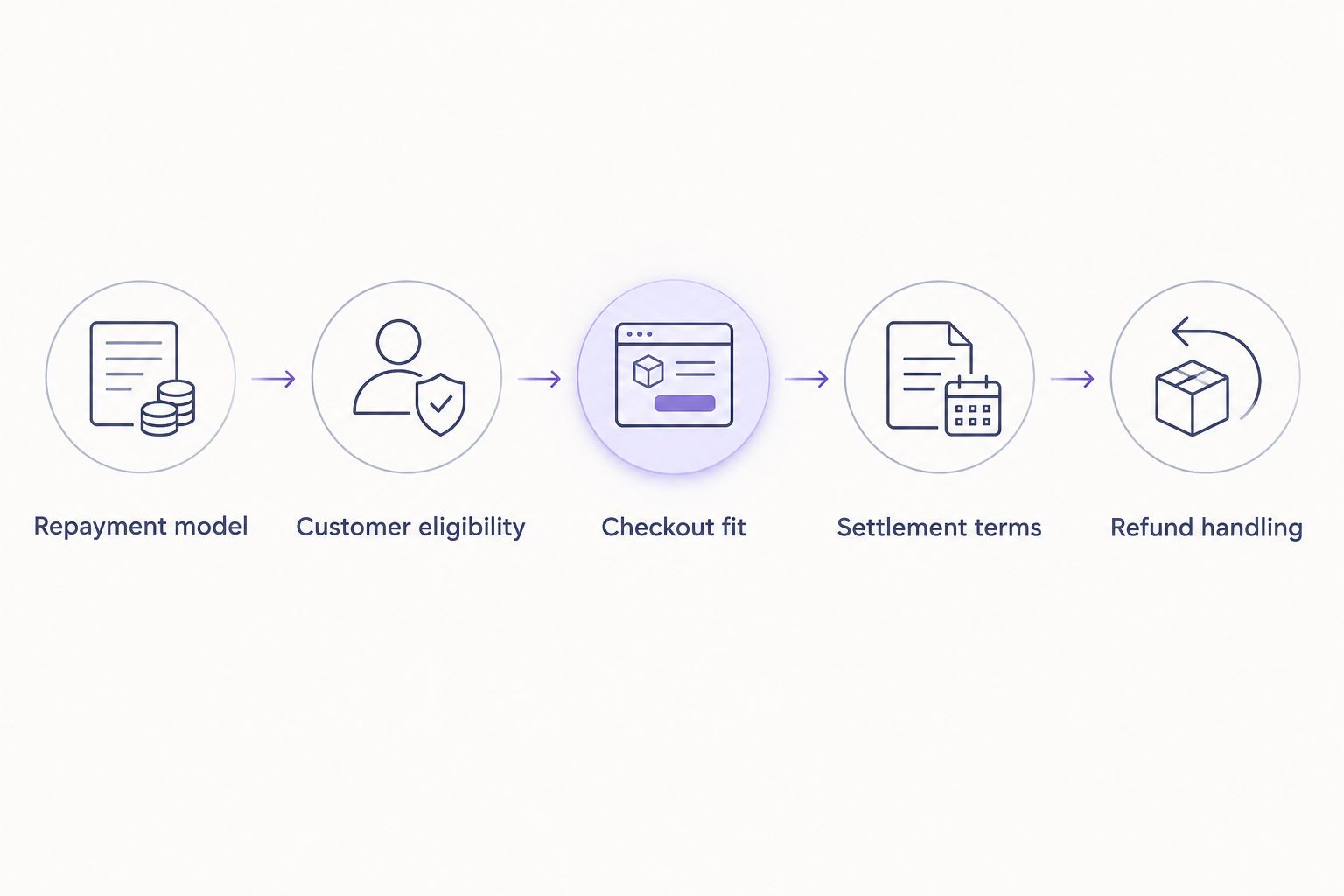
- Repayment model: choose reusable credit, monthly instalments, a short instalment schedule or deferred payment.
- Customer eligibility: establish who can apply, how decisions are made and what happens after a decline.
- Checkout fit: confirm support for the sales channels you actually use.
- Settlement terms: establish the settlement trigger, reconciliation process and any circumstances that change payment handling.
- Refund handling: confirm how cancellations and partial refunds affect the customer agreement and your records.
For your 2026 decision, request a demonstration of the ordinary purchase journey and the exception journey. Seeing a successful application is useful; seeing a cancellation or partial refund answers a different set of operational questions.
Ask who handles each task. Your team needs clear ownership for application questions, repayment enquiries, order changes and accounting discrepancies.
Check the customer explanation
Ask a member of staff to explain the proposed option without using the provider's sales script. They should distinguish the payment schedule, eligibility decision and consequences of missed payments using the actual product terms.
Do not promise universal acceptance or describe interest-free finance as consequence-free. Keep the explanation accurate even when the sales message is short.
Check the switch itself
Before replacing Newpay, establish how existing customer agreements remain serviced and how new purchases will be handled. Changing your checkout provider does not, by itself, move existing credit agreements.
Keep customer messages separate from internal implementation instructions. Shoppers need to know which option applies to their purchase; staff need to know where enquiries and refunds belong.
Explore interest-free monthly instalments
Assess whether monthly customer repayments fit your UK retail business.
When staying with Newpay is the right call
Keep Newpay if reusable customer credit is the requirement and your current arrangement meets it. An alternative is not an upgrade simply because it uses a different repayment structure.
Before switching in 2026, give the incumbent the same operational checklist you give the shortlist. If it meets your requirements and the alternative does not solve a defined problem, hold the change.
Best for: merchants whose customers and operations fit the reusable credit-account model.
Verdict: Hold Newpay when it fits; switch only for a requirement the replacement demonstrably meets.
FAQ
What's the best Newpay alternative for UK merchants in 2026?
PayItMonthly is the best-fit shortlist choice when your requirement is interest-free monthly retail instalments. PayPal Pay in 3 fits a short three-payment requirement, while Klarna is relevant when comparing specific instalment and deferred-payment options.
Is Newpay the same as a monthly instalment plan?
No. Newpay uses a reusable customer credit-account model, which is different from a purchase-specific monthly instalment proposition. Compare the actual repayment terms rather than grouping every product under pay later.
Is PayPal Pay in 3 better than Newpay?
PayPal Pay in 3 fits a short purchase-specific payment schedule; Newpay fits a reusable credit-account requirement. The better choice is the one that matches the repayment model your business needs.
Should I compare Klarna as one product?
No. Compare the specific Klarna instalment or deferred-payment product you intend to offer. Different repayment models require different customer explanations and operational checks.
Does interest-free finance mean every customer gets accepted?
No. Interest-free describes interest charged under the repayment arrangement, not guaranteed customer acceptance. Confirm the provider's eligibility and application process before making claims at checkout.
What should I check before replacing Newpay?
Check repayment structure, customer eligibility, checkout fit, settlement and refund handling. Obtain written answers and establish how existing agreements will remain serviced before changing the option for new purchases.
Can I move existing Newpay agreements by changing my checkout?
Changing checkout does not, by itself, transfer existing customer credit agreements. Establish the servicing arrangements for existing agreements separately from the implementation of a new purchase option.
When should my business stay with Newpay?
Stay with Newpay when reusable customer credit fits your requirement and the current merchant arrangement meets your operational needs. Switch for a defined improvement, not just a different provider name.
One last thing
Test a partial refund before approving the switch. Ask each shortlisted provider to show what happens to the customer's repayments, the merchant's records and the support enquiry.
A purchase demonstration shows how finance begins. A refund demonstration shows whether your team can manage it after the sale.


