

Choose PayItMonthly if your UK retail business wants customers to spread purchases into interest-free monthly instalments; choose Novuna Personal Finance if you need a retail finance offering that includes interest-bearing credit alongside interest-free options. The deciding factor in 2026 is the finance agreement your customers need, not the provider's name.
- PayItMonthly vs Novuna: choose interest-free BNPL for monthly instalments, or Novuna Personal Finance for a broader retail finance requirement.
- Novuna Personal Finance suits retailers considering interest-bearing credit alongside interest-free finance.
- Both offer interest-free customer finance; compare the actual merchant agreement before choosing.
- Test applications, settlement and refunds before committing to either provider.
Why this matters
Customer finance changes more than the payment screen. It affects how you explain a purchase, when you release an order, how you reconcile payments and what happens when a customer cancels.
For your 2026 shortlist, start with the customer proposition. An interest-free monthly instalment option and an interest-bearing credit agreement solve different payment needs, even when both appear at checkout.
Interest-free for the customer does not mean cost-free for the merchant. Assess the customer agreement and your merchant agreement separately. A clear repayment message is useful only when the commercial terms also work for your business.
The practical comparison is therefore narrow: which provider supports the agreement you want to offer, and which arrangement fits your sales process? Treat claims about faster payouts, easier approval or higher sales as questions to investigate—not reasons to sign.
At a glance
| Dimension | PayItMonthly | Novuna Personal Finance |
|---|---|---|
| Best for | UK retailers seeking interest-free monthly instalments | Retailers considering a broader retail credit offering |
| Standout feature | An interest-free BNPL proposition for retail checkout | Retail finance encompassing interest-free and interest-bearing credit |
| Interest-free payments | Customers spread purchases into interest-free monthly instalments | Interest-free retail finance is part of its offering |
| Interest-bearing finance | Keep the comparison centred on the stated interest-free offering | The more relevant shortlist option when interest-bearing credit is required |
| Checkout fit | Check the proposed application journey against your sales channels | Check the proposed application journey against your sales channels |
| Settlement and refunds | Assess the merchant agreement and operational process | Assess the merchant agreement and operational process |
| Pricing model | Assess the charge structure in the merchant proposal | Assess the charge structure in the merchant proposal |
| Customer clarity | Explain the actual instalment agreement | Explain the actual credit agreement |
This table separates product fit from operational performance. The interest-free proposition is explicit; implementation, settlement and commercial terms require an assessment of the arrangement offered to your business.
Do not use a category label as a substitute for that assessment. “BNPL” does not establish a repayment duration, a credit-check policy, a settlement schedule or a particular integration.
PayItMonthly fits an interest-free monthly instalment brief
PayItMonthly is best for UK retailers seeking an interest-free monthly instalment BNPL proposition. Its stated service lets customers spread purchases into monthly instalments without interest.
That is a clear starting point when your commercial brief is straightforward: add an interest-free payment option to retail checkout. You can assess the provider against that requirement without first designing an interest-bearing finance proposition.
The advantage is alignment with the brief, not a proven advantage in application speed or merchant payouts. Keep those distinctions clear when comparing proposals.
The limitation is equally important. An interest-free monthly instalment proposition does not, by itself, establish suitability for every order value, customer, repayment period or business sector. Your business still needs confirmation that the proposed arrangement covers its actual transactions.
Before proceeding, define:
- Customer purpose: what purchase the finance supports.
- Payment message: how staff will explain monthly instalments.
- Sales channel: where customers will start the application.
- Order fulfilment: when goods or services will be released.
A focused proposition is useful when it matches your requirement. It is not a reason to skip eligibility, contract or implementation checks.
Novuna Personal Finance fits a broader retail credit brief
Choose Novuna Personal Finance when your shortlist needs to include interest-bearing retail credit as well as interest-free finance. Its retail finance offering covers both categories, making it relevant to a broader credit brief.
That distinction matters if you are evaluating different customer borrowing arrangements rather than simply adding interest-free monthly instalments. Decide which type of agreement you need before comparing individual repayment structures.
The benefit is product breadth. The trade-off is that a broader offering creates more decisions about the agreement you will promote, its customer disclosures and the sales process around it.
Do not assume every arrangement is suitable for your business. Ask Novuna Personal Finance to identify the specific proposal that matches your sector, transaction profile and sales channels.
For a retailer with an established finance process, assess the proposed agreement alongside current staff training and order handling. For a first-time merchant, start with the customer explanation: what is being borrowed, what repayment means and where customers obtain help.
A broader finance offering wins only when you need the additional agreement types. Extra choice is not automatically a better checkout experience.
Both offer an interest-free customer finance route
Interest-free customer finance is not a unique deciding feature here. Both providers belong on a shortlist built around that requirement.
The useful comparison starts beneath the label. Check the repayment schedule, any upfront payment, eligibility conditions and the information shown before the customer commits. Use the actual proposed agreement rather than a general description of the provider.
Your 2026 customer messaging should explain the complete obligation. A monthly payment headline does not replace the repayment schedule, and “interest-free” does not answer every question about missed payments or cancellation.
Assess the explanation from the customer's perspective:
- Can they distinguish the purchase agreement from the finance agreement?
- Can they find the repayment schedule before committing?
- Can they identify who handles a repayment question?
- Can they understand what happens if the order changes?
Verdict: a tie on offering an interest-free route; choose on the agreement and its practical fit. Neither provider earns a blanket win from the interest-free label alone.
Checkout fit is decided by your actual sales journey
Neither a BNPL label nor a retail finance label establishes compatibility with your checkout. Ask each provider to demonstrate the proposed journey for the channels you actually use.
For an online retailer, inspect the handover from basket to application and back to order confirmation. For a shop, inspect what staff do while the customer completes the application. For remote sales, confirm how the customer receives and completes the relevant information.
Do not rank either provider on integration ease without testing the proposed setup. A supported sales channel and a workable implementation are separate questions.
Use 3 test orders in the demonstration: a completed purchase, a cancelled purchase and an order changed after the application. These are recommended test cases, not claims about either provider's performance.
Follow each case through four checkpoints:
- Application: identify what the customer and staff must do.
- Order confirmation: establish the status that permits fulfilment.
- Settlement: trace the merchant payment and reconciliation record.
- Refund: check how a cancellation or change reaches the finance agreement.
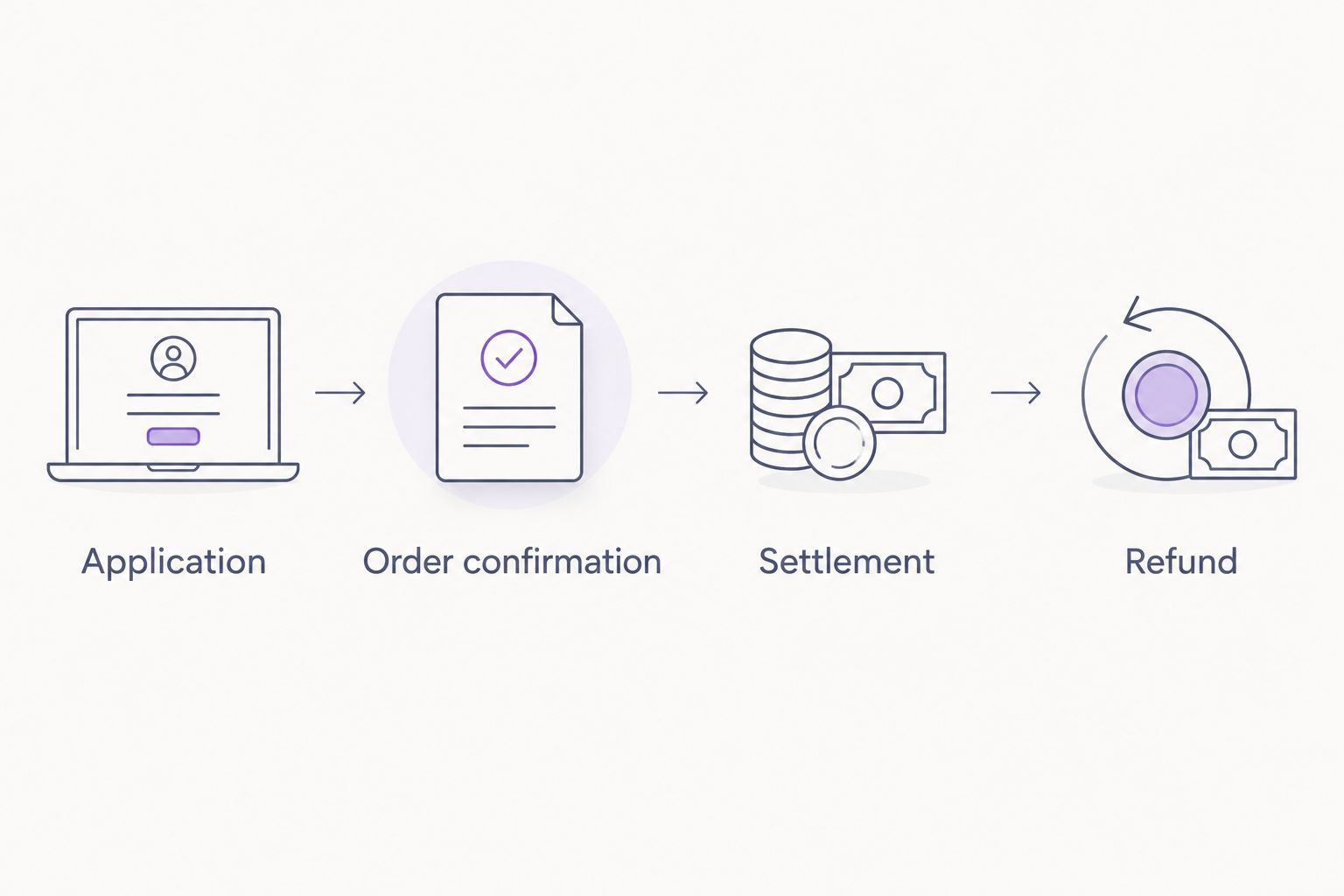
Give the demonstration to the people who will use the process. Your checkout owner should assess the application handover; your accounts team should assess reconciliation; your customer service team should assess exceptions.
A polished demonstration is not enough. Ask staff to explain the next action at every checkpoint without relying on the sales presenter.
Settlement and refunds need a contract-level comparison
Choose on documented settlement and refund handling, not assumed speed. The relevant question is when your business receives funds under the proposed agreement and what conditions apply.
An application decision, an order confirmation and merchant settlement are different events. Build your fulfilment policy around the event specified in the agreement, not an informal promise about getting paid quickly.
For your 2026 review, ask both providers the same questions:
- What triggers settlement to the merchant?
- What documents or order statuses are required?
- How are transactions matched to payments?
- What happens when goods are delayed or services are rescheduled?
- How are cancellations, disputes and refunds handled?
Run 1 full-refund test and 1 partial-refund test before launch. Ask the demonstrator to show the merchant action, the customer's updated position and the accounting record for each.
Those tests expose operational differences without inventing a performance ranking. A provider that suits your repayment brief still needs a workable exception process.
Do not overlook staff ownership. Assign responsibility for issuing refunds, checking the finance adjustment and communicating with the customer. A clear contract cannot compensate for an unassigned task inside your business.
Pricing: compare the charge basis, not the headline
For PayItMonthly and Novuna Personal Finance, assess the pricing model in the merchant proposal against the same order profile. Customer interest and merchant charges are separate parts of the comparison.
Start by identifying the charge basis. Is the proposed arrangement transaction-based, does it include fixed charges, or does it combine different charge types? Check which costs arise on completed sales and which arise through setup, ongoing service or exceptions.
Different charge structures create different trade-offs. Fixed charges favour predictability but remain payable regardless of how many financed transactions you process. Transaction-linked charges follow usage, while making the cost of each financed sale part of your margin calculation.
These are evaluation principles, not a statement that either provider uses a particular structure. Use the agreement offered to your business to establish the actual model.
Include refunds and cancellations in the comparison. Check which charges are reversed, retained or applied when an order changes, and ask how the settlement record reflects that outcome.
The guide to how merchant fees work for buy-now-pay-later providers explains the questions behind that assessment.
Neither provider wins on merchant cost without like-for-like terms. A quote for a different repayment arrangement or transaction profile is not a meaningful comparison.
Both need clear customer explanations
Both providers require your business to explain the arrangement it actually offers. The provider's name is not a substitute for clear sales wording.
Train staff to separate interest-free instalments from interest-bearing credit. They should explain the proposed payment arrangement without promising acceptance, claiming there are no checks or improvising answers about credit records.
For your 2026 launch, keep the customer explanation consistent across product pages, checkout, staff conversations and order emails. Check every channel against the approved agreement and provider guidance.
Use a short internal script covering:
- What payment option is being offered.
- Where the customer reviews the agreement.
- What happens after the application.
- Who handles questions about repayments or cancellation.
Verdict: a tie on the need for clear communication. Product breadth does not remove that responsibility, and an interest-free proposition does not make every customer question simple.
Final verdict: choose the agreement that matches your brief
Choose PayItMonthly for interest-free monthly instalment BNPL
Best for: a UK retailer whose brief is to let customers spread purchases into interest-free monthly instalments. Start here when that is the proposition you want to add to retail checkout.
Proceed after confirming transaction suitability, the application journey, settlement conditions and refund handling. Keep the recommendation tied to the stated interest-free offering rather than assumptions about approval or implementation.
Choose Novuna Personal Finance for a broader retail credit requirement
Best for: a retailer evaluating interest-bearing credit alongside interest-free finance. Novuna Personal Finance is the more relevant shortlist choice when your requirement extends beyond an interest-free instalment proposition.
Assess the specific agreement offered to your business. Product breadth is the reason to consider it—not proof that every available arrangement fits your checkout or customers.
One-glance scorecard
| Dimension | Winner |
|---|---|
| Interest-free monthly instalment brief | The focused BNPL proposition |
| Broader retail credit brief | Novuna Personal Finance |
| Offering an interest-free route | Tie |
| Checkout fit | Decide through a demonstrated journey |
| Settlement and refunds | Decide through contract review and testing |
| Merchant pricing | Decide through like-for-like proposals |
| Customer clarity | Tie: both need agreement-specific explanations |
Explore interest-free monthly instalments
Assess an interest-free BNPL proposition for your UK retail business.
FAQ
Is PayItMonthly better than Novuna for a small UK retailer?
PayItMonthly is the clearer starting point when the requirement is interest-free monthly instalment BNPL. Novuna Personal Finance is relevant when the retailer also needs to evaluate interest-bearing retail credit; business size alone does not decide the winner.
Does Novuna Personal Finance offer interest-free finance?
Yes, Novuna Personal Finance offers interest-free retail finance alongside interest-bearing credit. Assess the specific agreement proposed for your business rather than assuming every arrangement has the same terms.
Which provider is cheaper for merchants in 2026?
Choose on like-for-like merchant proposals, not an assumed cost ranking. Compare the charge basis, repayment arrangement and treatment of cancellations and refunds.
Does interest-free finance mean my business pays nothing?
No, interest-free describes customer interest, not your merchant charges. Review the merchant agreement separately from the customer's repayment agreement.
Which provider pays retailers faster?
Choose on the settlement conditions documented in the proposed merchant agreement. Establish what triggers payment, what documentation is required and how your accounts team reconciles it.
Can I assume BNPL means there is no credit check?
No, the BNPL label does not establish a provider's credit-check policy. Obtain the applicable eligibility and assessment information before making customer-facing claims.
What should I test before choosing a finance provider?
Test a completed purchase, a cancellation and an order change. Follow each through the application, order confirmation, settlement and refund process with the staff who will handle it.
One last thing
Make the refund demonstration part of the buying decision. Your customer sees a payment option; your team inherits the process when a purchase changes.
Ask each provider to handle the same cancellation scenario while your accounts and customer service teams watch. A clear answer about responsibility, finance adjustments and reconciliation is more useful than another feature slide.


