
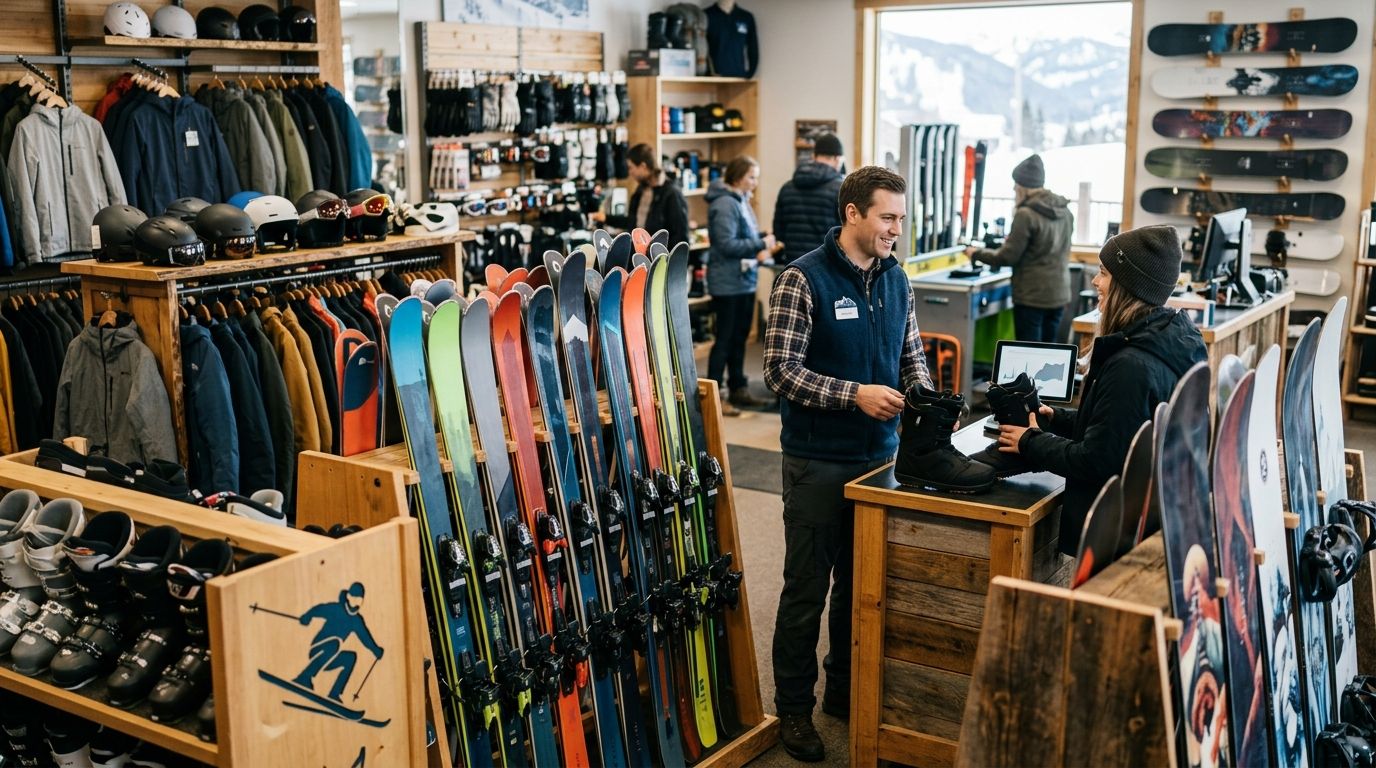
Ski and snowboard equipment retailers use 0% finance to turn a £400-plus kit purchase into a monthly amount a customer can approve at the till in seconds, with the goal of protecting sales during a trading window that's shorter than almost any other retail category. Unlike a furniture shop or a gym selling year-round, a ski shop has to convert most of its annual revenue in the run-up to Christmas and again around February half-term — miss that window and the till stays quiet until next winter.
- 0% finance ski equipment offers work best when they cover full kit bundles — skis, boots, bindings, board and outerwear — not single low-value items.
- PayItMonthly lets ski and snowboard retailers spread the cost of a kit over interest-free monthly instalments at checkout, in-store or online.
- Launch finance messaging before October, not after Black Friday — most UK ski retail sales concentrate into a four-to-five month season.
- FCA rules bring BNPL products under formal consumer credit regulation from 2026, so affordability checks matter more than ever.
- Retailers that train till staff to mention finance convert more browsers than those relying on a product-page badge alone.
Why 0% finance ski equipment matters for this segment
A full ski or snowboard setup — boots, bindings, skis or board, helmet, outerwear — is one of the highest average order values in seasonal sporting goods retail. Customers researching gear in September and October are already comparing prices across specialist shops, sports chains and marketplaces, and a chunk of them abandon the basket the moment they see the total.
The trading calendar makes this worse than most retail categories. Ski and snowboard sales cluster into roughly a five-month window, September through February, with spikes around Black Friday, Christmas and half-term. A retailer that only adds 0% finance messaging in January has already lost the biggest buying moment of the season.
Second-hand and rental markets also compete hard for this customer. Interest-free monthly instalments give a retailer a reason for a shopper to buy new gear outright instead of renting for a week or settling for last season's stock off a marketplace listing.
A ski or snowboard retailer that adds 0% finance ski equipment messaging before the September buying window converts more full-price kit bundles than one that waits until the January sale. That's the sentence worth repeating to anyone weighing up whether to bother.
Update your product page pricing to show monthly cost
Customers scanning ski gear on a phone screen make snap decisions based on the total price, not the specification sheet. Showing a monthly instalment figure next to the full price changes that decision instantly, but the manual version of this still works if you're not ready to plug in a platform.
- Add a clear "spread the cost" line under the price on every product over roughly £150
- Bundle high-ticket combinations — skis, boots, bindings — into a single product listing with one combined instalment figure
- Use the same wording across every product page so customers don't have to hunt for it
- Test the badge above the fold, not buried below a description
- Once this is proven manually, PayItMonthly adds a live instalment calculator to checkout so the figure updates automatically as basket contents change
Time your 0% finance push to the ski retail calendar
Ski and snowboard demand doesn't behave like general retail. It spikes hard around three windows — early autumn pre-season buying, Black Friday through Christmas, and February half-term — then drops off almost completely by March.
- Launch finance messaging on the homepage and category pages by mid-September, before the first cold snap drives search traffic
- Push email and social reminders in the two weeks before half-term, when families buy kit for a first trip
- Keep the offer visible through January rather than pulling it the moment Boxing Day sales end
- Match instalment messaging to your seasonal stock cycle — new-season kit gets the full-price finance push, clearance gets a shorter, sharper promotion
- Review structuring instalment plans for seasonal sales spikes before locking in the 2026 calendar, since a badly timed launch wastes the busiest four weeks of the year
Train till and floor staff to pitch finance, not just display it
Most ski and snowboard shops still sell heavily in-store — customers want a boot fitting and a hands-on comparison before spending several hundred pounds. That means the pitch happens at the till, not just on a webpage.
- Give staff one sentence to use every time a basket crosses roughly £250: offer to spread it over a few months at 0%
- Put a small finance sign at the boot-fitting bench and the till, not just the shop window
- Role-play the objection that a customer would rather pay it off in one go — most haven't considered instalments until it's offered
- Track which staff members mention finance and compare their average basket size to those who don't
Vet customers properly before approving finance
Offering 0% finance ski equipment doesn't mean approving every application. A rushed or careless process creates missed repayments and compliance exposure, especially now BNPL sits under formal FCA consumer credit rules from 2026.
- Run a basic affordability check on every application over your chosen threshold, not just the high-ticket ones
- Keep a documented process for declines so staff aren't guessing on the shop floor
- Never let a sales target push a decline into an approval — that's the fastest route to a bad debt problem
- Review how to vet customers for buy now pay later eligibility before the 2026 season ramps up
- A platform-run credit check removes the guesswork from staff who aren't trained underwriters
Measure basket size and conversion after launch
A finance option that isn't tracked is a guess dressed up as a strategy. Ski retailers need to know whether 0% finance actually lifted average order value or just shifted existing sales into instalments.
- Compare average basket value for finance customers versus cash customers each month
- Track cart abandonment on high-ticket bundle pages before and after adding instalment messaging
- Watch conversion rate specifically during the three peak windows, not just the season total
- Flag any spike in declined applications immediately rather than at the season-end review
Protect margin during the post-Christmas sale bounce
January sales are where ski retailers give away margin fastest. Layering 0% finance on top of a discount without a plan can turn a decent season into a thin one.
- Cap finance eligibility on already-discounted stock if margin is tight
- Read how to protect profit margins when offering 0% finance before the 2026 January sale goes live
- Set a minimum basket value for finance during clearance so it applies to full kits, not single accessories
- Reassess merchant fee terms with your provider annually, not just at signup
Get 0% finance live before the season
See how fast a ski or snowboard retailer can launch instalment checkout.
Comparing finance options for ski and snowboard retailers
| Option | Best for | Key limitation |
|---|---|---|
| Interest-free BNPL (PayItMonthly) | Full kit bundles, in-store and online | Requires setup and staff training before peak season |
| In-house store credit account | Long-standing local shops with repeat customers | Manual admin, no automated affordability checks |
| Weekly-repayment BNPL apps | Younger customers buying single items online | Not built for full-season kit bundles, shorter terms |
| Traditional retail finance broker | Very high-ticket bundles and multi-item orders | Slower approval, often needs a full credit search |
Check point-of-sale finance options for UK retailers if you're weighing this against a broader retail finance stack rather than a ski-specific one.
Common mistakes ski and snowboard retailers make
- Launching finance too late. Adding 0% finance ski equipment messaging in January means missing the September-to-Christmas window where most full-price sales happen.
- Applying finance to accessories, not kit. A £30 pair of ski socks doesn't need instalments — a £600 boot-and-binding bundle does.
- Leaving it off the boot-fitting bench. The fitting session is where the sale actually closes; finance messaging that only lives online misses the moment.
- Skipping affordability checks under time pressure. A rushed approval on a busy Saturday in December is exactly when compliance gaps show up.
- Pulling the offer the day after Christmas. February half-term buyers still need the same finance option — don't cut it off early.
FAQ
What is 0% finance ski equipment and how does it work?
0% finance ski equipment lets a customer split the cost of skis, boards, boots or a full kit bundle into interest-free monthly instalments at checkout instead of paying the full amount upfront. The retailer is paid at the point of sale while the customer repays over several months.
Is 0% finance worth offering for a small ski shop?
Yes, when the average basket value is high enough to justify the setup. Most ski and snowboard bundles run into hundreds of pounds, which is exactly the price point where finance changes a customer's buying decision.
Does offering finance require an FCA credit licence?
A merchant working with a regulated finance provider typically does not hold the consumer credit licence themselves, because the provider handles the regulated lending. Confirm the specific arrangement with your provider before launch.
When should a ski retailer launch a 0% finance offer?
Before mid-September, ahead of the autumn and Black Friday buying window. Launching after Christmas means missing the busiest four to five months of the ski retail season.
Should finance be offered in-store or online only?
Both. Most ski and snowboard shoppers still buy in-store after a boot fitting, so finance needs to be pitched at the till as well as shown on the website.
How does 2026 BNPL regulation affect ski retailers offering finance?
From 2026, buy now pay later products fall under FCA consumer credit rules, so affordability checks and clear terms become a formal requirement rather than best practice. Check that your finance provider is set up for it.
Can finance be limited to specific product categories?
Yes. Most platforms let a retailer set a minimum basket value or exclude categories such as accessories, so finance applies to full kit bundles rather than every item in the store.
Does 0% finance affect a customer's credit score?
That depends on the provider and how the application is structured. Ask any provider directly whether their process runs a soft or hard credit search before you launch.
One last thing
The retailers that get the most out of 0% finance ski equipment offers don't treat it as a checkout add-on — they build the whole autumn marketing calendar around it, starting the messaging before the first frost rather than after the first sale slump. The four weeks before Black Friday matter more to a ski shop's 2026 season than the entire month of January.


