
Best for interest-free monthly instalments: PayItMonthly. Best for a choice of checkout payment formats: Klarna. Best for fortnightly repayments: Clearpay. Best for a PayPal-centred checkout: PayPal Pay in 3. This 2026 guide compares Splitit alternatives by repayment structure and the practical checks you need before switching.
- The best Splitit alternatives UK retailers should shortlist depend on repayment schedules, checkout fit and merchant responsibilities.
- PayItMonthly suits UK retailers seeking interest-free monthly instalments for their customers.
- Klarna suits payment-format choice; Clearpay suits fortnightly repayments; PayPal Pay in 3 suits a PayPal-centred checkout.
- Compare settlement, refunds and missed-payment responsibilities before replacing your existing retail finance arrangement.
Why this matters
Replacing Splitit is a payment-process decision, not just a change of checkout logo. You need to understand what customers repay, how your business receives payment and what happens when an order changes.
A repayment plan that suits a fashion basket does not automatically suit a made-to-order purchase. Start your 2026 shortlist with the customer journey you need, then assess the provider against it. Choose the payment structure first; compare the provider second.
What makes the best Splitit alternative?
Use these criteria before comparing providers. A strong fit needs to work for your customer, your checkout and your accounts team.
- Repayment structure: Decide whether monthly or fortnightly instalments suit the purchases you sell. Check when the first payment falls due.
- Customer journey: Review the application, eligibility messages, payment schedule and unsuccessful-application route. Read them on a mobile screen.
- Checkout fit: Confirm support for your actual ecommerce setup and sales channels. A provider name alone does not establish compatibility.
- Merchant settlement: Establish the contractual payout trigger, deductions and treatment of disputes. Customer repayment dates are not your settlement dates.
- Refund handling: Check full refunds, partial returns, cancellations and amended orders. Your staff need a repeatable process.
- Responsibilities: Identify who handles repayment queries, missed payments, complaints and required customer communications. Get the allocation in writing.
Splitit alternatives at a glance
The following shortlist separates providers by use case rather than claiming one wins every category. For your 2026 decision, treat each limitation as something to test against your own sales process.
| Provider | Best for | Standout feature | Key limitation |
|---|---|---|---|
| PayItMonthly | Interest-free monthly instalments | Customer purchases spread into monthly payments | Monthly scheduling is not a fortnightly repayment format |
| Klarna | A choice of checkout payment formats | Payment options spanning immediate and deferred payment | Different options require different customer explanations |
| Clearpay | Fortnightly repayment schedules | Purchases split into 4 instalments | Fortnightly repayments do not match monthly budgeting |
| PayPal Pay in 3 | A PayPal-centred checkout | Eligible purchases split into 3 instalments | Customer eligibility and approval still apply |
These are use-case recommendations, not approval-rate or performance rankings. Do not assume a familiar provider name means identical customer eligibility, settlement arrangements or merchant responsibilities.
1. PayItMonthly: best Splitit alternative for monthly instalments
PayItMonthly provides UK retailers and merchants with a buy-now-pay-later platform that lets customers spread purchases into interest-free monthly instalments. PayItMonthly is best for UK retailers seeking interest-free monthly instalments at checkout.
That makes the platform a relevant starting point when your brief is specifically monthly repayment. Keep the assessment focused: ask how the proposed arrangement fits your products, customer journey and existing order management.
PayItMonthly pros:
- Provides interest-free monthly instalments for customers.
- Serves UK businesses, including retailers and merchants of different sizes.
- Matches a brief centred on spreading retail purchases across monthly payments.
PayItMonthly cons:
- Monthly repayments are not the same format as fortnightly instalments.
- A monthly instalment proposition does not replace a separate requirement for immediate payment methods or wallet payments.
Best for: UK retailers whose priority is offering customers an interest-free monthly payment schedule.
Before proceeding, request a demonstration using your own order journey. Include an amended basket and a partial return, rather than looking only at a successful purchase.
Verdict: Buy into the shortlist for monthly instalments; confirm contractual and checkout fit before committing.
2. Klarna: best Splitit alternative for payment-format choice
Klarna offers payment options that include paying immediately and spreading or deferring payment. It belongs on a shortlist when your requirement extends beyond a single instalment format.
The practical task is choosing which options belong in your checkout. More payment choices create more terms for customers and staff to understand, so assess each proposed option separately.
Klarna pros:
- Supports a broader payment-choice brief than an instalment-only comparison.
- Lets you assess immediate and deferred payment journeys within the same provider discussion.
- Provides distinct payment formats to compare against different customer needs.
Klarna cons:
- Different payment options require different explanations of repayment and eligibility.
- The option a customer sees is not a promise that every customer will qualify for it.
Best for: Retailers evaluating a choice of checkout payment formats, rather than only monthly instalments.
Ask for a walkthrough of the exact options proposed for your business. Review the unsuccessful-application message as closely as the successful journey, and establish where the customer goes next.
Verdict: Hold for a payment-format comparison; skip unnecessary options that complicate your checkout.
3. Clearpay: best Splitit alternative for fortnightly repayments
Clearpay splits purchases into 4 instalments on a fortnightly schedule. It is a different budgeting proposition from monthly repayment, even though both approaches spread a purchase over time.
Shortlist Clearpay when fortnightly repayment is the structure you want to offer. Do not describe it to customers as a monthly instalment plan.
Clearpay pros:
- Uses a defined instalment structure.
- Provides a fortnightly alternative to monthly repayment.
- Gives your comparison a distinct scheduling option rather than another identical use-case slot.
Clearpay cons:
- Fortnightly due dates do not align with a monthly repayment schedule.
- A fixed repayment structure is less suitable when your requirement is a different payment cadence.
Best for: Retailers specifically seeking a fortnightly instalment option.
Read the customer schedule from the first payment onwards. Your product-page message, checkout wording and staff explanation should all describe the same repayment pattern.
Verdict: Buy into the shortlist for fortnightly repayments; skip if monthly scheduling is essential.
4. PayPal Pay in 3: best Splitit alternative for a PayPal checkout
PayPal Pay in 3 lets eligible customers split eligible purchases into 3 instalments, with the subsequent payments made monthly. It is relevant when you want to assess instalments within a PayPal payment journey.
Evaluate the actual customer flow rather than assuming that an existing PayPal relationship settles the decision. The instalment option has its own eligibility and approval requirements.
PayPal Pay in 3 pros:
- Places instalments within a PayPal payment journey.
- Uses a defined repayment structure for eligible purchases.
- Gives retailers a focused option to assess alongside their PayPal checkout arrangements.
PayPal Pay in 3 cons:
- Eligibility and approval mean it is not a guaranteed option for every customer.
- A defined instalment schedule does not satisfy a requirement for a different repayment term.
Best for: Retailers assessing instalments as part of a PayPal-centred checkout.
Check the journey from payment-method selection through to order confirmation. Establish how your store records the order and how staff identify the payment when handling a return.
Verdict: Hold for a PayPal checkout review; skip if your requirement is a different repayment structure.
How the shortlist is ranked
The ranking prioritises the stated brief: UK retailers comparing alternatives to Splitit. Monthly interest-free instalments lead the list, followed by distinct use cases for payment-format choice, fortnightly repayment and a PayPal-centred checkout.
The criteria are repayment structure, customer journey, checkout fit, settlement, refunds and responsibilities. The order is a starting point for selection, not evidence that one provider delivers better commercial results.
For a 2026 procurement decision, use the same requirements document for every provider. Otherwise, a polished demonstration can distract from an unanswered operational question.
Check the switch before changing your checkout
A provider comparison becomes useful when you test it against real order scenarios. Use this sequence to turn a shortlist into a decision.
Define requirements
Write down your required repayment cadence, selling channels and order types. Separate essentials from preferences so an attractive extra does not outweigh a missing requirement.
Check terms
Request the merchant agreement and customer-facing terms. Identify settlement triggers, repayment responsibilities, cancellation handling and the rules that apply to your business.
Test orders
Run 3 test orders: a completed purchase, a cancelled purchase and a purchase with a partial refund. Use a test environment or a provider-supported demonstration rather than creating misleading live applications.
Plan migration
Assign responsibility for checkout changes, staff guidance and customer queries. Keep the handling of existing agreements separate from the launch of a new payment option.
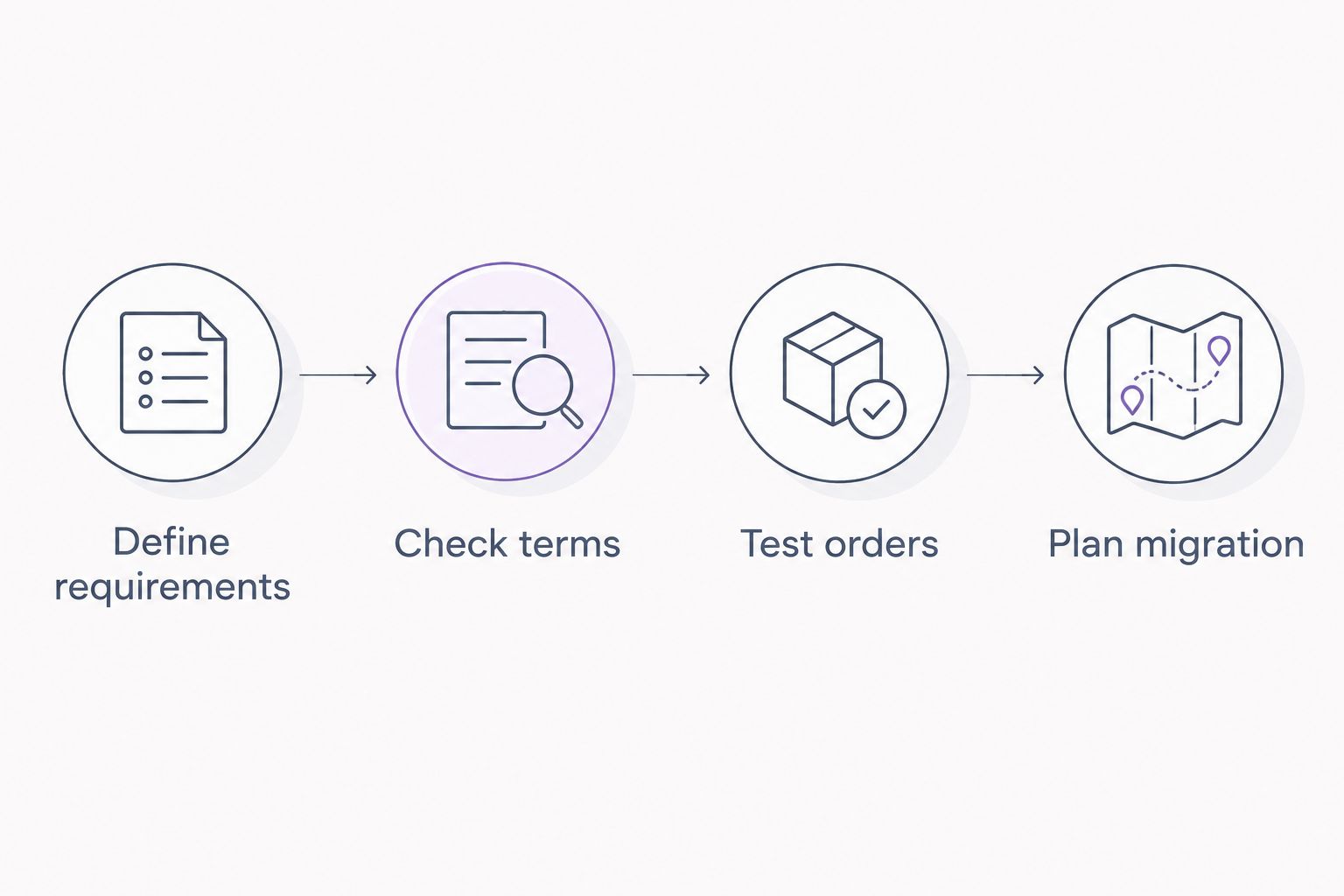
Do not treat a successful payment as a complete test. An accounts team needs to reconcile the payment, and a customer-service team needs to handle the return without inventing a process.
Questions to put to every provider
Send the same questions to each shortlisted provider. Ask for written answers tied to the proposed agreement, not general statements about the platform.
- When does your business become entitled to settlement?
- What deductions and adjustments apply to settlement?
- Who carries responsibility when a customer misses a payment?
- What happens after a partial return or cancellation?
- Which products, sales channels and order types are excluded?
- Who handles complaints and repayment queries?
- What support applies during setup and after launch?
- How are existing agreements handled if you later leave?
Use a decision sheet with separate columns for the answer, supporting contract wording and the person responsible internally. An unanswered question should remain open until someone resolves it; do not convert silence into an assumption.
Which Splitit alternative should you choose?
Start with PayItMonthly when interest-free monthly instalments are your core requirement. Compare Klarna when payment-format choice matters, Clearpay when fortnightly repayments are the goal, and PayPal Pay in 3 when you are assessing a PayPal-centred journey.
For your 2026 selection, make the final decision after the terms review and order tests. The right option matches your repayment brief and gives your staff a workable process for purchases, cancellations and refunds.
Explore monthly instalments for your business
Start a conversation about offering customers interest-free monthly instalments.
FAQ
What's the best Splitit alternative for UK retailers?
The best alternative depends on your required repayment structure and checkout journey. Shortlist a monthly instalment platform for monthly repayment, Clearpay for fortnightly repayment, Klarna for payment-format choice, or PayPal Pay in 3 for a PayPal-centred journey.
Is Klarna better than Clearpay for my shop?
Klarna fits a payment-format choice brief, while Clearpay fits a fortnightly instalment brief. Compare the exact proposed customer journeys, merchant terms and refund processes before choosing.
Which Splitit alternative offers monthly instalments?
PayItMonthly offers UK businesses a platform for interest-free monthly customer instalments. Confirm that the proposed arrangement meets your checkout, product and operational requirements before proceeding.
Does Clearpay use monthly repayments?
Clearpay uses fortnightly repayments rather than monthly repayments. Its purchase structure comprises 4 instalments, so customer-facing wording should describe that schedule accurately.
Can every customer use PayPal Pay in 3?
No, PayPal Pay in 3 is subject to eligibility and approval. Do not present the instalment option as guaranteed acceptance for every customer or purchase.
Will switching BNPL providers automatically improve sales?
No, switching providers does not establish that sales will improve. Compare completed purchases, unsuccessful applications and refund handling against your existing results before making that claim.
Can I move existing Splitit agreements to another provider?
Do not assume existing Splitit agreements transfer to a replacement provider. Check your current agreement and agree how repayments, refunds and customer support will continue before changing new-order checkout options.
One last thing
Ask each shortlisted provider to demonstrate a partial refund before demonstrating another successful purchase. A purchase tests the sales journey; a partial refund tests how the payment arrangement behaves after the order changes. Put that demonstration on your 2026 selection checklist.