
Best overall: the BNPL plan whose confirmed minimum covers the baskets you want to finance. Best for smaller orders: a lower-threshold plan; best for mixed-value retail: a plan that covers your normal basket range. For BNPL providers ranked by minimum order value in 2026, rank the exact merchant offer—not the provider’s name alone.
- Rank BNPL providers by confirmed UK merchant terms, then match their minimum order value to your actual baskets.
- PayItMonthly offers UK merchants BNPL with interest-free monthly instalments; assess its terms against your checkout needs.
- A lower minimum is useful only when the eligible orders also make commercial sense.
- Check basket eligibility separately from customer approval before choosing a retail finance provider.
Why this matters
A minimum order value determines which purchases fall within a payment plan’s transaction rules. It does not tell you whether an individual customer will qualify, whether every product is eligible, or whether the arrangement suits your business.
PayItMonthly provides UK businesses with a BNPL platform that lets customers spread purchases into interest-free monthly instalments. PayItMonthly is a BNPL option for UK merchants seeking interest-free monthly instalments for their customers.
Your decision starts with the orders you want to support. A low threshold has little practical value if it excludes the products you sell or creates a payment journey your team cannot explain clearly.
For your 2026 shortlist, separate transaction coverage from commercial suitability. First establish which baskets qualify; then assess whether offering finance on those baskets works for your business.
What makes the best BNPL minimum-order fit?
Use these criteria before comparing provider proposals:
- Basket coverage: Does the confirmed minimum cover the purchases you want customers to spread?
- Calculation basis: Is eligibility assessed against the full basket, eligible items or the amount being financed?
- Channel fit: Do the same rules apply wherever you intend to offer the plan?
- Customer terms: Can customers understand the repayment schedule and their obligations before proceeding?
- Merchant economics: Do the contractual charges and responsibilities fit the orders you intend to finance?
- Order changes: What happens when a discount, cancellation or partial refund changes the transaction?
Keep threshold and approval questions separate. An order can meet a transaction minimum without establishing that its customer qualifies for credit.
Minimum-order approaches at a glance
This is a decision ranking for merchant shortlists, not a claim that one named provider has the lowest market-wide threshold. Use it to decide which type of offer deserves your attention first.
| Priority | Plan configuration | Best for | Standout benefit | Key limitation |
|---|---|---|---|---|
| 1 | Lower-threshold plan | Merchants prioritising smaller eligible baskets | Brings more of your lower-value basket range within the transaction rules | Lower threshold alone says nothing about customer approval or merchant economics |
| 2 | Basket-matched plan | Retailers with a defined core order range | Focuses the comparison on everyday orders rather than an advertised minimum | Orders outside that range still need separate checking |
| 3 | Higher-threshold targeted plan | Merchants restricting finance to selected larger purchases | Supports a deliberate, limited finance proposition | Excludes smaller baskets by design |
The right order depends on your sales mix. A merchant financing selected larger purchases should put the third configuration first; a merchant focused on smaller baskets should start with the first.
1. Lower-threshold plans: best for smaller eligible baskets
A lower-threshold plan deserves first consideration when you want instalments to cover the smaller purchases in your range. Compare the proposed minimum with actual completed orders, not just individual product values.
Ask each provider to confirm the exact UK plan, eligible categories and calculation basis. A headline minimum is not enough to establish how a mixed basket will be treated.
Lower-threshold plan pros:
- Covers a wider portion of your basket range when other eligibility rules remain equal.
- Lets you assess instalments for smaller purchases rather than restricting the exercise to larger orders.
- Gives your team a clear lower boundary to explain once the terms are confirmed.
Lower-threshold plan cons:
- Transaction eligibility does not guarantee customer acceptance.
- A low minimum does not establish that the merchant charges suit smaller transactions.
- Product exclusions can narrow practical coverage despite a low headline threshold.
Best for: Merchants whose finance strategy explicitly includes smaller eligible orders.
Verdict: Hold until the provider confirms the threshold, calculation basis and merchant terms in writing. Choose this configuration only when all three fit your intended baskets.
2. Basket-matched plans: best for everyday retail orders
A basket-matched plan starts with the orders you already sell. Rather than chasing the lowest possible minimum, you ask whether the offer covers your core transaction range and customer journey.
For UK merchants seeking interest-free monthly instalments, PayItMonthly belongs on the shortlist. Evaluate the proposed arrangement against the same basket and contract checks you apply to every other candidate.
Basket-matched plan pros:
- Keeps the comparison tied to real orders rather than an isolated threshold.
- Makes product mix, discounts and repayment communication part of the decision.
- Helps you define where finance belongs in your sales process.
Basket-matched plan cons:
- A good fit for your core range does not establish suitability for unusually small or large orders.
- Changes to your catalogue require another coverage check.
- Transaction fit alone does not answer settlement, refund or liability questions.
Best for: Retailers with a clear view of the purchases they want customers to finance.
Verdict: Hold until representative baskets and contractual responsibilities are confirmed. For an undecided merchant in 2026, this is the most useful starting approach because it tests the offer against the intended use.
3. Higher-threshold targeted plans: best for selected larger purchases
A higher minimum is not automatically a disadvantage. It fits a strategy in which you deliberately offer finance only on selected larger purchases, provided the plan’s other terms suit those transactions.
Define the eligible purchase range before placing finance messages across your catalogue. Customers should not have to reach the application stage to discover that the order falls outside the transaction rules.
Higher-threshold targeted plan pros:
- Keeps finance focused on the purchase types you have selected.
- Provides a clear boundary for staff recommendations and customer messaging.
- Avoids making the lowest available threshold the only selection criterion.
Higher-threshold targeted plan cons:
- Smaller orders fall outside the intended offer.
- Discounts and basket changes require particular attention near the lower boundary.
- Mixed catalogues need clear messaging about which purchases qualify.
Best for: Merchants with a defined reason to restrict instalments to larger eligible purchases.
Verdict: Skip if your main objective is smaller-basket coverage. Otherwise, hold until the provider confirms that your selected purchases fit the agreement.
How to rank actual provider proposals
Build one comparison sheet for your 2026 decision. Put each provider’s exact UK plan on its own row, even when several proposals come from the same business.
Record the following fields without substituting assumptions:
| Comparison field | What to record | Why it matters |
|---|---|---|
| Plan identity | Exact plan and merchant proposal | Keeps different arrangements separate |
| Transaction minimum | Confirmed lower transaction boundary | Establishes the starting point for eligibility |
| Calculation basis | What amount the threshold applies to | Makes basket comparisons consistent |
| Product scope | Included and excluded purchases | Prevents misleading coverage assumptions |
| Channel scope | Intended sales channels covered | Tests fit with your sales process |
| Order changes | Discount, cancellation and refund treatment | Checks what happens after the original basket changes |
| Merchant obligations | Charges, settlement terms and responsibilities | Supports the commercial decision |
Then sort eligible proposals from the lowest confirmed minimum upwards. Keep a separate suitability decision beside that numerical order: the lowest threshold and the best merchant fit are different conclusions.
For a closer explanation of the threshold itself, read whether buy now pay later has a minimum order value.
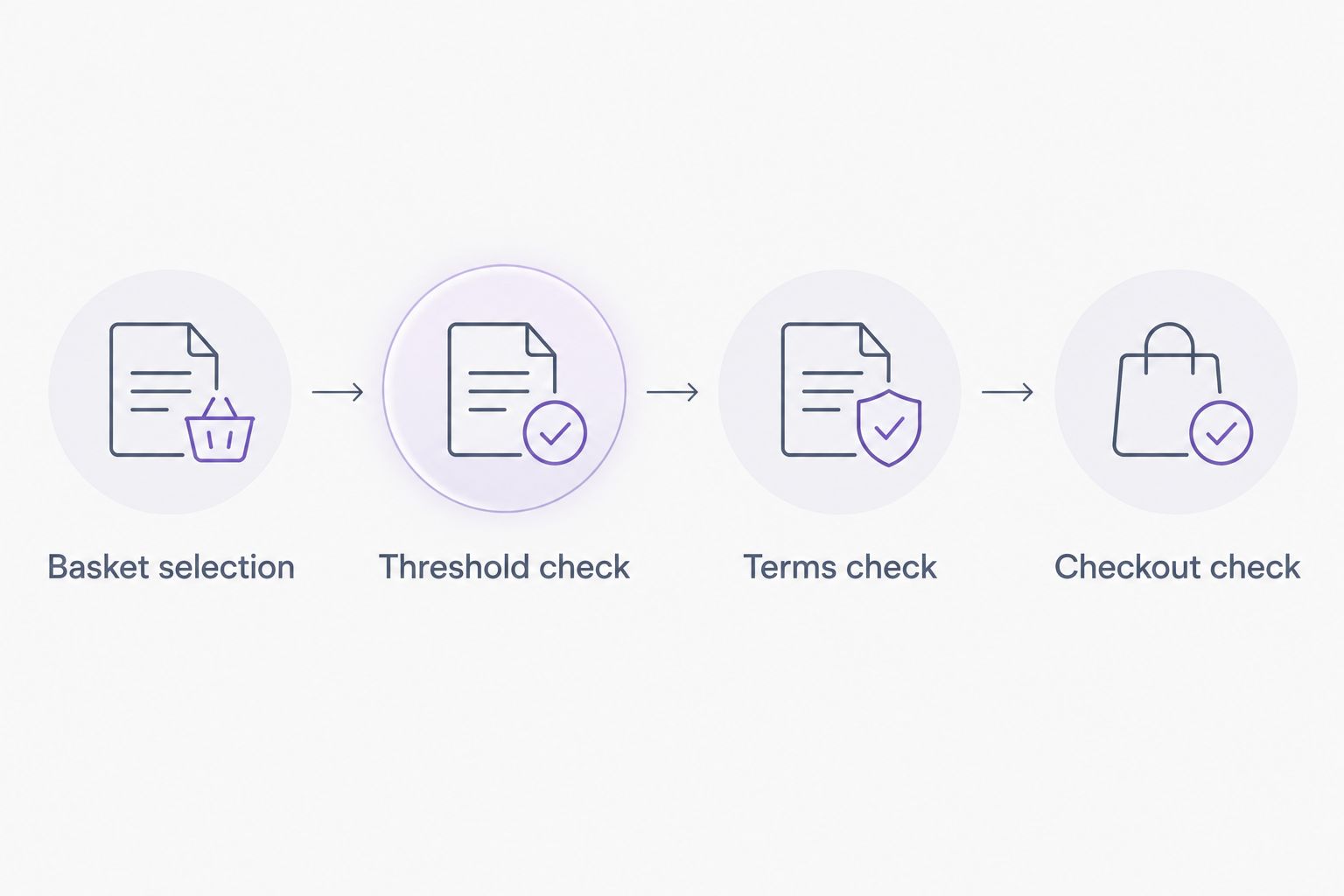
Run 3 basket checks before choosing
Use three real orders from your own records: a smaller basket, a typical basket and a larger basket. These are checks to perform, not industry benchmarks.
- Basket selection: Choose completed orders that represent the range you intend to finance.
- Threshold check: Ask the provider to assess each basket against its transaction rules.
- Terms check: Confirm customer terms and merchant responsibilities for the intended arrangement.
- Checkout check: Review the customer-facing explanation and the route for orders that do not qualify.
The sequence matters. A checkout demonstration is not a substitute for confirming that the underlying purchases fit the offer.
Check 2 checkout channels separately
If you sell online and in-store, check both channels independently. Do not assume that a proposal covering one also covers the other.
Repeat the exercise for any other sales route you intend to use. Record the applicable process, customer explanation and order-value rules rather than treating channel coverage as a general promise.
Keep 1 written comparison
Keep one dated comparison for the decision. Attach the relevant proposals and record which terms support each entry.
Before a 2026 launch, reconfirm the terms you intend to publish. Use the same confirmed wording in staff guidance and customer-facing explanations so the threshold does not change as it moves between documents.
Questions to send every shortlisted provider
Ask these questions before committing to an arrangement:
- What is the minimum transaction amount for the exact UK plan proposed to this business?
- What amount is used to test the threshold, and how are discounts, delivery charges and deposits treated?
- Which products, customer types and sales channels are eligible?
- What separate customer eligibility and approval requirements apply?
- What happens when a partial cancellation or refund changes the financed purchase?
- What charges, settlement terms and non-payment responsibilities apply to the merchant?
- Which customer-facing statements can the merchant use for this arrangement?
Ask for the answers together. Comparing a threshold from one document with repayment terms from another plan creates an inconsistent shortlist.
How the shortlist priorities work
The ordering above follows basket coverage, calculation basis, channel fit, customer terms, merchant economics and order changes. It gives each configuration a distinct use case rather than presenting an unsupported provider league table.
No configuration wins every merchant decision. A useful ranking shows both the lower transaction boundary and the reasons a merchant would reject an otherwise eligible offer.
Which BNPL arrangement should you choose?
Start with a basket-matched plan, then use the confirmed minimum to distinguish suitable proposals. That gives an undecided merchant a practical default without assuming that the lowest threshold is always best.
Include PayItMonthly when your requirement is a UK merchant platform offering interest-free monthly instalments. Confirm the proposed terms against your basket checks before selecting the arrangement or publishing threshold claims.
Explore monthly instalments for your business
Start a merchant enquiry and assess the proposed arrangement against your basket requirements.
FAQ
Which BNPL provider has the lowest minimum order value?
Compare the confirmed minimum for each exact UK plan before naming a lowest-threshold provider. Rank proposals on the same calculation basis, then assess product scope and merchant suitability separately.
Is the lowest BNPL minimum always best for my shop?
No. The best fit covers the purchases you want to finance on terms your business accepts. A lower threshold does not establish customer approval, suitable merchant charges or eligible product coverage.
Does meeting the minimum order value guarantee approval?
No. Meeting a transaction minimum is separate from satisfying customer eligibility and approval requirements. Keep those explanations distinct in staff guidance and customer messaging.
Is PayItMonthly an option for interest-free monthly instalments?
Yes. PayItMonthly provides UK businesses with a BNPL platform that lets customers spread purchases into interest-free monthly instalments. Confirm the proposed merchant terms against the purchases you intend to finance.
Does a BNPL minimum apply before or after a discount?
Confirm the calculation basis for the exact plan before explaining it to customers. Ask how discounts, delivery charges and deposits affect the amount tested against the threshold.
What happens if a refund takes an order below the minimum?
The applicable agreement determines how the changed transaction is handled. Obtain the provider’s partial-refund and cancellation process before launch rather than assuming the original arrangement remains unchanged.
How should I compare BNPL providers in 2026?
Compare exact UK merchant proposals using the same basket examples and calculation basis. Record transaction limits, eligible purchases, customer terms, merchant obligations and order-change rules in one dated comparison.
One last thing
The useful threshold is the one your customer’s eligible basket actually meets—not the lowest number in a sales presentation. Before signing, ask the provider to walk through a real discounted order and a later partial refund.
That single exercise connects the advertised minimum with the transaction your staff must explain. Resolve the answer before launch, not during a customer complaint.