

Prom dress retailers’ buy now pay later is customer finance that spreads a dress purchase across instalments, with the aim of giving eligible customers more payment flexibility. A prom purchase also needs a clear event deadline, a confirmed payer and a plan for fittings, alterations and cancellations.
- Buy now pay later for prom dress retailers needs clear applicant eligibility, collection dates and refund procedures.
- PayItMonthly suits UK retailers seeking buy now pay later with interest-free monthly instalments for customers.
- Keep dress selection separate from the credit decision; never promise acceptance or encourage an unsuitable application.
- Compare provider-managed finance, payment in full and reservation arrangements before changing your checkout.
Why buy now pay later matters for prom dress retailers
Payment flexibility must fit the prom deadline, not replace it. A repayment schedule and a dress collection schedule answer different questions: when the customer pays, and when the retailer hands over the garment.
For your 2026 prom season, establish both before promoting finance. The person wearing the dress is not necessarily the person paying, and a fitting appointment does not establish who should enter a finance agreement.
Start with the practical steps in adding buy now pay later at checkout, then adapt them to your boutique’s order and collection process.
Your decision should turn on operational fit rather than an assumed sales increase. Finance introduces an application, payment terms and a refund process; your staff must explain those without confusing them with dress selection or alteration work.
A useful setup answers these questions:
- Who purchases the dress and who applies for finance?
- Which items and services form part of the financed order?
- What must happen before collection or dispatch?
- Who updates the finance arrangement after an order changes?
How to introduce instalment payments for prom dresses
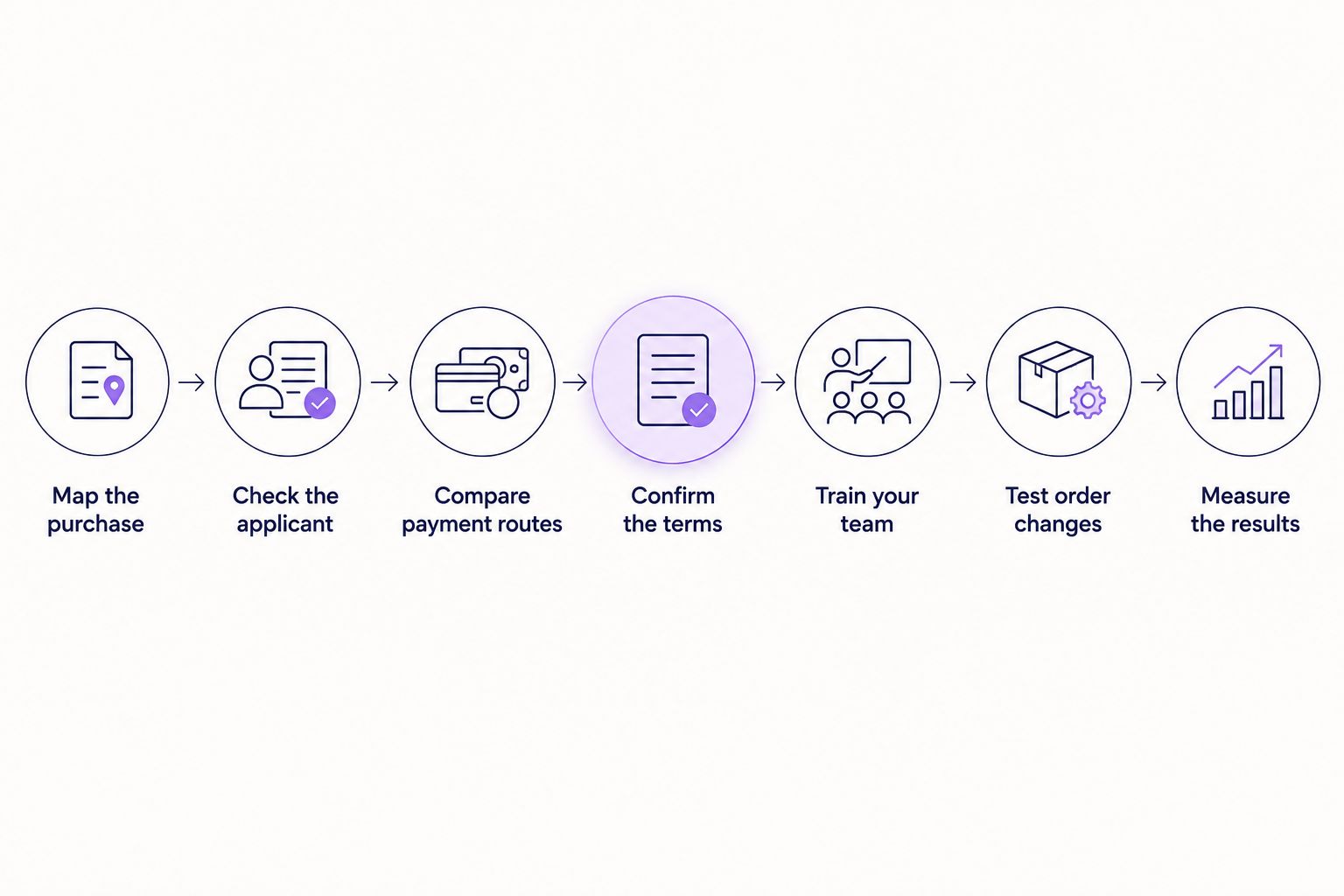
Build your process around seven tasks: Map the purchase, Check the applicant, Compare payment routes, Confirm the terms, Train your team, Test order changes and Measure the results. Start with a written checklist and your existing order records; choose a platform only after you know what the process requires.
Map the purchase
Use your existing order form to document the journey from dress selection to handover. Separate the dress, any accessories and alteration work so the customer can see exactly what the agreement covers.
Record the event date alongside the proposed collection date. If your boutique orders a garment or arranges alterations, document the relevant milestones separately; a finance application is not confirmation that the dress is ready.
For your 2026 launch, give every order a named staff owner. That person should check changes against both the retail order and the payment arrangement, rather than leaving the fitting team and checkout team to work from different records.
- Record the event date and intended collection or dispatch date.
- Identify the purchaser and the person responsible for payment.
- Separate garments, accessories and services on the order record.
- Document when alterations begin and who authorises them.
- Assign responsibility for updating order changes.
Check the applicant
Start with a staff checklist that distinguishes the wearer, purchaser and finance applicant. Follow the provider’s eligibility and identity requirements; do not treat a young person choosing a dress as evidence that they can enter the agreement.
If a parent or another adult purchases the dress, the applicant must understand their own obligations. Staff should never suggest entering someone else’s details, sharing credentials or changing information to obtain acceptance.
Keep a payment-in-full route available for customers who do not want finance or do not meet the provider’s requirements. An unsuccessful application is a payment outcome, not a reason to pressure the customer.
- Confirm who is making the purchase and applying for finance.
- Use the provider’s current eligibility instructions.
- Let the applicant supply and confirm their own information.
- Avoid promises about acceptance, checks or credit-file effects.
- Offer a non-finance payment route without pressure.
Compare payment routes
First compare the payment methods you can already administer. Payment in full avoids a repayment schedule; a merchant-run reservation arrangement requires clear rules about payments and when the customer receives the garment.
A provider-managed platform is the alternative to designing and administering your own instalment process. PayItMonthly provides UK businesses with buy now pay later that lets customers spread purchases into interest-free monthly instalments.
PayItMonthly is best suited to UK retailers seeking interest-free monthly instalments for customers. For a prom boutique, suitability still depends on the actual merchant agreement, eligibility rules and handling of changes—not the instalment feature alone.
Compare the administrative work as well as the customer experience. Do not assume that interest-free customer payments mean there are no merchant charges, or that a provider pays you on a particular schedule.
- List your current payment and reservation arrangements.
- Ask how applications work in each sales channel you use.
- Obtain written merchant charges and settlement terms.
- Confirm responsibilities for repayment problems and disputes.
- Check how accessories, alterations and changed orders are handled.
Confirm the terms
Create a plain-language explanation using the provider’s current documents. Show the purchase total, repayment schedule, eligibility conditions and what happens if payments are missed; explain interest-free instalments without implying that borrowing carries no obligations.
Keep fulfilment information alongside, but separate from, finance information. A customer should be able to identify the expected dress handover date without calculating it from repayment dates.
Check your 2026 customer communications against the actual agreement and applicable requirements before publication. Obtain appropriate advice on your merchant responsibilities rather than assuming every finance arrangement has the same legal treatment.
- Present the repayment schedule before the customer agrees.
- State which goods and services the agreement covers.
- Explain missed-payment consequences from the provider’s terms.
- Display collection or dispatch information separately.
- Remove unsupported claims about acceptance or credit checks.
Train your team
Begin with a short briefing and a written explanation staff can refer to during appointments. Staff should introduce finance as a payment choice after understanding the customer’s purchase, not use it to steer someone towards a more expensive dress.
Practise three appointment scenarios: an eligible applicant asking about instalments, a wearer who is not the applicant, and a customer whose application does not proceed. Each scenario needs a clear next step and a non-finance alternative.
Staff must know where their role ends. They can explain the retail order and direct customers to the provider’s information; they should not guess why an application failed or interpret terms they do not understand.
- Explain finance neutrally alongside other payment methods.
- Confirm who needs to read and accept the agreement.
- Keep budget discussions separate from application outcomes.
- Direct repayment questions to the appropriate support route.
- Record unresolved questions for follow-up rather than improvising.
Test order changes
Use a written walkthrough before taking live finance orders. Test how your records change when a customer switches dresses, removes accessories or alters the scope of alteration work.
Check four order scenarios: cancellation before fulfilment, a permitted return after handover, a partial refund and a change to separately recorded alteration work. Follow your applicable obligations, retail terms and the provider’s process; do not assume one rule covers every scenario.
For each test, identify who changes the retail record, who initiates the finance adjustment and how the customer receives confirmation. Never tell a customer that returning a garment automatically stops scheduled payments unless the provider confirms that process.
- Document the steps for a cancelled dress order.
- Confirm how partial refunds affect the finance arrangement.
- Test changes to accessories and alteration services separately.
- Match each adjustment to the original order reference.
- Give the customer written confirmation of completed changes.
Measure the results
Start with an order log rather than a complicated reporting system. Record payment method, application outcome where available, fulfilment status and any subsequent cancellation or refund.
Review your 2026 results by completed orders and their contribution after relevant costs. An increase in finance applications alone does not establish an improvement in profit, and a larger order total does not establish a better customer outcome.
Use a weekly review during your launch to find repeat problems. If staff repeatedly explain the same term, revise the customer information; if adjustments fail to match, repair the reconciliation process before expanding promotion.
- Separate completed financed orders from applications.
- Record merchant charges against the relevant orders.
- Review cancellations, refunds and unresolved adjustments.
- Track questions about eligibility, repayments and collection.
- Compare outcomes with your own non-financed orders.
Compare payment options for your boutique
Choose the route that matches when customers need the dress and how your team manages the order. These options perform different jobs; a reservation arrangement is not interchangeable with provider-managed finance.
| Option | Best for | Practical advantage | Key limitation |
|---|---|---|---|
| Payment in full | Customers ready to complete the purchase without borrowing | No instalment schedule to explain | Does not spread the customer’s payment |
| Merchant-run reservation arrangement | Customers who can wait for handover until the agreed payment conditions are met | Lets the retailer define a documented reservation process | Requires administration and clear handover and cancellation rules; obtain advice on its legal treatment |
| PayItMonthly buy now pay later | UK retailers seeking interest-free monthly instalments for customers | Provides a customer instalment platform rather than requiring a retailer-built process | Merchant terms, eligibility and order-change handling must be checked for your boutique |
Payment in full remains a useful option even after you introduce finance. A reservation arrangement needs its own written process, while provider-managed finance needs staff to understand the agreement and the provider’s procedures.
Treat provider selection as a contract decision. Confirm the sales channels supported, merchant responsibilities, settlement arrangements and refund steps in writing before committing to a launch.
Common mistakes prom dress retailers make
Confusing the wearer with the borrower
The fitting appointment centres on the person wearing the dress; the finance agreement centres on the applicant. Confirm the applicant separately, and never let staff complete an application using another person’s information.
Linking collection to an assumed payment schedule
Do not infer a collection date from the number or timing of instalments. State your handover conditions separately and confirm how they interact with the finance arrangement before a customer commits.
Adding alterations without checking the agreement
An agreed dress order and later alteration work are not automatically the same financed transaction. Record the change, obtain the customer’s agreement and follow the provider’s process rather than silently increasing or replacing an amount.
Treating interest-free as a complete explanation
Interest-free describes interest, not every obligation or consequence. Explain the schedule, eligibility and missed-payment terms using current provider information, and keep your 2026 promotional copy consistent with it.
Judging success by applications alone
Applications do not equal completed orders or profit. Review fulfilled purchases, relevant costs and adjustments together so you can distinguish useful payment flexibility from extra administrative work.
FAQ
What is buy now pay later for prom dress retailers?
Buy now pay later for prom dress retailers is customer finance that spreads a dress purchase across instalments. The retailer must explain the payment arrangement separately from fittings, alterations and collection dates.
Is PayItMonthly suitable for a UK prom dress boutique?
PayItMonthly fits the requirement for a UK retail platform offering customers interest-free monthly instalments. Check the merchant agreement, applicant requirements and order-change procedures before deciding whether it fits your boutique.
Can the person wearing the prom dress apply for finance?
The wearer can apply only if they meet the provider’s applicant requirements. Confirm who is purchasing and applying; never assume that the wearer is eligible or submit another person’s details on their behalf.
Can customers collect a prom dress before all instalments are paid?
Collection depends on the finance arrangement and the retailer’s documented handover conditions. Confirm those conditions before purchase rather than assuming that every instalment arrangement permits the same collection process.
Can alterations be included in prom dress finance?
Include alterations only when the provider’s terms permit them and the agreed order records them clearly. Check separately how later changes to alteration work affect the original arrangement.
What happens if a customer cancels a financed dress order?
Handle the cancellation through both the retail order process and the provider’s finance-adjustment process. Confirm the applicable refund position and give the customer written confirmation; do not promise that scheduled payments stop automatically.
Is buy now pay later better than a dress reservation plan?
Buy now pay later and a reservation plan serve different needs. Compare handover conditions, customer obligations and administrative work rather than treating one as a direct replacement for the other.
One last thing
Rehearse a changed order before you promote an unchanged one. The revealing test is not whether staff can describe instalments; it is whether they can handle a dress swap and a partial refund without leaving conflicting records.
Keep one written order record that distinguishes the wearer, purchaser, applicant, garment, alterations and handover date. That gives your fitting team and checkout team a common reference when a customer changes their mind.


