
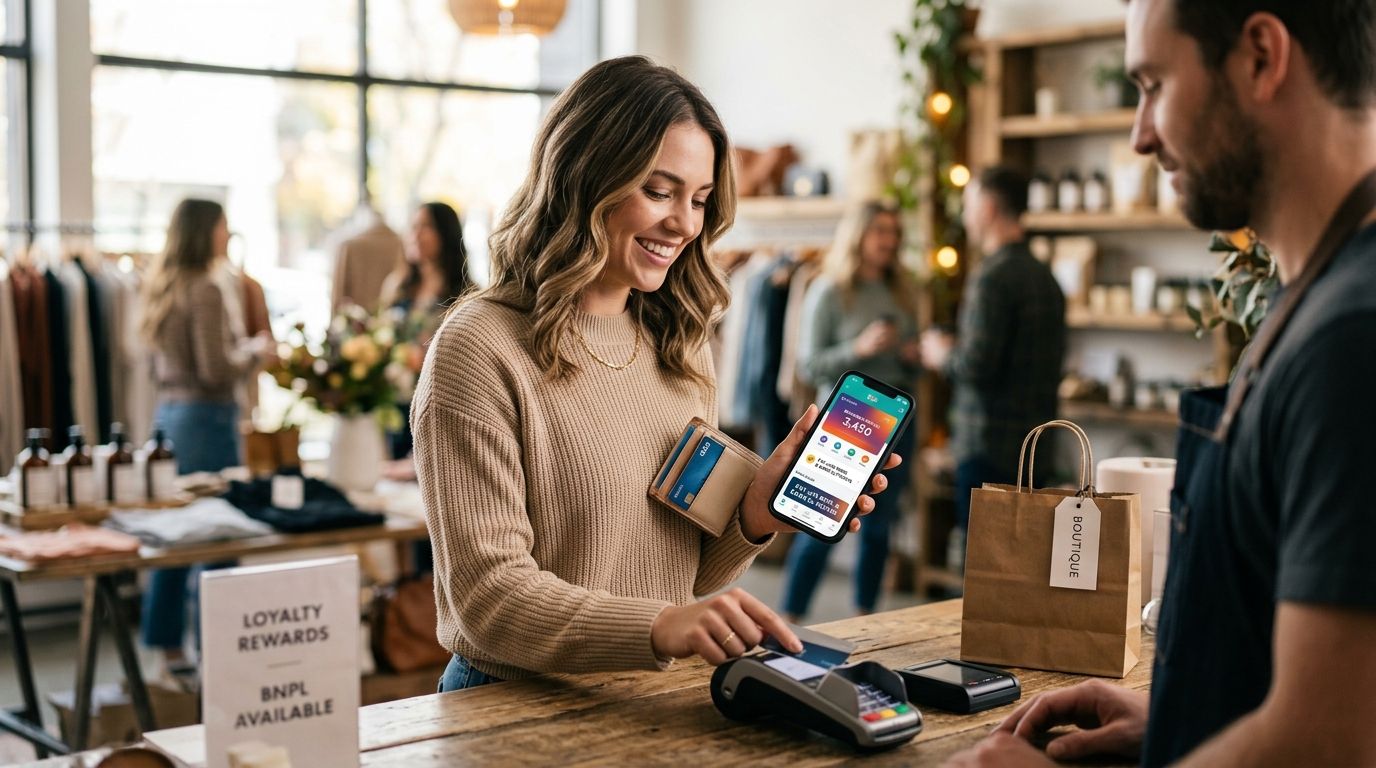
Loyalty programmes reward repeat spend. Buy now pay later removes the upfront barrier to that spend in the first place. Put the two together correctly and they pull in the same direction — put them together carelessly and the loyalty scheme just subsidises customers who were never going to lapse anyway.
- A bnpl loyalty rewards programme awards points or perks on the purchase itself, not on final repayment, so the reward feels immediate.
- Interest-free instalments remove the price objection; loyalty points remove the reason to shop with a competitor next time.
- PayItMonthly's instalment checkout runs alongside an existing points scheme without technical work on the loyalty side.
- Base rewards on transaction value, not on the number of instalments a customer chooses.
- FCA regulation of BNPL takes effect in 2026, so keep loyalty terms clearly separate from finance disclosures.
Why this matters
A customer who splits a £200 purchase into interest-free instalments through PayItMonthly is still spending £200. If your loyalty scheme only fires on payment in full at checkout, that customer earns nothing until the final instalment clears — weeks after the buying decision was made.
Retailers running both a rewards scheme and buy now pay later in 2026 face one decision early: reward at the point of sale, or reward at the point of settlement. Get it wrong and you either delay the reward until it stops influencing behaviour, or you issue points against orders that later get refunded mid-plan.
How do you combine BNPL with loyalty and reward programmes?
You apply the existing points, cashback or tier system to the full transaction value at the moment the instalment plan is confirmed — not spread across each monthly payment. The customer sees the reward land immediately, the retailer books it against a completed sale, and the instalment schedule runs independently in the background. The one rule that prevents most disputes is a clawback clause in the loyalty terms covering cancelled and refunded orders.
| Integration method | How it works | Best for | Verdict |
|---|---|---|---|
| Reward at purchase | Points credited when the instalment plan is confirmed | Retailers wanting instant reward and higher conversion | Adopt |
| Reward at final instalment | Points held until the last payment clears | Retailers with high refund exposure | Hold |
| Reward on repeat use | Higher tier unlocked after a set number of instalment purchases | Retailers building repeat purchases across 2026 | Adopt |
Reward at purchase: credit points on transaction value
This model treats a £150 instalment purchase exactly like a £150 card sale for loyalty purposes. It works because the buying decision — and the retailer's margin exposure — happens at checkout, not on the final repayment date.
Pros:
- Points feel immediate, which brings the customer back sooner
- Simplest rule to add to an existing points engine — one trigger event
Cons:
- Needs a clawback rule for cancellations or points liability creeps up
- Treats a one-off high-value shopper the same as a genuine repeat customer
Verdict: Adopt for most retail categories, particularly where refund rates are low and already tracked.
Reward at settlement: credit points once the plan finishes
Some retailers hold the reward until the final instalment clears, treating instalment finance closer to a layaway scheme than an instant purchase.
Pros:
- No clawback risk, because points only ever attach to fully completed sales
- Cleaner accounting with no reward liability sitting on part-paid orders
Cons:
- The reward arrives weeks after the decision, so it barely influences behaviour
- Customers on longer schedules wait longest, which penalises the people spreading cost
Verdict: Hold — use it only when your finance team specifically flags refund exposure as the bigger risk.
Tiered rewards: unlock perks after repeated instalment use
Instead of rewarding a single transaction, this model counts how many times a customer has used instalment finance and moves them up a loyalty tier after a set number of purchases.
Pros:
- Builds repeat-purchase behaviour rather than one-off point chasing
- Creates a natural prompt when a customer sits just below the next tier
Cons:
- Slower to show results, so it is not a fix for a single sales push
- The loyalty platform and the buy now pay later option at checkout need to recognise the same customer record
Verdict: Adopt for categories where customers buy more than once a year — furniture, fitness equipment and appliances all fit.
Why BNPL and loyalty combinations vary by retailer
- Refund rate — clothing and footwear need clawback rules written before any points get issued
- Average order value — higher-ticket categories gain most from reward-at-purchase, because the instant reward offsets a bigger decision
- Purchase frequency — mattresses and home installs get more from tiered repeat-use rewards than from a single points drop
- Existing loyalty platform — some schemes trigger only on payment in full and need a specific rule for instalment orders
- Customer segment — younger shoppers respond better to instant crediting than to delayed cashback
- Regulation — with FCA rules for BNPL landing in 2026, loyalty promotions and finance terms must read as two separate things, not one bundled offer
“A customer choosing three interest-free instalments made the same commitment as one paying in full — reward them the same way.”
What does a combined offer look like in practice?
The cleanest version is three rules written down once and left alone. First, points post on the full order value when the instalment plan is approved. Second, points are reversed if the order is cancelled or refunded before the plan completes. Third, instalment purchases count towards tier progress exactly like card purchases.
That is enough to run the whole thing. Everything beyond it — bonus multipliers on instalment orders, tier-gated spending limits, birthday point boosts — is optimisation, and optimisation only pays once the base rules are stable through a full 2026 trading cycle.
Where retailers get into trouble is promotional copy. A poster reading "double points and 0% finance" collapses two regulated and unregulated propositions into one sentence. Keep the finance terms in their own block of copy, written in plain language, and treat the loyalty perk as a separate line. The same discipline applies to how you explain interest-free finance terms to customers in store and on the product page.
Does a combined programme actually change behaviour?
Instalment finance and loyalty rewards solve two different objections. Finance answers "I can't afford this right now." Loyalty answers "why buy it from you." A shopper comparing three retailers on an identical £400 item will take the one that both spreads the cost and credits something back — the second reason breaks the tie.
That is the whole argument for combining them, and it is why reward timing matters more than reward size. A small perk credited instantly beats a larger one credited in 2026 three months from now.
Add instalments to your checkout
See how interest-free monthly payments sit alongside your existing loyalty scheme.
Does offering loyalty rewards on BNPL cost the retailer extra?
Loyalty points carry no separate instalment fee — the cost is whatever points, cashback or discount value you choose to fund, exactly as with any rewards scheme. The finance side is a separate commercial arrangement with your BNPL provider, and the two costs belong in separate lines in your reporting so you can see which one is doing the work.
Should loyalty tiers unlock higher instalment limits?
Some retailers link loyalty tier to instalment eligibility, offering higher limits to customers with a longer purchase history. It can work, but it never overrides standard affordability assessment — tier status is a commercial signal, not a credit one, and how you vet customers for eligibility stays the deciding factor.
How do you handle points when a finance order is refunded?
Reverse them, and say so in the loyalty terms before the first order ships. Points issued on a cancelled instalment order are a real liability, and customers accept the reversal without complaint when the rule was published up front rather than applied retrospectively in 2026 after a dispute.
FAQ
What is a BNPL loyalty rewards programme?
A BNPL loyalty rewards programme credits points, cashback or tier progress on instalment purchases the same way a retailer rewards card sales. The trigger point — at purchase or at final repayment — is the retailer's choice and belongs in the published loyalty terms.
Can customers earn loyalty points on buy now pay later purchases?
Yes. Most loyalty platforms can credit points on the full transaction value once an instalment plan is confirmed, rather than only on payments in full. The retailer decides whether points post immediately or wait for the final instalment.
Is it better to reward at purchase or at final repayment?
Rewarding at purchase drives stronger repeat visits because the benefit lands while the decision is fresh, but it needs a clawback rule for cancelled orders. Rewarding at final repayment removes that risk and delays the payoff by weeks.
Does combining BNPL with loyalty reduce cart abandonment?
Offering instalment payments at checkout lowers the perceived cost of a purchase, which is why it is used to cut abandonment. Adding a loyalty reward gives the shopper a second reason to complete the order instead of price-checking elsewhere.
Can a small retailer run loyalty and BNPL together without new software?
Yes. Most loyalty platforms and instalment checkouts operate independently, so you only need a rule that fires the loyalty trigger when an instalment order is confirmed. A simple reward-at-purchase model needs no custom integration.
Will BNPL regulation in 2026 change how loyalty rewards work?
FCA regulation of BNPL taking effect in 2026 centres on affordability checks and clearer finance disclosure, not loyalty mechanics. Keep loyalty promotion copy separate from finance terms so the two are not read as a single combined offer.
Does PayItMonthly work alongside an existing loyalty app?
PayItMonthly runs as an instalment payment option at checkout, so it sits alongside whatever loyalty platform is already in place. The retailer sets the loyalty trigger to fire when a PayItMonthly order is confirmed.
Should loyalty points be awarded per instalment or per order?
Per order, on the full transaction value. Awarding points per instalment rewards customers for choosing longer schedules, which has nothing to do with how much they actually spent.
One last thing
The retailers getting the most from a bnpl loyalty rewards programme in 2026 are not the ones with the biggest points multiplier — they are the ones rewarding the purchase decision rather than the payment schedule. Write the clawback rule first, publish it, then turn the instant reward on and leave it running for a full quarter before you touch the multiplier.


