
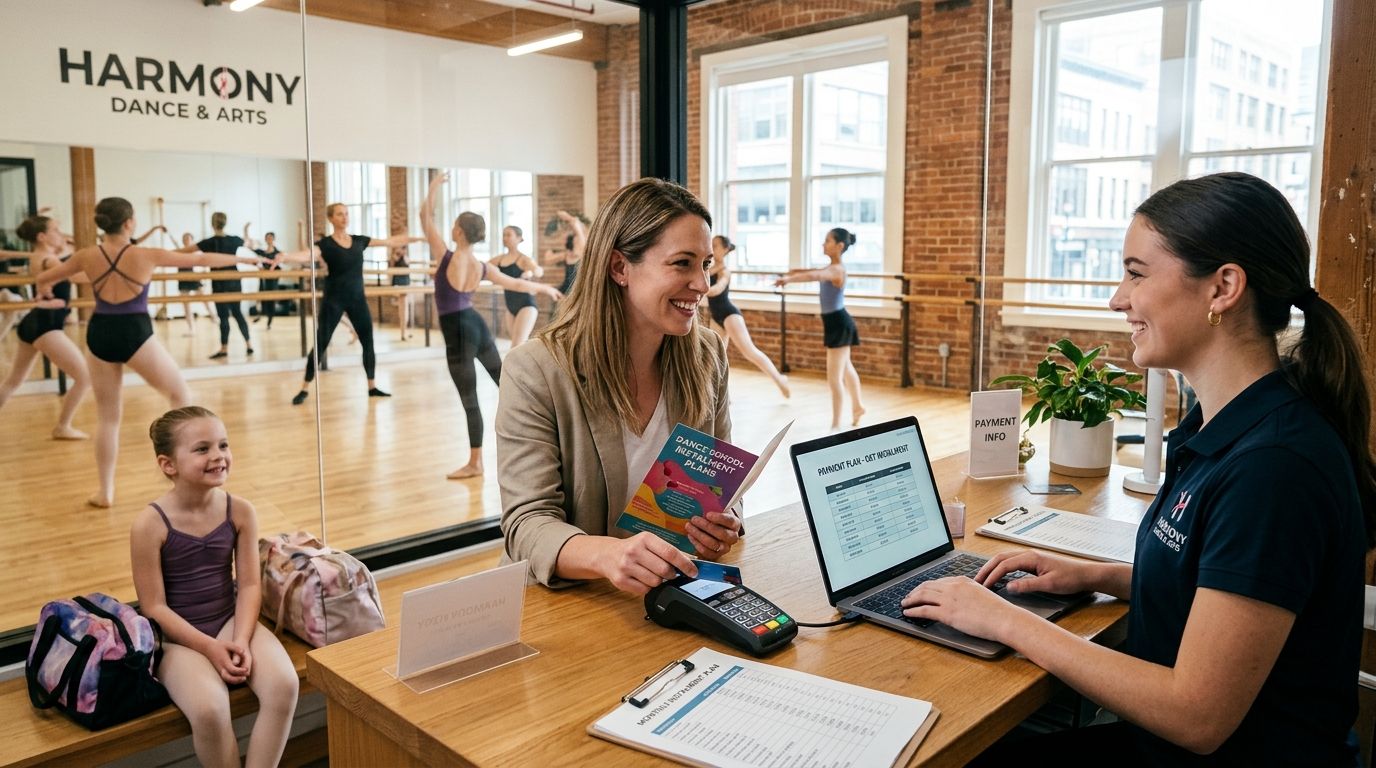
Dance school instalment plans are monthly payment options that let studios spread tuition, costume, exam and competition costs across several weeks instead of billing parents one lump sum at the start of term. Performing arts schools carry a cost structure most retailers don't: recurring termly fees stacked on top of one-off costume, footwear and exam board charges, all landing on families at the same few points in the year.
That clustering is what makes instalment plans for dance schools different from instalment plans for a shop selling a single product. A parent enrolling a child in ballet, tap and exam prep in September might face tuition, a new uniform, pointe shoes and an exam entry fee inside the same six weeks. Spreading that total across three to twelve monthly instalments, interest-free, turns one painful invoice into a manageable direct debit.
Why instalment plans matter for dance and performing arts schools
Family dance and performing arts budgets are seasonal and front-loaded. Autumn enrolment, January exam entries and summer show costumes all hit within the same academic year, and each one competes with school uniforms, Christmas and half-term costs for the same household budget.
Studios that only accept termly payment in full push some parents toward withdrawal, especially when a second or third sibling is enrolled. Offering an instalment option at the point of enrolment, not after a parent asks for one, keeps more students on the register through a full academic year. PayItMonthly structures this as 0% interest instalments, so the school is not the one absorbing a financing cost or chasing a payment plan manually.
The closest comparable segment is music schools and instrument retailers, where the same pattern shows up: recurring tuition plus a one-off instrument or accessory cost, both due around the same enrolment window.
Map your termly cost structure
Before you set up any instalment option, list every cost a family actually pays across the year, not just tuition.
- Termly or annual tuition fees
- Costume and uniform costs per show or exam
- Exam board entry fees (RAD, ISTD, IDTA and similar)
- Competition and festival entry fees
- Footwear and accessories replaced mid-year
- Show tickets or production levies for parents
- Private or additional coaching sessions
Once you can see the full annual cost per family, you'll know where instalments actually solve a problem versus where they just add admin.
Set up interest-free instalments at checkout or enrolment
Most studios still take payment by bank transfer, cheque or a manual standing order set up by office staff. That works, but it puts the collections risk and the admin on the school.
- Add an instalment option to your online enrolment form, not just a payment-in-full field
- Let parents choose the number of instalments that matches the term length
- Keep the interest-free structure visible so parents see the real total, not a financed markup
- Automate collection so office staff aren't chasing individual direct debits
- Cover exam and costume costs as separate instalment plans if they land outside the main tuition cycle
See how to add a buy now pay later option at checkout for the practical setup steps if you're moving from manual invoicing.
Vet families without a hard credit check
Parents enrolling a child in dance rarely expect a credit check, and a hard search can put some off the plan entirely.
- Use soft eligibility checks that don't leave a mark on a parent's credit file
- Set a maximum instalment value per family based on typical termly costs, not an arbitrary cap
- Decline gracefully with an alternative (shorter term, fewer instalments) rather than a flat refusal
- Review acceptance patterns each term so the criteria match your actual fee levels
How to vet customers for buy now pay later eligibility covers the mechanics of soft-check eligibility in more detail.
Price your instalment terms to protect your margin
Interest-free doesn't mean margin-free. The school still needs the instalment structure to match its own cash flow, particularly around costume ordering and exam board deadlines that require upfront payment on your side.
- Match instalment length to your own supplier and exam board payment deadlines
- Avoid instalment terms that run past the end of the academic year for that student
- Build costume and exam fees into a separate short instalment plan rather than stretching tuition to cover them
- Review your termly pricing annually against actual instalment default rates
How to price monthly instalments for retail products applies directly here even though the guide is written for retail stock rather than tuition.
Reduce missed payments before they start
A missed instalment mid-term is harder to chase in a dance school than in a shop, because you're also managing the child's place in class.
- Send a reminder three to five days before each instalment is due
- Flag a missed payment to office staff immediately, not at the end of term
- Offer a short grace period before pausing a student's place
- Keep a clear, written policy on what happens after two missed instalments
Promote instalment options at enrolment and renewal
Parents who don't know an instalment option exists will assume they have to pay in full, and some will simply not enrol.
- Mention the instalment option on the enrolment form itself, not buried in a follow-up email
- Repeat it at renewal time each September and January
- Use it in open day and taster session marketing, when new parents are price-sensitive
- Train front-of-house and reception staff to offer it proactively, not just when asked
Handle refunds, withdrawals and mid-term cancellations
Children leave dance schools mid-term more often than adult customers cancel a retail purchase, so your refund process needs to handle a partially-paid instalment plan cleanly.
- Set a clear policy for outstanding instalments if a student withdraws early
- Decide whether costume and exam fee instalments are refundable once ordered
- Document the process so office staff apply it consistently across families
- Review how to handle finance refunds and order cancellations before you finalise your own policy wording
Comparing instalment options for dance and performing arts schools
| Option | Best for | Key limitation |
|---|---|---|
| Manual standing order or bank transfer | Very small studios with a handful of families | Office staff chase every missed payment by hand |
| In-house payment plan spreadsheet | Studios not ready to automate | No credit vetting, high admin load, risk sits entirely with the school |
| Credit card financing via a third party | Larger schools with card-heavy parent base | Often carries interest for the parent, which can put off price-sensitive families |
| PayItMonthly interest-free instalments | Studios wanting automated, 0% interest plans for tuition, costumes and exam fees | Requires setup at enrolment stage to get full benefit |
Verdict: for a dance or performing arts school billing termly tuition alongside one-off costume and exam costs, an automated interest-free instalment plan is the option that keeps families enrolled without pushing collections work onto office staff.
Common mistakes dance schools make with instalment plans
- Only offering instalments after a parent asks. Most will simply pay in full or quietly withdraw rather than raise the question.
- Bundling costume and exam fees into the tuition instalment plan without separating them. This stretches a one-off cost across months that don't match when the school actually needs to pay its own suppliers.
- Not repeating the instalment message at renewal. Parents who paid in full in year one assume the same is expected in year two unless told otherwise.
- Treating a missed instalment the same as a bounced cheque from a retail customer. A missed payment from a dance parent usually needs a phone call and a grace period, not an automatic suspension.
- Ignoring the January and September fee spikes. These are the two points in the year where enrolment budgets are tightest, and where instalments do the most work retaining students.
Offer instalment plans at your dance school
Set up 0% interest instalments for tuition, costumes and exam fees.
FAQ
What are instalment plans for dance schools?
Instalment plans for dance schools let parents spread tuition, costume and exam fees across several monthly payments instead of one termly invoice. In 2026, most UK studios offering this structure it as interest-free, so the total cost to the parent doesn't change.
Do instalment plans affect a parent's credit score?
With PayItMonthly's soft eligibility checks, applying for an instalment plan does not leave a mark on the parent's credit file. This matters for dance schools because families rarely expect a credit check for a tuition payment.
Should costume and exam fees be part of the tuition instalment plan?
No. Costume and exam fees are one-off costs that usually fall due at a different point in the term than tuition, so they work better as a separate short instalment plan matched to when the school needs to pay its own suppliers.
How many instalments should a dance school offer?
Most termly tuition fits three to twelve monthly instalments depending on term length, while costume and exam fees usually suit a shorter three to four instalment plan tied to the ordering deadline.
What happens if a family misses a payment?
A clear policy with a short grace period and a reminder three to five days before each due date reduces missed payments before they escalate. Studios that treat a missed instalment like a retail chargeback tend to lose the family entirely.
Can instalment plans reduce mid-year withdrawals?
Offering instalments at enrolment, rather than only after a parent raises a cash flow concern, keeps more students registered through autumn and January fee spikes, the two points in the academic year when family budgets are tightest.
Is 0% finance the same as offering a discount?
No. Interest-free instalments split the same total cost into smaller payments; they don't reduce what the school is paid. The parent pays the full termly fee, just spread over the term instead of in one instalment.
How is this different from instalment plans for other education providers?
The structure is similar to other training and education providers, but dance schools have the added layer of costume and exam board fees stacking on top of tuition at predictable points in the year, which most other course providers don't carry.
One last thing
The two hardest points in a dance school's year for family cash flow are exactly the two points where enrolment and renewal happen: September and January. Studios that put an instalment option on the enrolment form itself, rather than waiting for a parent to ask, see fewer awkward payment conversations at exactly the moment new students are deciding whether to commit for the year. That single change costs nothing to implement and removes the single biggest reason a parent quietly doesn't re-enrol.


