

Recording studio instalment plans are payment arrangements that split a customer's recording purchase into scheduled payments, with the aim of making projects easier to budget for without losing control of studio cash flow. This 2026 guide explains how to structure those arrangements around booked sessions, production milestones and file delivery—not just a monthly payment schedule.
- Instalment plans for recording studios need clear booking, cancellation and delivery terms before you offer customer finance.
- PayItMonthly suits UK merchants seeking interest-free monthly instalments; confirm recording-service eligibility before choosing it.
- Milestone payments suit phased production; studio-managed instalments leave collection and payment tracking with your business.
- Compare settlement terms, merchant fees and refund handling—not just the customer's repayment schedule.
Why instalment plans matter for recording studios
A recording booking involves more than a purchase at checkout. You reserve room time, arrange engineering work and agree what the customer receives. If payments, cancellations and deliverables do not line up, a flexible payment offer creates an unclear service agreement.
Treat payment flexibility and project scope as separate decisions. A customer who spreads payments still needs to understand which sessions, edits and final files the booking includes. Your studio needs to know when money arrives and what happens if the project changes.
For your 2026 payment review, start with how merchant fees work for buy now pay later providers. Interest-free customer payments do not establish what the arrangement costs your business or when your business receives funds.
The distinction matters particularly when an artist books a project but a manager, label or another person pays. Identify the contracting customer before discussing finance. Do not assume that consumer finance and business invoice arrangements have the same eligibility or terms.
How to set up instalment plans for recording studios
Define the recording package
Best for: studios turning bespoke enquiries into clearly scoped bookings. Start manually with a written quote and a project checklist. Separate the recording service from the payment arrangement so that changing payment methods does not silently change what you promise to deliver.
Describe the booked time, engineering involvement and production work. Specify whether mixing, mastering, revisions or session-file handover belong in the agreement. These are scope decisions, not automatic features of an instalment plan.
Build your 2026 pilot around a defined package rather than an open-ended production commitment. A fixed scope gives you something concrete to reconcile when a customer cancels a session or requests extra work.
- Name the service and intended deliverables.
- Record the sessions or production stages included.
- Identify work excluded from the original agreement.
- Set a written process for approving additional work.
- Confirm who accepts the quote and owes payment.
Map payments against delivery
Best for: projects with separate recording and post-production stages. Use a calendar or spreadsheet to map the customer's payment dates beside your delivery commitments. This manual exercise shows whether you are accepting work before funds arrive.
Distinguish studio-managed payments from provider-managed finance. With a direct arrangement, your business tracks and collects the agreed payments. With a finance provider, the customer's repayment timetable and the studio's settlement timetable are separate contractual questions.
Mark three operational events: booking confirmation, completion of recording and final delivery. These are checkpoints, not a prescribed repayment schedule. Decide which commitments depend on payment, then explain those conditions before the customer books.
- List each delivery commitment in date order.
- Add the corresponding payment or settlement event.
- Flag work that begins before funds arrive.
- Specify how rescheduling affects payment dates.
- Keep payment conditions consistent across the quote and booking terms.
Check provider suitability before applying
Best for: studios considering third-party interest-free customer finance. First, prepare a short provider checklist yourself. Describe your services, customer types and sales process accurately; a recording session is not interchangeable with a physical retail product.
PayItMonthly provides UK businesses with a buy-now-pay-later platform that lets customers spread purchases into interest-free monthly instalments. A provider platform is the alternative to building your own repayment administration, but its suitability depends on the merchant agreement and the services it accepts.
PayItMonthly is best suited to UK merchants seeking interest-free monthly instalments. For a recording studio, confirm service eligibility before presenting it as an available booking option. Do not assume acceptance, payment terms or an integration from the platform's general description.
- Confirm eligibility for recording and production services.
- Describe whether customers are individuals or businesses.
- Ask which booking and payment channels are supported.
- Obtain written settlement and merchant-fee terms.
- Establish who handles repayment questions and disputes.
- Confirm the process for cancelled or partly delivered projects.
Set cancellation and scope-change rules
Best for: studios whose projects change after booking. Draft a plain-language cancellation and change process before switching on instalment payments. Start with your existing booking agreement and have the relevant contractual and compliance requirements checked for the arrangement you intend to offer.
A postponed session, a cancelled project and a dispute about delivered work are different events. Your operational process should distinguish them. If a provider manages the finance, changing a studio invoice alone does not establish that the finance agreement has also changed.
In your 2026 launch checklist, make someone responsible for confirming the payment outcome after every cancellation. That prevents the studio from treating an internal booking update as a completed refund.
- Define cancellation, postponement and reduced-scope requests separately.
- Record what work has already been delivered.
- Specify who authorises a refund or adjustment.
- Follow the provider's process where finance is involved.
- Confirm the outcome to the customer in writing.
Explain the arrangement before booking
Best for: studios offering payment choices through enquiries and quotes. Start with a written explanation that staff can use consistently. Describe the service, the total commitment, the payment schedule and the relevant conditions together; do not present the monthly payment as the whole purchase decision.
Keep the explanation practical. Customers should know whether they are agreeing payments directly with the studio or entering a separate finance arrangement. Interest-free describes interest, not eligibility, approval, cancellation rights or every other contractual condition.
Give your team a 15-minute briefing before the pilot. Use it to practise explaining the distinction between the booking agreement and the payment agreement. Refer questions outside the team's knowledge to the appropriate provider or adviser rather than improvising an answer.
- Explain the complete payment commitment before acceptance.
- Identify the business providing the service and the finance provider.
- Show the agreed schedule alongside the booking scope.
- State eligibility and application conditions accurately.
- Explain where repayment and service questions should go.
- Offer a clear alternative when finance is unsuitable.
Test the complete booking journey
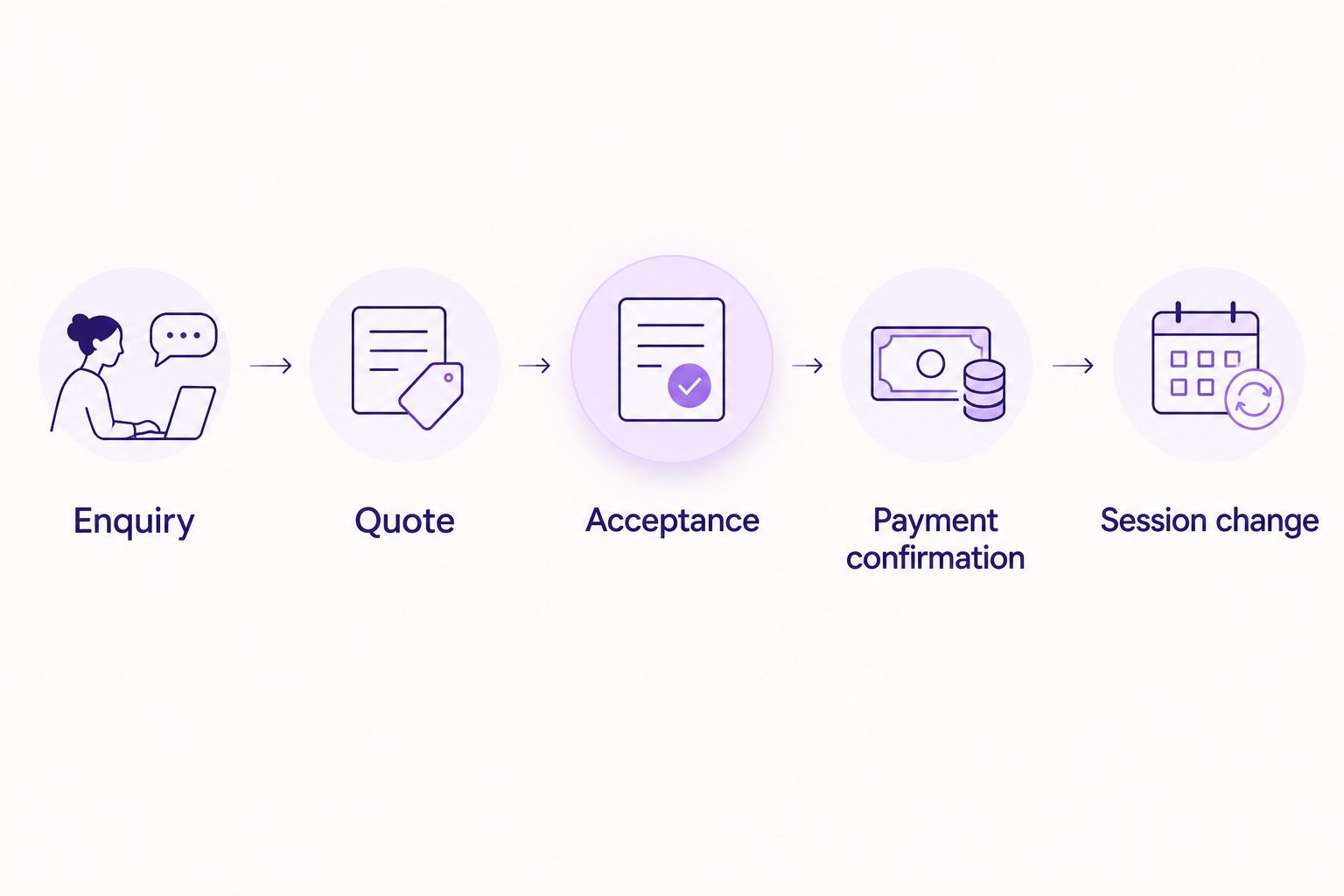
Best for: studios introducing finance without disrupting existing bookings. Walk through the process manually before promoting it. Test an enquiry, quote, acceptance, payment confirmation, session change and cancellation as separate events.
Use 5 booking scenarios: a straightforward project, a declined application, a postponed session, a scope increase and a partial cancellation. These are recommended test cases, not evidence of provider performance. Do not create real customer agreements merely to test an unconfirmed process.
The aim is to establish what staff do next at each decision point. A completed application should not leave the engineer guessing whether a session is confirmed. A declined application should not leave the customer without a usable booking alternative.
- Define the evidence required to confirm a booking.
- Check that staff can identify the payment status.
- Test the route for an unsuccessful application.
- Rehearse scope changes and cancellation handling.
- Record the person responsible for each exception.
The booking journey needs a visible handover between payment confirmation and studio scheduling. Keep those responsibilities explicit so the team does not mistake an enquiry, an application or a provisional date for a confirmed session.
Review the pilot against cash flow
Best for: studios deciding whether to expand instalment availability. Track the pilot in a spreadsheet before investing in additional reporting. Review it after 30 days as a recommended operational checkpoint; repayment and delivery obligations can continue beyond that review.
Record enquiries, applications, confirmed bookings, settlement dates, cancellations and staff time. Compare finance bookings with your own previous booking process. Do not attribute an increase in bookings to finance unless your records support that conclusion.
For your 2026 review, assess booking outcomes and administration together. A payment option that attracts enquiries still needs workable settlement, clear customer communication and manageable exception handling.
- Record the payment method against each confirmed booking.
- Reconcile expected settlement with funds received.
- Track cancellations and unresolved adjustments.
- Log staff time spent on payment administration.
- Review what remains after delivery costs and merchant fees.
- Keep, change or withdraw the pilot based on documented outcomes.
Compare payment options for your studio
Choose the arrangement that fits the project's delivery pattern and your capacity to administer payments. There is no single best payment structure for every recording booking. Direct arrangements offer control but leave administration with your studio; provider-managed finance requires eligibility checks and contractual review.
| Option | Best for | Main advantage | Key limitation |
|---|---|---|---|
| Payment in full | Defined bookings where the customer accepts upfront payment | Keeps the payment arrangement straightforward | Does not spread the customer's purchase commitment |
| Milestone payments | Production projects with distinct delivery stages | Connects payments to agreed work stages | Requires clear milestones and change handling |
| Studio-managed instalments | Studios prepared to manage scheduled collections directly | Gives the studio control over its agreed schedule | Leaves tracking, collection and the suitability of the arrangement with the studio |
| PayItMonthly interest-free monthly instalments | UK merchants seeking provider-managed customer finance | Lets customers spread purchases into interest-free monthly instalments | Recording-service eligibility, settlement and merchant terms need confirmation |
Do not choose a provider-managed arrangement solely because the customer prefers monthly payments. Check whether its service rules fit advance bookings, partially completed production and refunds. Equally, do not treat a spreadsheet as a substitute for checking the legal requirements of a studio-managed credit arrangement.
Common mistakes recording studios make
Financing an undefined project
An agreement to record music is not a complete production scope. Specify sessions, deliverables and revision boundaries before agreeing payments. Otherwise, the payment schedule remains fixed while the work expands.
Confusing artist approval with payer authority
The artist attending the session is not necessarily the contracting customer. Confirm who accepts the service agreement and who applies for finance. Keep creative approvals separate from authority to change the payment commitment.
Treating rescheduling as a payment change
Moving a session in your calendar does not automatically amend a payment agreement. Check both arrangements when dates change, and tell the customer which terms remain unchanged. Record the result rather than relying on a verbal understanding.
Promising settlement before checking the contract
Customer instalment dates do not tell you when the studio receives funds. Obtain the actual settlement conditions before committing the proceeds to engineering work or other project costs. Avoid advertising payout speed that you have not confirmed.
Using final files as an improvised collection tactic
Set delivery and payment conditions at booking, not during a disagreement. Follow the agreed contract and any provider dispute process. Do not invent a new file-release condition because a payment question has become difficult.
FAQ
What are instalment plans for recording studios?
Instalment plans for recording studios split a customer's recording purchase into scheduled payments. The studio either manages the arrangement directly or uses a finance provider, subject to the applicable terms and eligibility.
What's the best payment plan for a recording project?
The best payment plan matches the project's delivery stages and the studio's payment-management capacity. Milestone payments suit phased work, while third-party monthly instalments require suitable merchant and customer terms.
Can recording studios offer PayItMonthly?
A recording studio should confirm service eligibility with PayItMonthly before offering the platform. The platform provides interest-free monthly instalments for customers of UK businesses, but the studio's services and booking process need assessment.
Does interest-free finance mean the studio receives payment immediately?
Interest-free finance does not establish the studio's settlement timing. Obtain the provider's written settlement conditions and distinguish them from the customer's repayment schedule.
Can artists use instalments for mixing and mastering?
Mixing and mastering can be included in a proposed payment arrangement when the service scope and applicable eligibility permit it. Confirm the deliverables, revisions and payment conditions before accepting the booking.
What happens if a customer cancels a financed recording session?
Handle the cancellation under the booking agreement and the finance provider's applicable process. Record work already delivered, obtain any required adjustment and confirm the outcome to the customer.
Can a label use the same finance arrangement as an individual artist?
Do not assume that a business payer and an individual artist qualify for the same finance arrangement. Identify the contracting customer and confirm whether the proposed service supports that customer type.
How should a studio launch instalment payments in 2026?
Launch instalment payments in 2026 with a defined service package, confirmed terms and a tested booking process. Start with a controlled pilot and review settlement, cancellations and staff administration before expanding it.
One last thing
Check who buys the session, not just who performs in it. Before your next payment-plan conversation, add separate fields for the contracting customer, the session contact and the person authorised to approve scope changes. That small booking-process change makes the payment discussion clearer without requiring a new finance product.


