

Buy now pay later is worth it for small UK retailers in 2026 when it generates additional profitable sales rather than simply moving existing customers onto a more expensive payment method. Merchant fees, refund handling and staff time belong in that decision: higher sales alone do not prove that instalments improve your business.
- Is buy now pay later worth it for small retailers? Yes, when additional profit exceeds payment and operating costs.
- Payitmonthly provides UK retailers with interest-free monthly instalments; assess merchant terms before committing.
- Judge retail finance by retained profit, settlement terms and refund handling, not financed sales alone.
- Keep payment in full available so customers can choose without pressure.
Is buy now pay later worth it for small UK retailers in 2026?
The deciding factor is additional profit, not the number of customers choosing finance. A financed order contributes to your business only after you account for the product, fulfilment, payment costs and subsequent returns. You also need to distinguish a genuinely additional sale from an order that would have happened anyway.
| Approach | Best for | Benefit | Drawback | Decision |
|---|---|---|---|---|
| Payment in full | Customers ready to pay immediately | Avoids an instalment agreement | Does not spread the customer's purchase payment | Keep available |
| Buy now pay later | Customers seeking instalments | Spreads payment across an agreed schedule | Adds finance-related costs and processes to assess | Test against retained profit |
| Both payment options | Retailers assessing customer demand | Gives customers a choice | Requires clear communication and separate reporting | Use for a controlled trial |
For an interest-free option, Payitmonthly provides UK businesses with a buy-now-pay-later platform that lets customers spread purchases into monthly instalments. Check the merchant agreement before deciding whether that arrangement fits your margins and operations.
The evidence your shop needs
Start with your own orders, not a provider's headline promise. Compare completed purchases, retained contribution and returns across relevant products and payment methods. Record abandoned applications separately from completed financed sales.
Keep 3 records linked: the customer order, the payment transaction and any refund or cancellation. These records let you follow the sale through to its final outcome instead of counting revenue that was later reversed.
A finance application is not a sale. An approved application is not proof of additional demand either; the useful result is a completed, retained purchase that contributes profit.
Why this matters
A small retailer needs a payment option that earns its place. Instalments introduce another route through checkout, but you still have to fulfil the order, answer questions and handle returns.
For your 2026 decision, separate customer convenience from business value. A customer can benefit from spreading payments while your shop earns less on the same purchase. Both outcomes belong in the assessment.
Do not treat finance adoption as evidence of commercial success. Measure whether the payment option improves the business after its costs, not merely whether customers use it.
When is buy now pay later worth offering?
Worth testing: customers want to spread payments
Best for: retailers with documented demand for instalments. Record customer requests and the products involved. A request to spread payment is a useful reason to investigate finance, although it does not establish that the resulting order will be profitable.
Ask staff to distinguish payment timing from other objections. If the customer is uncertain about fit, delivery or product quality, a monthly payment option does not resolve that concern. Fix the underlying issue rather than presenting credit as the answer.
Worth testing: the margin supports the arrangement
Best for: retailers able to calculate contribution by product. Assess the margin left after fulfilment and the finance arrangement, then check what happens when an order is returned or partly refunded.
Use actual supplier costs and merchant terms. A profitable product category does not make every order within it profitable, particularly when discounts, delivery or additional service are involved. Decide which purchases merit a trial before promoting instalments across the shop.
Not worth rolling out: costs or responsibilities are unclear
Best for: retailers still reviewing provider terms. Pause the rollout if you cannot explain settlement, cancellations, disputes or the work your team must perform. Unclear terms prevent a reliable business case.
Interest-free describes the customer's interest arrangement; it does not establish that the merchant incurs no cost. The guide to how merchant fees work for buy now pay later providers covers the questions to take into that review.
Why the value of buy now pay later varies
Your shop's economics determine whether instalments are useful. Assess these factors together rather than selecting a provider on a single headline feature:
- Product margin: Calculate what remains after product, fulfilment and payment costs. Sales volume cannot compensate for an arrangement that loses money on the orders involved.
- Additional demand: Separate new purchases from customers switching away from payment in full. The latter creates no additional revenue by itself.
- Settlement terms: Confirm when funds reach your business, what triggers settlement and how adjustments work. Use the written agreement, not an assumed payout schedule.
- Returns and cancellations: Establish how full refunds, partial refunds and cancelled orders affect both the customer's agreement and your account.
- Staff workload: Identify who answers application, payment and refund questions. Include that work in your assessment rather than treating it as invisible.
- Customer suitability: Present instalments clearly and without pressure. Do not make promises about eligibility, affordability or acceptance that the provider has not confirmed.
These factors are a decision checklist, not a forecast. Use your own records to establish which ones determine the result for your business.
How do you test BNPL without guessing?
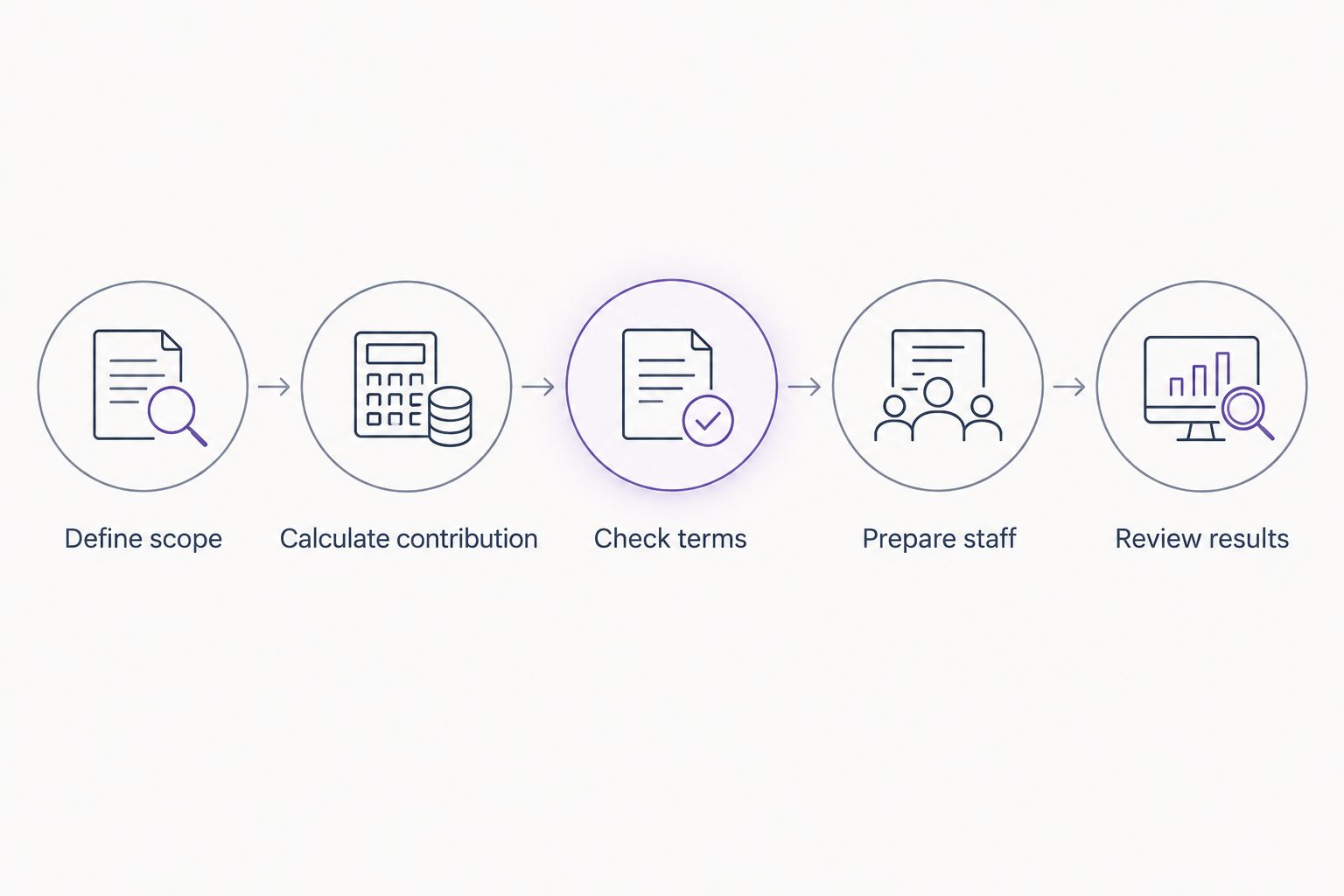
Use 5 steps to assess a 2026 trial: define the scope, calculate contribution, check terms, prepare staff and review results. Keep the trial narrow enough that you can trace each order and explain the outcome.
1. Define scope
Choose the products and sales channels you want to assess. State why customers buying those products would find instalments useful, using recorded enquiries or existing order information rather than assumptions.
Write down the decision you want the trial to answer. For example, determine whether instalments help complete profitable purchases that payment in full does not secure. Avoid changing the product range, promotion and payment journey together if you want to understand the payment option's contribution.
2. Calculate contribution
Build an order-level calculation using sales revenue less product costs, fulfilment, payment charges and other costs attributable to the sale. Account for refunds and the work required to resolve them.
Calculate additional profit separately from financed-order profit. An order can remain profitable while the switch to finance reduces what your shop earns. Compare the result with the realistic alternative, not with receiving no order at all unless the evidence supports that comparison.
3. Check terms
Ask for written explanations of merchant charges, settlement conditions, cancellation handling and dispute responsibilities. Identify any obligations your business must meet before funds are released or an order is fulfilled.
For a 2026 launch, confirm the current requirements that apply to your specific arrangement. Do not assume that another retailer's process, permissions or advertising wording applies to your shop. Obtain qualified advice where you need a legal or regulatory determination.
4. Prepare staff
Give staff a clear explanation of the payment choice and a defined route for customer questions. Separate what the retailer handles from what the finance provider handles.
Include declined applications, incomplete applications and returned goods in the training. Staff should know how to continue the conversation without promising approval or encouraging a customer to take on unaffordable repayments. Keep payment in full visible and explain the purchase independently of the finance offer.
5. Review results
Review completed orders, contribution, cancellations, refunds and support work together. Look at the products sold as well as the payment method: a change in product mix can alter the result without proving that finance caused it.
Make 2 decisions explicit: whether to retain the payment option and whether to expand its scope. A useful result in a limited trial is a reason to review expansion, not evidence that every product or channel will perform the same way.
What should you ask a BNPL provider before signing?
Ask questions that establish your responsibilities, not just the customer's checkout experience. Get answers in writing and retain them alongside the merchant agreement so your team has a consistent reference.
- What charges apply to completed, cancelled and refunded transactions?
- What conditions determine settlement to the retailer?
- Who handles customer repayment enquiries and complaints?
- What happens when an application is declined or left incomplete?
- How do partial returns and exchanges affect the agreement?
- What happens if goods are delayed, disputed or not delivered?
- What must your staff and customer-facing material explain?
- How can the merchant arrangement be ended?
Payitmonthly is a fit for UK retailers seeking an interest-free monthly instalment platform. That describes its stated offer, not a guarantee of higher sales or a recommendation to accept terms without review.
The customer benefit is the ability to spread a purchase into interest-free monthly instalments. The merchant-side limitation is that this feature alone does not establish profitability, settlement suitability or operational fit. Assess those separately before committing.
Assess instalments for your shop
Review an interest-free monthly instalment option against your margins and operating needs.
Does buy now pay later guarantee more sales?
Buy now pay later does not guarantee more sales. Providing another payment choice is different from proving that it creates additional purchases. Review completed orders and customer behaviour before attributing a sales change to finance.
Keep the comparison fair. A promotion, different stock or a change in traffic can affect sales during the same period, so document those changes alongside the payment trial.
Is interest-free finance free for the retailer?
Interest-free finance is not proof of a cost-free merchant arrangement. It describes interest charged to the customer under the agreement. Assess merchant charges and operating responsibilities from the provider's current terms.
For your 2026 review, include the work involved in administering the option. Even a charge you understand fully does not capture every cost of offering and supporting finance.
Should a small shop offer BNPL on every product?
A small shop should assess BNPL by product economics before offering it across the range. Products with different margins, fulfilment requirements and return patterns need separate consideration.
Start where there is a clear customer reason to use instalments and a business case you can measure. Expansion should follow evidence, not the convenience of switching the option on everywhere.
FAQ
Is buy now pay later worth it for small retailers in 2026?
Buy now pay later is worth it when additional retained profit exceeds its payment and operating costs. Compare completed orders, refunds and staff work rather than judging the option by financed sales alone.
What's the best way to decide whether my shop needs BNPL?
The best starting point is documented customer demand and an order-level margin calculation. Then check the provider's terms and run a controlled trial.
Does BNPL mean my business gets paid immediately?
BNPL does not establish an immediate merchant payout. Confirm settlement timing, conditions and deductions in the specific merchant agreement.
Can I keep payment in full alongside instalments?
Keep payment in full available alongside instalments when your payment setup supports both. Give customers a clear choice without presenting credit as necessary to complete a purchase.
Does interest-free mean there are no costs?
Interest-free does not mean the retailer's arrangement has no costs. Review merchant charges, refund handling and operating work separately from the customer's interest terms.
Who handles a refund on a financed purchase?
Refund responsibilities depend on the provider agreement and your order process. Confirm who initiates the refund, how the finance agreement is adjusted and what your team must tell the customer.
What does Payitmonthly offer UK retailers?
Payitmonthly offers a buy-now-pay-later platform that lets customers spread purchases into interest-free monthly instalments. Retailers should assess the merchant terms against their own margins and operating requirements.
One last thing
A profitable financed order can still reduce your shop's profit if the customer would otherwise have paid in full. That is the comparison that makes the assessment useful: not finance revenue against nothing, but the actual outcome against the realistic alternative.
Before expanding your 2026 trial, write down why you believe the retained sales are additional. Keep that explanation beside the margin calculation. If the evidence supports only customer convenience, describe it that way rather than claiming a sales gain.


