

Choose PayItMonthly if your UK retail business wants customers to spread purchases into interest-free monthly instalments; choose Klarna if your checkout strategy calls for a broader choice of payment formats and a consumer shopping app. This 2026 comparison separates that product-fit decision from the merchant terms you must check before signing.
- PayItMonthly vs Klarna: choose monthly retail finance or a broader consumer payment offering.
- PayItMonthly is best for UK retailers seeking interest-free monthly instalments for customers.
- Klarna is best for merchants prioritising payment choice and its consumer shopping app.
- Compare merchant fees, settlement terms, checkout compatibility and refund handling before choosing either BNPL provider.
Why this matters
A buy-now-pay-later option changes more than the payment button. It introduces a customer repayment agreement, a merchant settlement process and another workflow when an order changes or a customer asks for help.
Start with the experience you want to offer. PayItMonthly provides UK businesses with buy-now-pay-later finance that spreads customer purchases into interest-free monthly instalments. Klarna combines payment products with a consumer-facing shopping app.
Choose the repayment experience first, then test the commercial and operational fit. Neither a recognisable checkout logo nor an interest-free customer offer tells you what the merchant agreement requires.
For your 2026 shortlist, separate three questions: what customers repay, how your business gets paid, and who handles problems. Treat each as a distinct decision. A good customer proposition does not replace a workable merchant contract.
At a glance
| Dimension | PayItMonthly | Klarna |
|---|---|---|
| Best for | UK retailers seeking interest-free monthly customer instalments | Merchants seeking several payment formats and a consumer shopping app |
| Repayment structure | Interest-free monthly instalments are the stated core offering | UK products include Pay in 3 and Pay in 30 days |
| Payment choice | A focused monthly-instalment proposition | A broader payment-product proposition |
| Shopper experience | Finance attached to the retailer's purchase | Checkout payments alongside a consumer shopping app |
| Checkout implementation | Confirm compatibility with your exact sales workflow | Confirm compatibility with your exact sales workflow |
| Refund handling | Assess the cancellation and refund workflow before signing | Assess the cancellation and refund workflow before signing |
| Pricing model | Obtain a written merchant fee schedule | Obtain a written merchant fee schedule |
| Standout feature | Interest-free monthly instalments for UK retail customers | Payment choice combined with a consumer shopping app |
Klarna's UK consumer product descriptions distinguish Pay in 3, which divides a purchase into 3 instalments, from Pay in 30 days, which defers payment for 30 days. These describe different repayment formats, not merchant charges. Check the current product terms and merchant eligibility for your intended checkout.
Monthly instalments win for a focused retail-finance brief
The monthly-instalment proposition is the closer fit when your requirement is specifically interest-free monthly retail finance. It gives your team a clear starting point: explain how customers can spread a purchase rather than introduce several different payment formats.
That focus suits a retailer whose sales conversation already centres on monthly budgeting. The relevant question is whether the offered repayment schedule matches your customers' purchases and your sales process—not whether the provider has the longest feature list.
The limitation is equally important. A monthly-instalment proposition alone does not establish the repayment duration, purchase limits, customer eligibility or sales channels available to your business. Obtain those details before writing finance messages or briefing staff.
Ask for a sample customer agreement and a demonstration of the repayment schedule. Your team should understand the first payment, subsequent due dates and the customer's obligations without translating technical language at the checkout.
Best for: a UK retailer that has already decided monthly instalments are the desired customer experience. A business seeking several payment formats has a different brief.
Klarna wins when payment choice is the priority
Klarna is the stronger fit when your requirement includes both split payments and deferred payment. Its UK Pay in 3 and Pay in 30 days products illustrate that distinction: spreading a purchase and delaying a purchase payment are not the same thing.
Payment choice gives you more formats to consider. It also creates more communication work. Your product pages, checkout and support responses must describe the selected product accurately instead of treating every payment option as identical finance.
The practical downside is that a broader range does not automatically improve your checkout. You still need to establish which products apply to your business, how they appear to customers and whether they address a real purchasing need.
For a 2026 launch, write the customer explanation before deciding how many options to display. If your team cannot clearly explain when each repayment format applies, simplify the proposition.
Best for: an online retailer that deliberately wants several customer payment formats. Do not choose breadth merely to add more buttons.
Klarna wins for a consumer-app shopping experience
Klarna has a consumer shopping app alongside its payment products. That makes Klarna the better fit when an app-based consumer experience is part of your selection criteria. This is a product-scope difference, not proof of additional sales for your shop.
A merchant should distinguish an existing consumer app from a contractual promise to generate customers. Do not treat app presence as evidence that shoppers will discover your business or complete more purchases.
Ask how your intended payment product connects with the shopper's account experience. Then examine what happens when a customer needs help with a repayment, a disputed order or a return.
The trade-off is focus. If you only need to offer monthly instalments at your own checkout, a wider consumer shopping experience is not automatically a requirement. Evaluate it as a separate benefit rather than allowing it to outweigh the merchant terms.
Best for: a retailer that specifically values a consumer app alongside checkout payments. A retailer buying only monthly finance should keep its assessment centred on that requirement.
A monthly message wins when clarity is the main requirement
A focused monthly-instalment offer is easier to organise around a single customer question: how does spreading this purchase work? That is a communication advantage for a retailer that wants one consistent finance message across its sales materials.
The advantage is focus, not permission to omit terms. An interest-free description still needs an accurate repayment explanation and the relevant eligibility information. Avoid language that implies every customer will be accepted.
A broader payment proposition requires you to distinguish the products customers see. Deferred payment should not be described as a monthly repayment plan, and a split-payment product should not be presented as though every other finance option has identical terms.
Use the same approved terminology on product pages, in checkout messages and in staff explanations. Contradictory descriptions create avoidable questions even when the payment system itself works correctly.
For your 2026 content, prepare a short explanation for each payment format you intend to offer. Ask the provider to confirm the wording reflects the actual product rather than adapting a competitor's copy.
Checkout implementation is a tie until your workflow is tested
Neither provider earns an implementation win from its name alone. Your website platform, order process and sales channels determine what a usable implementation looks like.
Do not assume that a provider supports your exact configuration because you have seen its logo on another retailer's website. Ask about your platform version, custom checkout work and any existing payment arrangements.
Run 5 test journeys before making a launch decision:
- Complete purchase: follow the customer journey through to the merchant order record.
- Declined application: check the explanation and route back to another payment method.
- Full refund: confirm the customer and merchant records reflect the cancellation.
- Partial refund: establish how an adjusted order changes the finance records.
- Customer query: identify who responds to order questions and repayment questions.
These are recommended checks, not reported performance results. Use the same journeys for both providers so the comparison measures your actual workflow.
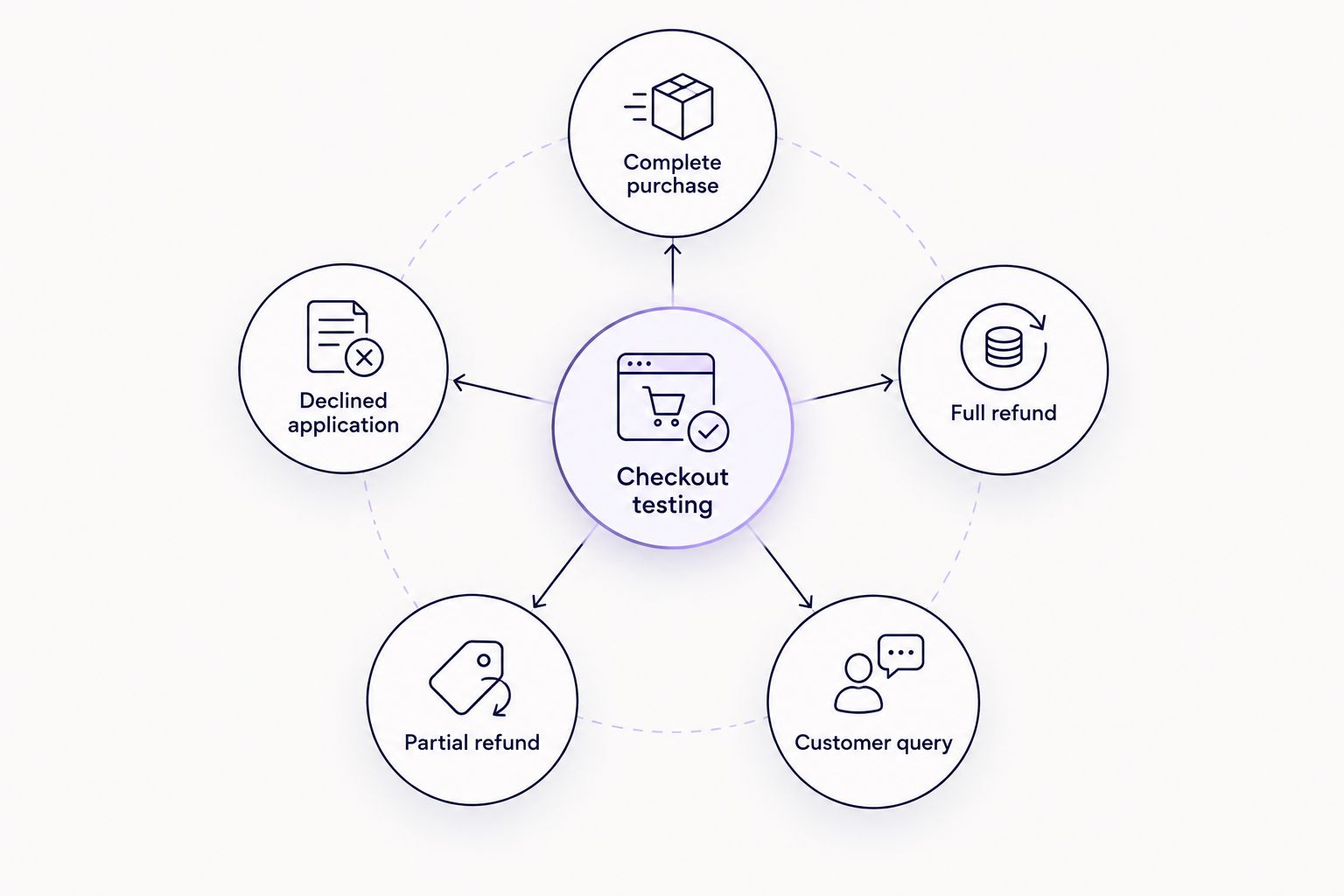
Record where staff intervene and what information they need. A checkout that looks straightforward to the customer still needs an order process your team can operate reliably.
Refund handling is a tie until responsibilities are clear
Refund handling deserves its own assessment. A customer returning goods creates both an order change and a repayment question; your staff need to know how those processes connect.
Choose neither provider on refunds until you have seen the workflow. Ask for demonstrations of full cancellation and partial refund handling, then confirm the responsibilities in the merchant terms.
Establish who initiates the refund, how the customer receives confirmation and what happens while the adjustment is being processed. Keep the retailer's responsibility for the order separate from the provider's responsibility for the repayment agreement.
The strength of either arrangement is an understandable division of responsibilities. The weakness is any gap that leaves the customer moving between organisations without a clear next step.
Give your support team a written escalation route. Include the information needed to investigate an order and the point at which a repayment question moves to the finance provider. Do not rely on staff improvising after launch.
Pricing: compare the merchant model, not the customer headline
Interest-free customer instalments do not establish the merchant's cost of offering finance. Customer repayment terms and merchant charges answer different questions.
Request a written fee schedule from each provider for your business. Compare whether the proposed arrangement uses transaction-based charges, fixed commitments or a combination, rather than assuming either provider follows a particular model.
The model determines the trade-off. Transaction-based charges connect expenditure to financed activity; fixed commitments create an obligation that must be assessed against your expected use. Where a proposal combines both, assess both parts together.
Use the same commercial brief for each quote:
- Your sales channels and checkout platform.
- The purchase types you want to finance.
- Your expected financed transaction volume, drawn from your own records.
- Your cancellation and partial-refund requirements.
- Your settlement and reconciliation needs.
Read the guide to how merchant fees work for buy-now-pay-later providers before comparing proposals. It gives the fee discussion a separate place from the customer-facing payment message.
For your 2026 decision, examine settlement triggers, refund adjustments, contractual commitments and termination terms alongside the fee model. There is no justified pricing winner without comparable written proposals.
Final verdict: choose for the job your business needs done
Choose PayItMonthly for monthly retail finance
Best for: a UK retailer seeking interest-free monthly instalments for its customers. PayItMonthly is the closer fit to that specific BNPL brief because monthly customer instalments are its stated offering.
Proceed once the repayment terms, merchant agreement and demonstrated workflow match your requirements. The focused proposition is the reason to shortlist it; the contract and operational checks are the basis for the final decision.
Choose Klarna for broader payment choice
Best for: an online retailer seeking several payment formats and a consumer shopping app. Klarna is the named winner for that broader product brief.
Its additional scope is useful only when your business needs it. Confirm the products offered to your merchant account, test the checkout and assess the commercial proposal before choosing it over a focused monthly-finance option.
| Dimension | Winner |
|---|---|
| Focused monthly retail-finance brief | PayItMonthly |
| Broader payment-format brief | Klarna |
| Consumer shopping app | Klarna |
| Single monthly-finance message | PayItMonthly |
| Checkout implementation | Tie pending workflow testing |
| Refund handling | Tie pending workflow testing |
| Merchant pricing | Decide from written proposals |
FAQ
Is PayItMonthly better than Klarna for a UK retailer?
PayItMonthly is the closer fit when the retailer specifically wants interest-free monthly customer instalments. Klarna is the closer fit when the brief includes broader payment choice and a consumer shopping app. Confirm merchant terms and checkout fit before choosing.
What's the main difference between monthly instalments and deferred payment?
Monthly instalments spread repayment across a schedule, while deferred payment postpones payment to a later due date. Klarna's UK Pay in 3 and Pay in 30 days illustrate distinct repayment formats, so explain the selected product accurately.
Does interest-free finance mean the retailer pays nothing?
No: an interest-free customer repayment offer does not establish the merchant's charges. Obtain the provider's written merchant fee schedule and assess the contract separately from the customer offer.
Which provider is easier to add to my checkout?
Choose on demonstrated compatibility with your exact checkout, not provider reputation. Test a completed purchase, a declined application, full and partial refunds, and a customer support query before launch.
Will adding buy-now-pay-later increase my sales?
Do not treat a sales increase as guaranteed. Measure completed purchases, financed orders, cancellations and the cost of serving those orders using your own business records.
Do all customers qualify for buy-now-pay-later?
Do not promise that every customer qualifies. Confirm the relevant product's eligibility and application requirements, then make sure staff and checkout messages explain them accurately.
What should I check before switching BNPL providers in 2026?
Check outstanding customer agreements, refunds, settlement reconciliation and termination requirements before switching in 2026. Plan how staff will handle existing orders while introducing the new checkout process.
One last thing
Ask both providers to demonstrate a partial refund before demonstrating another successful sale. A successful purchase shows the intended journey; an adjusted order exposes the responsibilities your team must manage afterwards.
Bring a real order scenario from your business, without customer personal data. Follow the adjustment through the order record, repayment explanation and merchant reconciliation. Choose only when your team can explain what happens next.


