

Choose PayItMonthly if your UK business wants to offer interest-free monthly instalments at retail checkout; choose Newpay if a reusable customer credit account is the payment experience you want. This 2026 comparison separates purchase-based instalments from account-based credit, then shows you how to assess the merchant terms that decide the final choice.
- PayItMonthly vs Newpay compares interest-free monthly instalments with a reusable retail credit account.
- Choose purchase-based instalments when your priority is explaining how customers spread a specific purchase.
- Choose Newpay when a reusable customer credit account is central to your retail finance strategy.
- Compare merchant contracts, settlement conditions and refund workflows before selecting either provider.
Why this matters
PayItMonthly is best for UK retailers seeking interest-free monthly instalments for customer purchases. Newpay serves a different requirement: NewDay describes it as a digital credit account, making the account relationship central to the comparison.
That distinction matters more than a feature count. A customer arranging payments for a particular purchase faces a different decision from a customer opening or using an ongoing credit account.
For your 2026 shortlist, start with the payment experience you want to explain at checkout. Then assess the commercial agreement, customer terms and day-to-day administration separately. A clear customer proposition does not establish merchant settlement speed, integration effort or profitability.
At a glance
| Dimension | PayItMonthly | Newpay |
|---|---|---|
| Best for | UK merchants seeking interest-free monthly instalments | Merchants seeking a reusable customer credit account proposition |
| Repayment structure | Customers spread purchases into monthly instalments | Account-based retail credit |
| Standout feature | Interest-free monthly instalment proposition | Reusable credit account structure |
| Customer explanation | Focus on the purchase and its instalment schedule | Explain the account alongside the purchase repayment terms |
| Repeat-purchase approach | Assess the process for each subsequent purchase | Assess how further purchases use the credit account |
| Integration assessment | Demonstrate the workflow on your actual checkout | Demonstrate the workflow on your actual checkout |
| Settlement and refunds | Assess the merchant agreement and refund process | Assess the merchant agreement and refund process |
| Pricing model assessment | Separate customer interest-free terms from merchant charges | Separate customer account terms from merchant charges |
The table compares the core propositions, not approval rates or commercial performance. Neither an instalment schedule nor a reusable account proves that a provider will improve your sales. Your own checkout results and signed merchant terms must establish that.
Purchase-based instalments win for a focused checkout proposition
An interest-free monthly instalment offer gives your sales team a specific proposition to explain: the customer spreads a purchase across monthly payments without interest. That is the stated purpose of the client's buy-now-pay-later platform for UK retailers and merchants.
The instalment proposition wins when your main requirement is helping customers understand payments for the purchase in front of them. Keep the explanation tied to the actual agreement rather than adding claims about universal acceptance, credit checks or payment flexibility.
The benefit is clarity of focus. Your customer needs to understand the purchase, the repayment schedule and the obligations attached to it.
The limitation is equally important: interest-free monthly instalments do not, by themselves, establish suitability for every customer or every basket. They also do not tell you the merchant's cost or when the business receives funds.
Newpay's account-based proposition introduces another consideration: the customer is dealing with a credit account as well as a purchase. That is a useful distinction for account-led retail, but it is not the same proposition as simply explaining a purchase's monthly instalments.
Newpay wins when the ongoing credit account is the priority
Newpay's distinguishing structure is the reusable credit account. That makes it the more relevant starting point when you want customers to have an account relationship rather than treat every finance decision solely as a standalone purchase.
Newpay wins on account continuity when reusable retail credit is your stated requirement. This is a product-structure verdict, not a claim that customers will return more often or spend more.
The advantage is that an ongoing account fits an account-led payment strategy. You can assess how a customer makes subsequent purchases within that relationship, subject to the applicable account terms and eligibility.
The trade-off is explanation. Your team must distinguish the account from any repayment arrangement attached to an individual purchase, and customers need to understand their continuing obligations.
Do not present account reuse as guaranteed borrowing. Check the conditions governing further purchases and the customer information your checkout must display before making it part of your sales message.
Interest-free instalments win when that is your central message
A retailer choosing finance specifically to offer interest-free monthly payments has a clear starting point. PayItMonthly provides that proposition for UK businesses.
Choose the explicitly interest-free instalment proposition when interest-free monthly payments are the requirement, not an optional feature. Build the customer explanation around the actual repayment schedule and terms.
Newpay's digital credit account should be assessed through its account documentation and the repayment options attached to the relevant retail arrangement. Do not assume that account-based credit and interest-free instalments mean the same thing, or that every transaction carries identical terms.
For a 2026 launch, write your intended checkout message before selecting the provider. Then ask whether the proposed agreement supports every part of that message.
This protects both clarity and consistency. Your product page, checkout and sales staff should explain the same offer, without turning a broad finance description into a promise the agreement does not support.
Newpay wins for an account-led repeat-purchase strategy
If your retail strategy explicitly centres on an ongoing credit account, Newpay's structure is the closer match. The account is part of the proposition rather than an incidental detail.
That is different from claiming an automatic repeat-sales advantage. A reusable account is a structural feature; improved customer retention is an outcome you must measure.
For an instalment-based approach, establish what happens when an existing customer wants to finance another purchase. Ask about the application journey, information required and treatment of existing commitments rather than assuming the first purchase determines the next.
For Newpay, ask how subsequent purchases work within the account and which conditions govern them. Make the distinction clear to staff who handle returning customers.
Neither route removes the need for responsible customer communication. Repeat purchasing must not become a reason to minimise repayment obligations or suggest that further credit is automatic.
Neither provider wins on integration without a checkout demonstration
An attractive finance proposition is not evidence of a working integration. Your shop's checkout, order management and refund processes need a demonstration using the proposed implementation.
Treat integration as a tie until you have seen the actual customer and merchant journeys. A generic sales presentation does not establish how finance will work in your particular store.
Use 3 test journeys in your 2026 assessment:
- Purchase: follow the customer from selecting finance through the application outcome and order confirmation.
- Cancellation: cancel an order and check how the retail order and finance record are updated.
- Partial refund: return part of an order and check the revised purchase and repayment information.
These are test cases, not claims about either provider's capabilities. Ask each provider to demonstrate the same cases so you compare like with like.
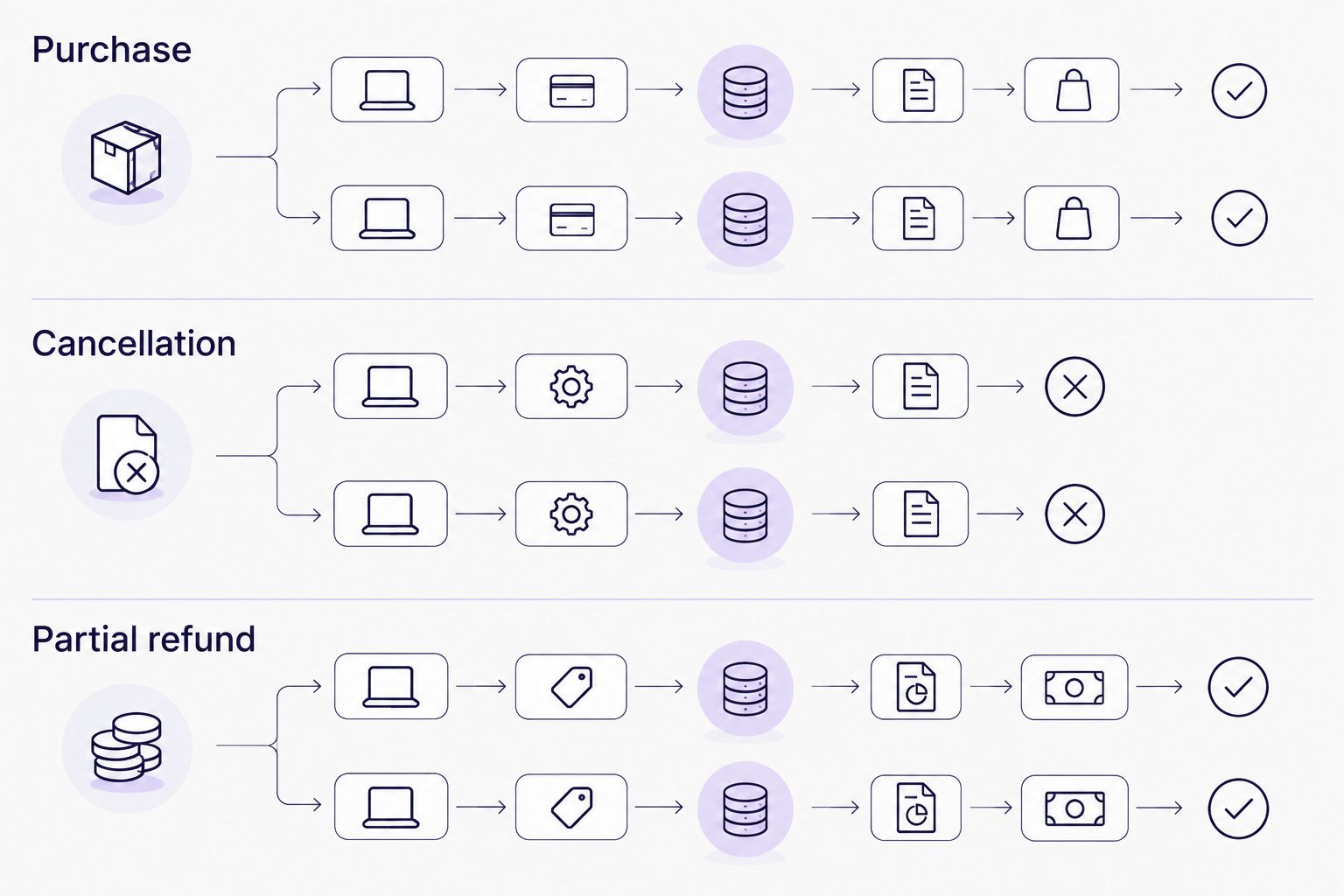
Record where staff must intervene and what the customer sees. If a task requires a manual handoff, include that work in your implementation decision rather than treating it as an issue to solve after launch.
Settlement and refunds are a contract-level tie
Customer repayment timing and merchant settlement timing are separate questions. An interest-free customer plan does not establish immediate merchant payment, and a credit account does not establish a particular settlement schedule.
Neither provider earns a settlement advantage from the repayment structure alone. Compare the written merchant conditions before making a cash-flow decision.
Ask each provider to explain:
- What event makes an order eligible for settlement.
- Which conditions affect payment to the merchant.
- What happens when an order is cancelled before fulfilment.
- How a full or partial refund changes the merchant balance.
- Which party handles a repayment query or payment dispute.
Use 1 fully cancelled order and 1 partially refunded order as practical review cases. Follow each from the original sale to the final merchant and customer records.
The strongest choice is the agreement your business can operate clearly and consistently. For the refund questions, use the guide to handling finance refunds and order cancellations alongside the provider's own documentation.
Pricing: separate customer terms from merchant economics
Interest-free describes the customer's interest arrangement. It does not establish that providing finance costs the retailer nothing.
Likewise, an account-based credit product has customer account terms that are separate from the merchant's commercial agreement. Do not compare the providers by putting a customer-facing payment description beside a merchant charge and treating them as equivalent.
Compare the commercial models in writing, using the same basket and operating assumptions. Ask how charges are calculated, which activities trigger them and how cancellations or refunds affect the amount your business retains.
For predictability, assess whether the proposed charging basis lets you understand the cost of a financed order before accepting it. For flexibility, assess which parts of the arrangement change with your sales mix, transaction activity or chosen service configuration.
Those are assessment criteria, not assumed pricing features of either provider. The agreement must establish the answers.
For your 2026 review, request a worked merchant example covering a completed purchase, a cancellation and a partial refund. Compare the explanation and the contractual treatment without publishing a price that becomes outdated or applying one merchant's quote to another business.
Final verdict: choose the structure your customers need
Choose PayItMonthly if you are an instalment-led retailer
Winner for this profile: the interest-free monthly instalment platform. You are a UK retailer or merchant whose primary requirement is letting customers spread a purchase into interest-free monthly payments.
This is the clearest fit when your checkout message starts with the purchase and its monthly repayment schedule. Confirm the commercial terms, implementation and operational responsibilities before committing.
Do not choose it on an assumed promise of faster settlement, higher acceptance or increased sales. Those are separate questions that need separate evidence.
Choose Newpay if you are an account-led retailer
Winner for this profile: Newpay. You want a reusable customer credit account to form part of the retail payment relationship.
The account structure makes Newpay the more relevant option for that requirement. Review the customer account terms, subsequent-purchase journey and merchant agreement together.
Do not choose it simply because an ongoing account sounds convenient. Your customers must understand the account obligations, and your business must be able to manage the associated order and support workflows.
One-glance scorecard
| Dimension | Winner |
|---|---|
| Purchase-focused monthly instalment proposition | Interest-free instalment platform |
| Ongoing customer credit account | Newpay |
| Explicit interest-free monthly instalment requirement | Interest-free instalment platform |
| Account-led repeat-purchase strategy | Newpay |
| Integration | Tie until demonstrated on your checkout |
| Settlement and refunds | Tie until merchant terms are compared |
| Merchant pricing | No winner without comparable commercial agreements |
FAQ
Is PayItMonthly better than Newpay for a UK retailer?
PayItMonthly is the better fit when your requirement is interest-free monthly instalments for customer purchases; Newpay is the closer fit when you want a reusable customer credit account. Compare the merchant agreements and actual checkout workflows before selecting either.
What is the main difference between instalments and a Newpay account?
Purchase-based instalments focus on spreading a purchase across scheduled payments, while Newpay is a digital credit account. The account relationship and the repayment terms for a purchase need to be understood separately.
Does interest-free finance mean the merchant pays nothing?
No, customer interest-free terms do not establish that finance is free for the merchant. Assess the merchant charging basis separately from the customer's repayment agreement.
Is Newpay better for repeat purchases?
Newpay is the closer structural fit when your requirement is a reusable credit account. That does not prove improved repeat sales or guarantee eligibility for further purchases.
Which provider pays retailers faster?
Merchant settlement speed must be established from the proposed merchant agreement. Customer instalment timing and account structure do not establish when your business receives payment.
What should I test before adding retail finance to checkout?
Test a completed purchase, a full cancellation and a partial refund using your proposed checkout implementation. Check both the customer's information and the merchant records at each stage.
How should I compare these providers in 2026?
Start with whether you need purchase-based interest-free instalments or an ongoing credit account. Then compare customer terms, merchant charges, settlement conditions, integration and refund handling on the same basis.
One last thing
Test the reversal of a sale, not just the sale itself. A successful application shows only part of the finance workflow; a cancellation or partial refund reveals who updates the records, explains the change and resolves the customer's question.
Make that demonstration a condition of your 2026 selection process. The repayment structure decides your shortlist, but the agreement and operational workflow decide whether the choice works for your business.


