

Choose PayItMonthly if you want a dedicated BNPL platform for your UK business; choose PayPal Pay in 3 if your customers want a fixed three-payment option through PayPal checkout. This 2026 comparison separates merchant-platform fit from repayment structure, so you can choose on the sale you need to support—not the payment logo.
- PayItMonthly vs PayPal Pay in 3 is a choice between a merchant-focused BNPL platform and a specific PayPal repayment option.
- PayItMonthly suits UK retailers seeking a dedicated interest-free monthly-instalment platform.
- PayPal Pay in 3 suits eligible purchases where customers want three interest-free payments through PayPal.
- Compare merchant terms, checkout requirements and refunds before choosing; interest-free repayments do not settle those questions.
Why this matters
A repayment option and a merchant finance platform are not the same buying decision. One describes how a customer pays; the other describes the service your business adopts to offer instalments. Comparing the names without separating those decisions produces the wrong shortlist.
For a UK retailer choosing BNPL in 2026, the useful questions are practical. Does the repayment structure suit your customers? Does the application fit your sales process? What happens to the order, settlement and refund when something changes?
Neither interest-free repayments nor a familiar checkout name answers every question. Treat customer convenience and merchant operations as separate requirements, then assess both against the same purchase journey.
At a glance
| Dimension | PayItMonthly | PayPal Pay in 3 |
|---|---|---|
| Best for | UK businesses seeking a dedicated monthly-instalment BNPL platform | Merchants serving customers who want a three-payment option through PayPal |
| Repayment structure | Interest-free monthly instalments; confirm the applicable schedule | Three interest-free payments: an initial payment, then two monthly payments |
| Checkout context | A merchant platform to assess against your retail sales process | A repayment option within the PayPal checkout journey |
| Standout feature | Dedicated provision of monthly-instalment finance for UK retailers and merchants | A defined three-payment structure within PayPal |
| Customer interest | Interest-free monthly instalments | Interest-free payments |
| Merchant operations | Review settlement, cancellations, refunds and responsibilities | Review settlement, cancellations, refunds and responsibilities |
| Pricing model | Assess the merchant commercial agreement separately from customer interest | Assess the applicable merchant payment terms separately from customer interest |
| Implementation | Confirm requirements for your actual sales channels | Confirm how PayPal checkout and Pay in 3 apply to your actual sales channels |
The table compares purpose and repayment structure, not an assumed feature list. It does not establish longer terms, faster settlement, lower merchant costs or wider customer acceptance for either provider.
A dedicated merchant platform wins for a retail-finance brief
PayItMonthly is the better BNPL starting point for UK retailers seeking a dedicated monthly-instalment platform. Its stated purpose is to help UK businesses offer customers interest-free monthly instalments. That makes it directly relevant when your buying brief starts with customer finance rather than a particular payment wallet.
The advantage is the fit between the business requirement and the platform's purpose. You can frame the discussion around the purchases you sell, the customers you serve and the way your staff introduce instalments. This is a merchant-platform selection exercise.
The limitation is equally important: purpose does not prove every operational capability. Do not infer a particular repayment length, sales-channel integration or settlement commitment from the phrase monthly instalments. Put those requirements into the provider discussion and obtain the applicable terms.
For a retailer assessing a dedicated finance service, start with:
- Sales journey: where customers first see the instalment option.
- Purchase suitability: which of your products and order types the agreement covers.
- Staff responsibilities: what your team explains and what the provider handles.
- Order management: what happens when an order changes after the finance application.
This approach gives you a useful shortlist without mistaking a business description for a completed technical assessment.
PayPal wins for a clearly defined three-payment schedule
PayPal's UK Pay in 3 product information describes three interest-free payments: the first at purchase, followed by two monthly payments. The schedule spans two months after the initial payment. That is a concrete structure customers can assess against their budget.
PayPal Pay in 3 wins when the requirement is specifically a three-payment plan. You are not asking the provider to design a different schedule. You are choosing a named repayment option with a defined pattern.
That clarity also sets the boundary. A fixed schedule is not the answer to a brief that requires a different repayment pattern. Confirm the applicable monthly-instalment schedule with the dedicated platform before comparing it with PayPal; do not assume that monthly means longer or more flexible.
For your 2026 checkout copy, describe the schedule customers actually receive. Explain the initial payment and subsequent payment dates rather than using a broad claim such as spread the cost on its own. The customer needs to understand the commitment before submitting an application.
A useful internal test is simple: can a member of your team explain when each payment falls due without inventing an example? If not, resolve the schedule before publishing finance messaging.
PayPal wins when the requirement starts inside PayPal checkout
PayPal Pay in 3 is the more direct fit when the customer requirement is to use an eligible instalment option through PayPal. Its advantage here is context, not a claim that every retailer can enable it without work.
If your business already uses PayPal, assess the customer journey in that environment first. Check how the option applies to your account, purchase type and checkout implementation. An existing PayPal payment method does not justify promising every customer the same finance outcome.
The drawback is that this route starts with a particular checkout environment. If your requirement begins elsewhere in the sales process, establish how the application and order would work before selecting it.
Use a real purchase journey for the assessment:
- Where does the customer select the payment method?
- At what point does the customer see the repayment schedule?
- What does your store show after an unsuccessful application?
- How does your team identify the payment against the order?
Assess PayPal Pay in 3 as a checkout option, not as proof that your entire retail-finance process is covered. That distinction keeps implementation decisions tied to actual customer behaviour.
Monthly-instalment focus wins when finance is the main brief
A dedicated monthly-instalment platform is the stronger starting point when your business brief is offer customer finance, rather than add a PayPal repayment option. The difference is the question you bring to the provider.
For the dedicated platform, the discussion starts with your retail-finance requirements. For PayPal Pay in 3, it starts with whether a particular PayPal repayment structure suits the purchase. Both are legitimate routes, but they solve differently framed problems.
The merchant-platform route still needs scrutiny. Do not treat a dedicated service as automatic evidence of bespoke terms, personal account management or compatibility with your website. Ask for confirmation of the capabilities your operation needs.
Before a provider discussion, write your brief under these headings:
- Sales channels: where you take orders.
- Repayment fit: the schedule your customers need to understand.
- Checkout fit: how the application connects to the purchase.
- Order handling: how changes and cancellations are managed.
- Commercial terms: the agreement your business will accept.
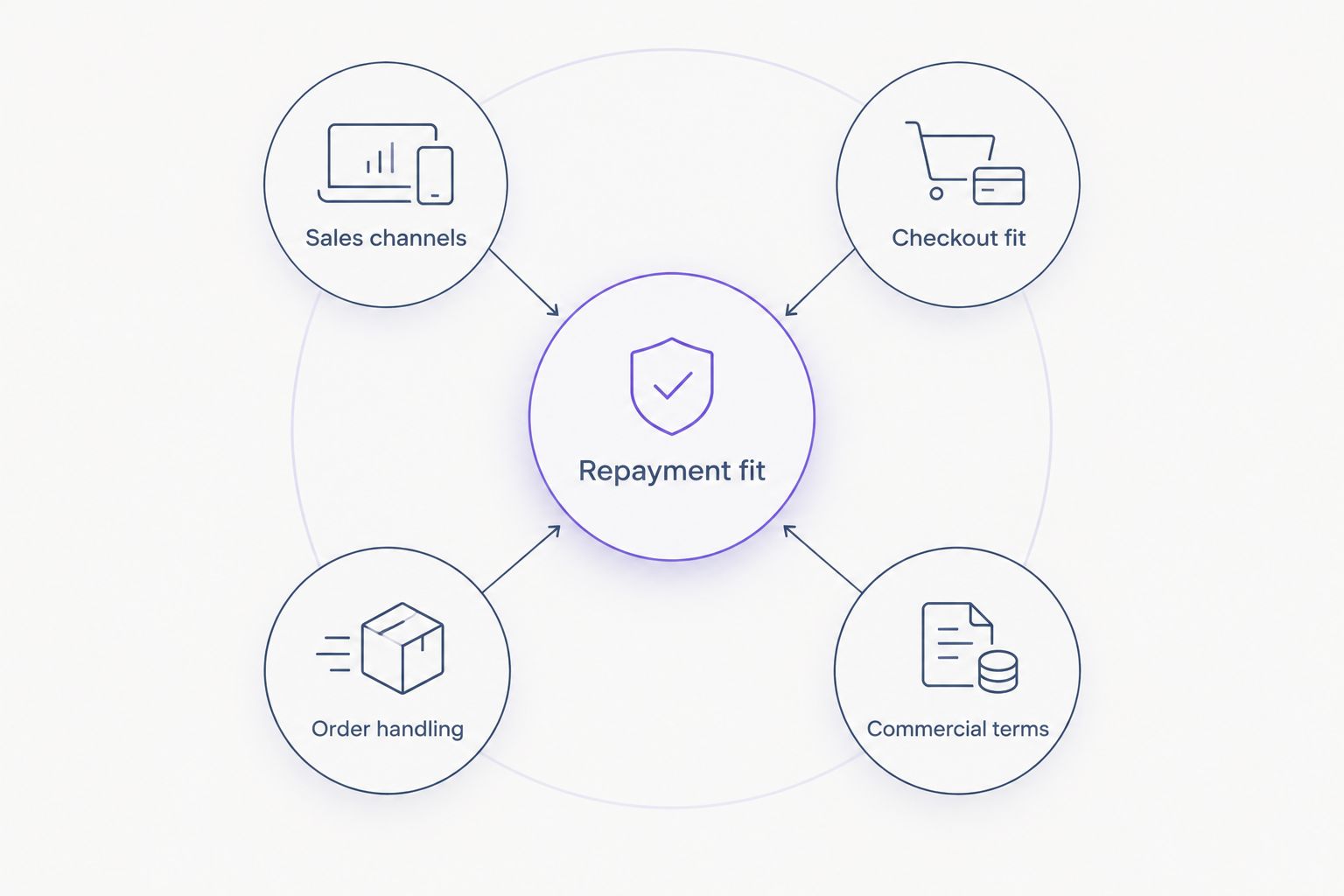
Use that brief for both providers. Asking different questions of each creates an uneven comparison and leaves important requirements unchecked.
Both offer interest-free customer repayments
Interest-free repayment is a tie, not the deciding advantage. The dedicated platform offers interest-free monthly instalments; PayPal Pay in 3 offers interest-free payments under its defined schedule.
The distinction is what sits around that shared benefit. Compare the repayment pattern, customer journey and commercial agreement rather than awarding a winner simply because one page emphasises interest-free finance more prominently.
Keep customer interest separate from merchant costs. A customer paying without interest does not establish what your business pays to provide the option. It also does not establish settlement timing or responsibility for an unresolved order.
Your customer-facing explanation should make the schedule clear without implying that borrowing is automatically suitable. Your merchant assessment should examine the contract. Those are different documents serving different decisions.
Neither wins operationally without checking your order journey
Settlement and refunds deserve the same scrutiny for both options. There is no operational winner until the applicable terms match your business requirements. A familiar brand or a dedicated finance proposition is not evidence of faster payouts or easier cancellations.
Ask each provider to explain how your team handles a completed sale, a cancelled order and a partial refund. Obtain the process in writing. Your staff need an operational instruction, not a general statement that refunds are supported.
Use the following checklist in your 2026 assessment:
- Settlement: when funds become payable and what conditions apply.
- Cancellation: what your team does before and after payment confirmation.
- Partial refund: how an order adjustment affects the customer's repayment arrangement.
- Dispute: which party handles the customer's query and which records you provide.
- Reconciliation: how the transaction appears in your order and accounting records.
Apply the same questions to both options. Do not rank settlement speed or refund quality on assumptions.
Pricing: compare merchant agreements, not customer interest
The pricing decision sits in the merchant agreement. Customer interest-free terms describe the repayment proposition; they do not describe your complete commercial relationship with the provider.
For the dedicated BNPL platform, review the commercial terms attached to the service your business is considering. For PayPal Pay in 3, review the merchant payment terms that apply to your PayPal arrangement. Do not assume identical charging structures, included services or refund treatment.
Compare how each agreement handles these questions:
| Commercial question | What your business needs to establish |
|---|---|
| Charging basis | Which event creates a merchant charge |
| Contract scope | Which services and transaction types the agreement covers |
| Refund treatment | What happens to applicable charges when an order is refunded |
| Payment conditions | Which conditions affect merchant settlement |
| Additional work | Which implementation and administration tasks remain with your team |
Predictability and flexibility are contract questions. A simple charging basis helps planning, but your decision also needs to account for order changes, administration and the services included.
Use the guide to how merchant fees work for buy now pay later providers to organise that review. For a 2026 provider comparison, obtain the terms applicable to your business rather than relying on a generic headline.
Implementation is a verification task for both options
Neither route earns an implementation win from its category alone. Your website, order process and sales channels determine what needs checking. A payment option that suits one retailer's checkout is not proof of compatibility with yours.
Ask the provider to show the journey from customer selection to order confirmation. Include an unsuccessful application and an order adjustment, not just a successful purchase. Your assessment needs to cover what staff actually encounter.
Keep the implementation review focused:
- Confirm the supported route for your sales channel.
- Identify any configuration or development work.
- Check the customer messages before and after the application.
- Establish who owns support when the payment and order records disagree.
The output should be a documented process your team can follow. That is more useful than an unsupported claim that one option is easier to add.
Final verdict: choose for the purchase, not the logo
Choose PayItMonthly if you are selecting a merchant BNPL platform
Best for: a UK retailer or merchant seeking a dedicated interest-free monthly-instalment service. Start here when the business requirement is to establish customer finance and assess the platform against your repayment, sales-channel and operational brief.
Confirm the applicable schedule and commercial agreement before committing. Do not turn the platform's stated purpose into promises about term length, acceptance or settlement.
Choose PayPal Pay in 3 if you want the PayPal three-payment route
Best for: a merchant whose customer requirement is a defined three-payment option through PayPal checkout. Start here when that repayment structure and checkout context match the purchase you need to support.
Check eligibility, implementation and merchant terms. The named repayment option does not remove those checks.
One-glance scorecard
| Dimension | Winner |
|---|---|
| Dedicated merchant-platform brief | Monthly-instalment platform |
| Defined three-payment schedule | PayPal Pay in 3 |
| PayPal checkout requirement | PayPal Pay in 3 |
| Finance-first provider selection | Monthly-instalment platform |
| Interest-free customer repayments | Tie |
| Merchant operations | No winner without applicable terms |
| Pricing model | No winner without commercial agreements |
| Implementation | No winner without sales-channel verification |
FAQ
Is PayItMonthly better than PayPal Pay in 3 for UK retailers?
PayItMonthly is the better starting point for a UK retailer seeking a dedicated monthly-instalment BNPL platform; PayPal Pay in 3 is the better fit for a defined three-payment option through PayPal. Confirm repayment schedules, checkout requirements and merchant terms before choosing.
How many payments does PayPal Pay in 3 involve?
PayPal Pay in 3 involves three payments: an initial payment at purchase followed by two monthly payments. That structure spans two months after the initial payment.
Are both options interest-free for customers?
Both options offer interest-free customer repayments. Customer interest does not establish the merchant's commercial terms or the customer's eligibility.
Does a monthly-instalment platform always offer longer terms than PayPal Pay in 3?
Monthly instalments do not automatically mean a longer repayment term. Confirm the applicable schedule before comparing it with PayPal's three-payment structure.
Can every customer use PayPal Pay in 3?
PayPal Pay in 3 is subject to eligibility and approval, so retailers should not promise access to every customer. Keep another payment route clear and explain the application accurately.
What should I compare in the merchant agreements?
Compare the charging basis, settlement conditions, refund treatment and responsibilities for disputes. Assess the commercial agreement separately from the interest-free customer proposition.
Which option is easier to integrate with my checkout?
The easier option is the one whose supported implementation matches your actual checkout and sales process. Confirm the customer journey, configuration work and order reconciliation rather than choosing on the brand name.
One last thing
Test a partial refund before you launch. A successful purchase shows only the straightforward path; an order adjustment exposes whether your staff understand the connection between the order, payment record and repayment arrangement.
For your 2026 rollout, ask for a walkthrough covering the customer message and merchant action. Make that process part of staff training before promoting the instalment option.


