

There's no single published average CPC for "buy now pay later" keywords in 2026 — Google doesn't release niche-level cost data, and anyone citing one flat number for the whole category is guessing. What does exist is a predictable cost pattern by search intent: informational BNPL searches sit at the bottom of the cost range, competitor-brand and comparison searches sit at the top, and the gap between the two is wide enough to break a PPC budget if you bid the same way across all of them.
- No official average CPC exists for buy now pay later keywords — intent, not the word 'BNPL', sets the price.
- Competitor-brand searches like 'PayItMonthly vs Klarna' carry the highest relative cost tier of any BNPL intent category.
- Informational queries ('how does buy now pay later work') sit at the cheapest tier and convert better through content than paid search.
- Finance & Insurance has ranked among the three or four highest cost-per-click verticals in Google Ads benchmark reporting for years running.
- Merchants evaluating a BNPL platform should budget PPC for commercial-intent terms and win informational and comparison traffic organically.
Why this matters
If you're a merchant comparing finance options, or you run paid search for a retail brand, you've probably tried to budget a campaign around "buy now pay later" terms and found the numbers don't behave consistently. That's because "BNPL keyword CPC" isn't one market — it's at least four, each with its own competitive pressure.
Searches for PayItMonthly and other finance providers get typed by three very different buyers: a shopper researching how instalment finance works, a shopper comparing named providers before checkout, and a merchant shopping for a platform to add to their own site. Google's auction prices these three buyers completely differently, and that difference is the benchmark that actually matters in 2026 — not a single blended average.
The benchmark: CPC by search intent for BNPL keywords
Google Ads auctions price a click on how close the searcher is to converting and how many advertisers are bidding on that exact intent. Across every vertical that's ever been studied, commercial and competitor-brand intent out-bids informational intent by a wide margin — Finance & Insurance is one of the verticals that shows this gap most sharply, and has repeatedly ranked among the three or four highest cost-per-click industries in Google Ads benchmark reporting published over the past several years.
The table below ranks BNPL search intent from lowest to highest relative cost pressure, using the "Overall blended" row as the reader's yardstick.
| Intent category | Relative CPC tier | Example query pattern | Who's bidding against you |
|---|---|---|---|
| Overall blended (all BNPL intent) | Medium | "buy now pay later" | Mixed — providers, retailers, comparison sites |
| Informational | Low | "how does buy now pay later work" | Content sites, review publishers, few direct advertisers |
| Merchant/implementation | Low-Medium | "add buy now pay later to checkout" | BNPL providers, ecommerce platforms |
| Comparison | Medium-High | "best buy now pay later providers for UK small businesses" | Multiple BNPL providers competing for the same click |
| Commercial/transactional | High | "buy now pay later for [product category]" | Providers plus retailers in that category |
| Competitor-brand | Highest | "PayItMonthly vs Klarna" | Named providers bidding to defend or poach the same searcher |
Where the cost actually goes
Competitor-brand searches carry the highest relative cost tier, because two or more providers are bidding to either defend their own name or intercept a shopper already evaluating a named rival — that's the most expensive click type in almost every vertical Google Ads touches, not just finance. A search like a PayItMonthly vs Klarna comparison sits at the top of the cost curve for exactly this reason.
Informational searches trail at the bottom of the range. A query like "how does buy now pay later work" has almost no direct commercial advertiser bidding on it, because the searcher isn't ready to pick a provider yet — which makes this intent the cheapest to rank for organically and the worst value to pay for.
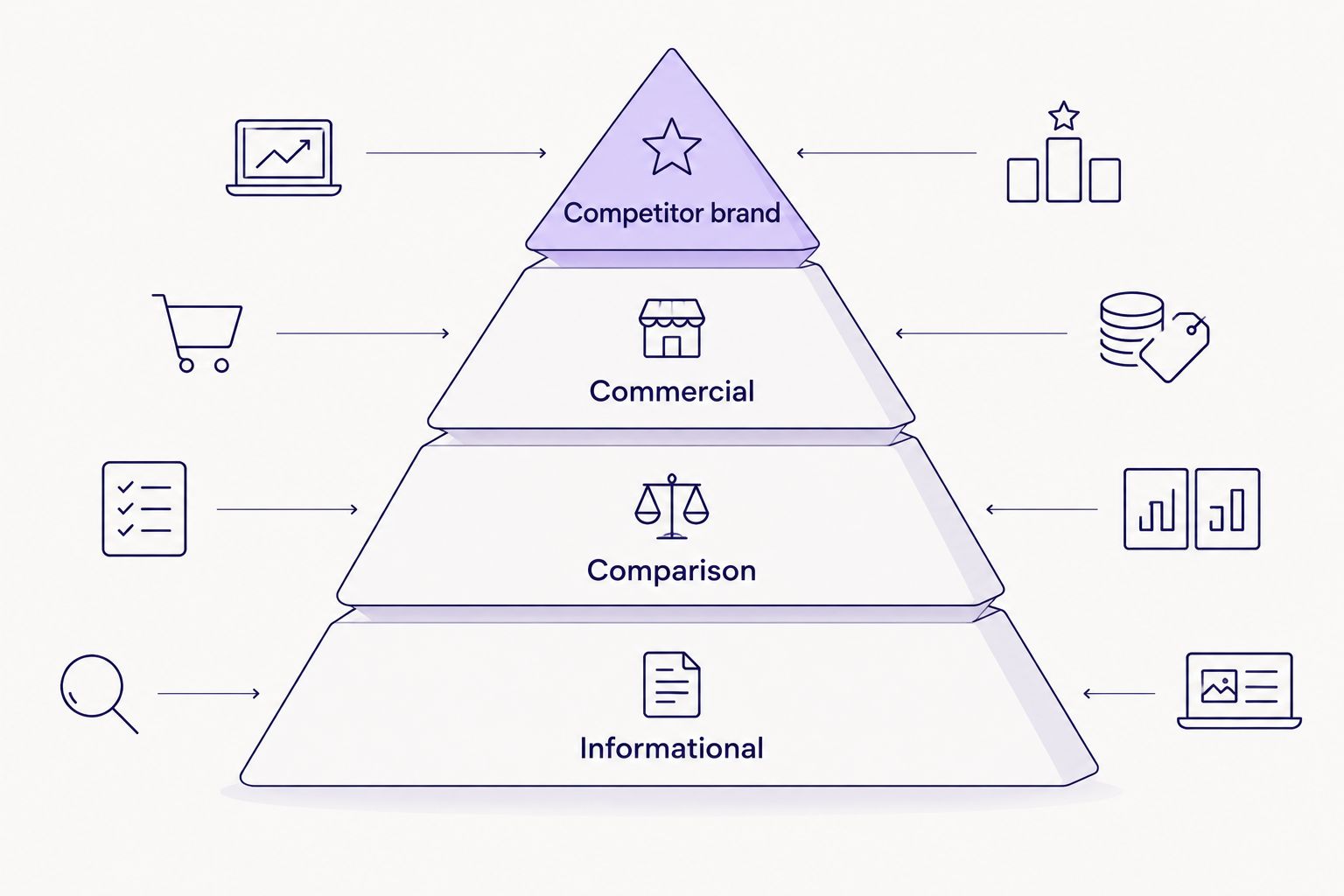
Merchant and implementation searches — things like "add buy now pay later to checkout" — sit just above informational, because the pool of advertisers bidding (mostly BNPL providers themselves) is smaller than in retail-facing commercial terms, where retailers and providers both compete.
Methodology and limitation
This ranking is built on how Google Ads auctions price intent generally — advertiser density and proximity to a purchase decision drive cost, and that mechanic is publicly documented in Google's own Quality Score and auction insights material, scored on the standard 1-10 scale. The limitation is real: Google does not publish exact average CPC by keyword or niche, so any page quoting a specific pound figure for "buy now pay later" as a category is citing a number nobody can verify. Treat the tiers above as a relative map for budget allocation, not a quote you can plug into a media plan.
How to use these benchmarks
- Don't bid head-on against named competitors unless you can win the click. Competitor-brand terms sit at the highest cost tier — a comparison page like the best buy now pay later providers for UK small businesses guide earns that traffic organically instead of paying auction price for every click.
- Spend paid budget where intent is closest to conversion. Commercial and merchant-implementation terms convert at a reasonable cost because the searcher already knows what they want.
- Win informational and implementation intent with content, not bids. A guide on how to add a buy now pay later option at checkout captures a merchant researching the category before they've picked a provider — that's a click you'd otherwise pay for at the comparison tier.
- Re-check quarterly. Auction pressure in finance keywords moves with the number of active BNPL providers running Google Ads campaigns at any given time in 2026, and that number has shifted year over year.
See BNPL at checkout before you bid on it
Read how merchants add instalment finance without rebuilding the checkout.
FAQ
What is the average CPC for buy now pay later keywords in 2026?
There's no single published average — Google doesn't release niche-level CPC data. Cost varies by intent tier, from low-cost informational searches to high-cost competitor-brand terms.
Why is 'buy now pay later' more expensive to bid on than other finance terms?
Finance & Insurance has ranked among the highest cost-per-click verticals in Google Ads benchmark reporting for years, and BNPL adds competitor-brand pressure on top of that as multiple providers bid for the same searcher.
Is 'PayItMonthly vs Klarna' a high-CPC search term?
Yes — competitor-brand comparison searches sit at the highest relative cost tier in the BNPL category because two named providers are both bidding to win or defend the click.
Should merchants pay for informational BNPL keywords?
No. Informational searches like 'how does buy now pay later work' sit at the lowest cost tier precisely because they convert poorly for direct advertisers — content ranks there more efficiently than paid search.
How much does it cost to add a buy now pay later option to a checkout?
That depends on the provider's merchant fee structure, not on keyword CPC — check current terms directly with the platform you're evaluating.
Does Google Quality Score affect buy now pay later keyword cost?
Yes. Quality Score is scored on Google's standard 1-10 scale, and a low score on a competitive BNPL term pushes the real cost per click above the auction floor.
Which BNPL search intent converts best for retailers?
Commercial and merchant-implementation intent converts best because the searcher already knows they want instalment finance and is evaluating how to add it, not whether to use it.
One last thing
The single biggest budget mistake merchants make in 2026 isn't overpaying for a click — it's paying auction price for a competitor-brand search when a comparison page could have won that same visitor for free. If you're spending on "BNPL vs" terms every month, check whether a comparison guide could carry that traffic instead; the cost difference between the two approaches is the gap between the top and bottom rows of the table above.


