

Buy now pay later keyword search volume benchmarks in 2026 depend on which of seven keyword categories you measure, and a single blended average hides more than it shows. This page gives the category structure, what each category signals, and how to benchmark your own numbers. PayItMonthly builds interest-free instalment finance for UK retailers, so the categories below are read from the merchant side.
- Buy now pay later keyword search volume benchmarks in 2026 only work per category, not as one blended average.
- Seven categories matter: provider brands, generic terms, merchant terms, platform terms, industry terms, comparisons and fees.
- Merchant-side and platform terms carry the buyers PayItMonthly serves; generic consumer terms carry the biggest audience.
- Benchmark each category against your own Search Console impressions, not against a headline average.
Why a single average is the wrong number
Search volume for BNPL splits by who is typing. A shopper typing a provider name wants a login or a checkout. A retailer typing a platform plus the phrase buy now pay later wants to install something.
Blend those into one average and you get a figure that matches neither audience. The useful benchmark is per category, then per page.
This page contains no volume figures. Exact monthly volumes change by month and by tool, and a number copied from one export goes stale within a quarter. Pull the figures for your own market from your keyword tool and Search Console, then drop them into the structure below.
The short answer
There is no single average monthly search volume for BNPL keywords in 2026. Provider brand terms and generic consumer terms sit at the top of the volume range. Merchant, platform and industry terms sit lower in volume but closer to a purchase decision for a business owner. Comparison and fee terms are the smallest groups and the most commercial.
The benchmark table: seven BNPL keyword categories
The table sets out each category, who searches it, the volume position relative to the other categories, and what it tells you. Fill the last column with your own exported figure.
| Category | Example query pattern | Who searches | Relative volume | Intent | Your figure |
|---|---|---|---|---|---|
| Provider brands | Klarna, PayPal Pay in 3 | Shoppers | Highest | Navigational | Add yours |
| Generic terms | buy now pay later | Shoppers, early researchers | High | Informational | Add yours |
| Merchant terms | buy now pay later for retailers | Business owners | Medium | Commercial | Add yours |
| Platform terms | buy now pay later shopify | Store owners | Medium to low | Commercial | Add yours |
| Industry terms | buy now pay later for furniture retailers | Sector merchants | Low per term, wide in total | Commercial | Add yours |
| Comparison terms | provider vs provider, alternatives | Merchants mid-decision | Low | Transactional | Add yours |
| Fee terms | merchant fees, how fees work | Merchants pre-contract | Low | Transactional | Add yours |
The volume ranking is a relative position, not a measured count. Check it against your tool before you plan around it.
High and low: where the volume sits
Provider brand terms lead on volume because every shopper who has used a BNPL checkout can name one. Generic terms follow. Fee and comparison terms trail, because only merchants weighing a provider search them.
That gap is the point. The smallest categories hold the readers closest to signing. A retailer reading a fee breakdown is further along than a shopper reading a definition.
Industry terms behave differently from the rest. Each single query is small, but there are dozens of sectors, from furniture to clinics to garden machinery. Added together they can outweigh a single generic term, and they face less competition.
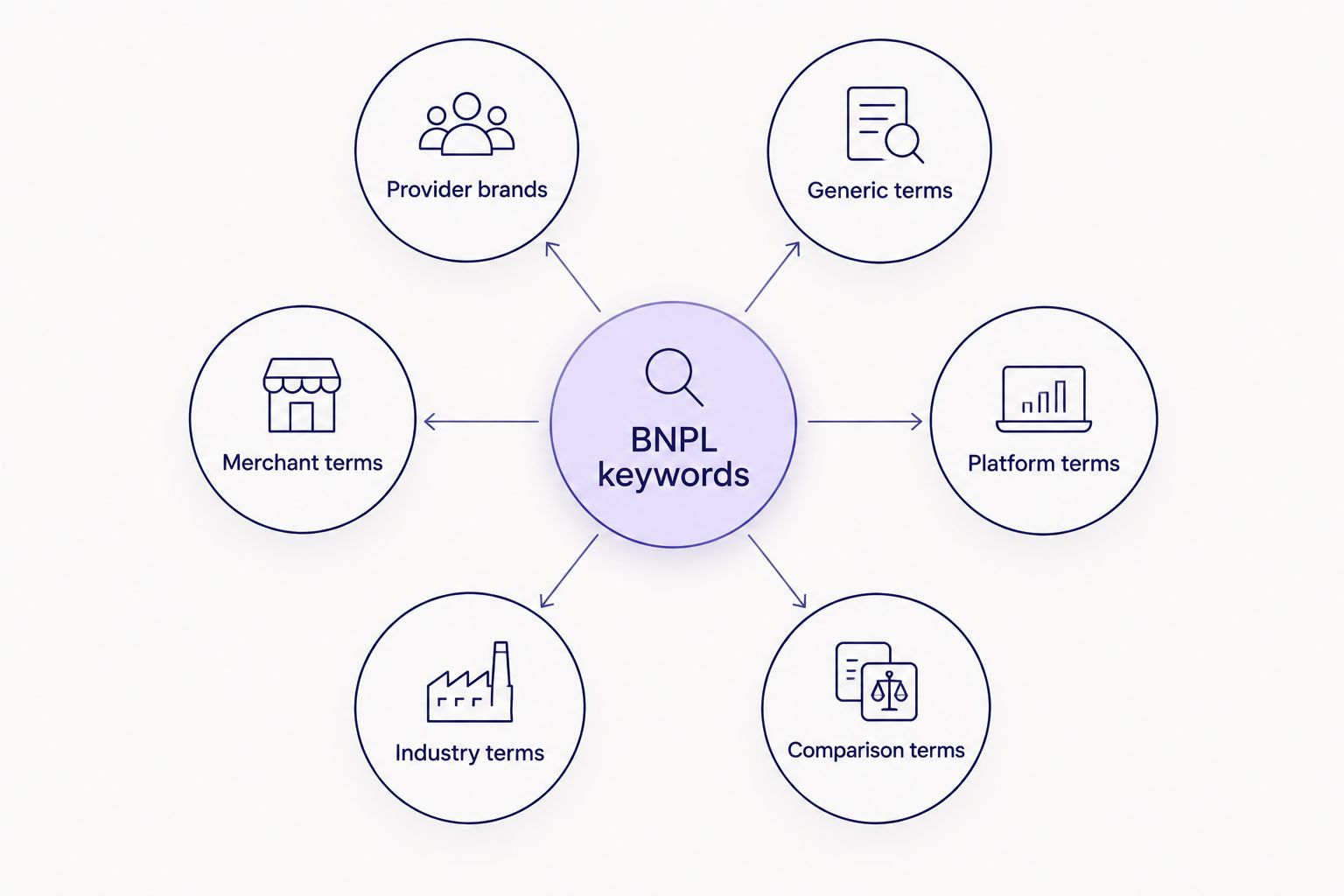
Category by category
Provider brand terms
These are queries for a named lender or payment product. You will not win them on your own pages unless you write a fair comparison. Treat them as a source of demand, not a target.
Verdict: Skip direct targeting. Use them as comparison fuel.
Generic consumer terms
Queries such as buy now pay later and how it works have the broadest audience. They are mostly shoppers, so the traffic converts poorly for a merchant platform. Use them for definitions and trust building.
Verdict: Hold. Cover the basics once, then link onward to merchant pages.
Merchant terms
This group covers retailers asking how to offer finance, what it costs and how settlement works. It is the core group for a platform like PayItMonthly. For fee-side questions, the BNPL providers ranked by merchant fees page is the natural pairing.
Verdict: Buy. This is where merchant intent is clearest.
Platform terms
Queries pairing a store platform with BNPL come from owners who already run a shop and want a plugin or integration. Volume per platform is modest, and the audience is ready to act.
Verdict: Buy. Build one page per platform you support.
Industry terms
Sector queries are the long tail. Each sector has its own objections, ticket sizes and customer profiles, so one generic page cannot serve them all.
Verdict: Buy, in batches, starting with the sectors where you already have merchants.
Comparison and fee terms
Searchers here are weighing providers. They want a plain table, honest trade-offs and the fee structure in words they can repeat to a finance director.
Verdict: Buy. Low volume, high value.
Methodology and limits
The categories above group queries by the reader's role and the stage they are at. Relative volume positions come from how each group is typically searched in the UK market, and exact counts depend on your tool, date range and country setting.
The limit: keyword tools report estimates, and they often fold close variants into one figure. Two tools will disagree on the same query. Pick one source, keep it constant, and compare month against month in 2026 rather than tool against tool.
How to use these benchmarks
- Export first, judge second. Pull 28 days of Search Console queries, assign each to one of the seven categories, and total impressions per category. That is your real benchmark.
- Compare categories to each other. If merchant and platform terms are under a tenth of your impressions, your content leans too consumer-facing.
- Pair volume with cost. A small-volume term with clear buying intent can be worth more than a large generic one. The average CPC for buy now pay later keywords by intent page covers the paid side of that comparison.
- Re-run quarterly. Seasonal peaks around Black Friday and January move consumer terms far more than merchant terms.
Offer finance to your customers
See how PayItMonthly lets UK retailers offer interest-free instalments.
FAQ
What is the average search volume for buy now pay later keywords in 2026?
There is no single reliable average. Volume varies by category, with provider brands and generic terms highest and fee and comparison terms lowest. Measure each category separately.
Which BNPL keyword category is best for a merchant platform?
Merchant, platform and comparison terms. Their volume is lower than consumer terms, but the searchers are business owners deciding whether to offer finance.
Should I target provider brand names like Klarna?
Not directly. Those queries are mostly shoppers. A fair comparison page is the better route, because it matches what a merchant searching those names actually wants.
Why do industry keywords matter for BNPL?
Each sector query is small, but there are many sectors. Together they add up, and they face less competition than generic BNPL terms.
Where do I find my own BNPL keyword volumes?
Use Google Search Console for queries you already appear for, and one keyword tool for the rest. Keep the same tool and date range each time you compare.
How often should I refresh BNPL keyword benchmarks?
Quarterly is enough for merchant terms. Check consumer terms around Black Friday and the January sales, when they swing most.
One last thing
The most useful single check is the ratio of merchant-side impressions to consumer-side impressions in your Search Console data. If consumer terms dominate, your site is attracting shoppers who cannot buy from you. Move content effort toward the platform, industry and fee categories in 2026.


