
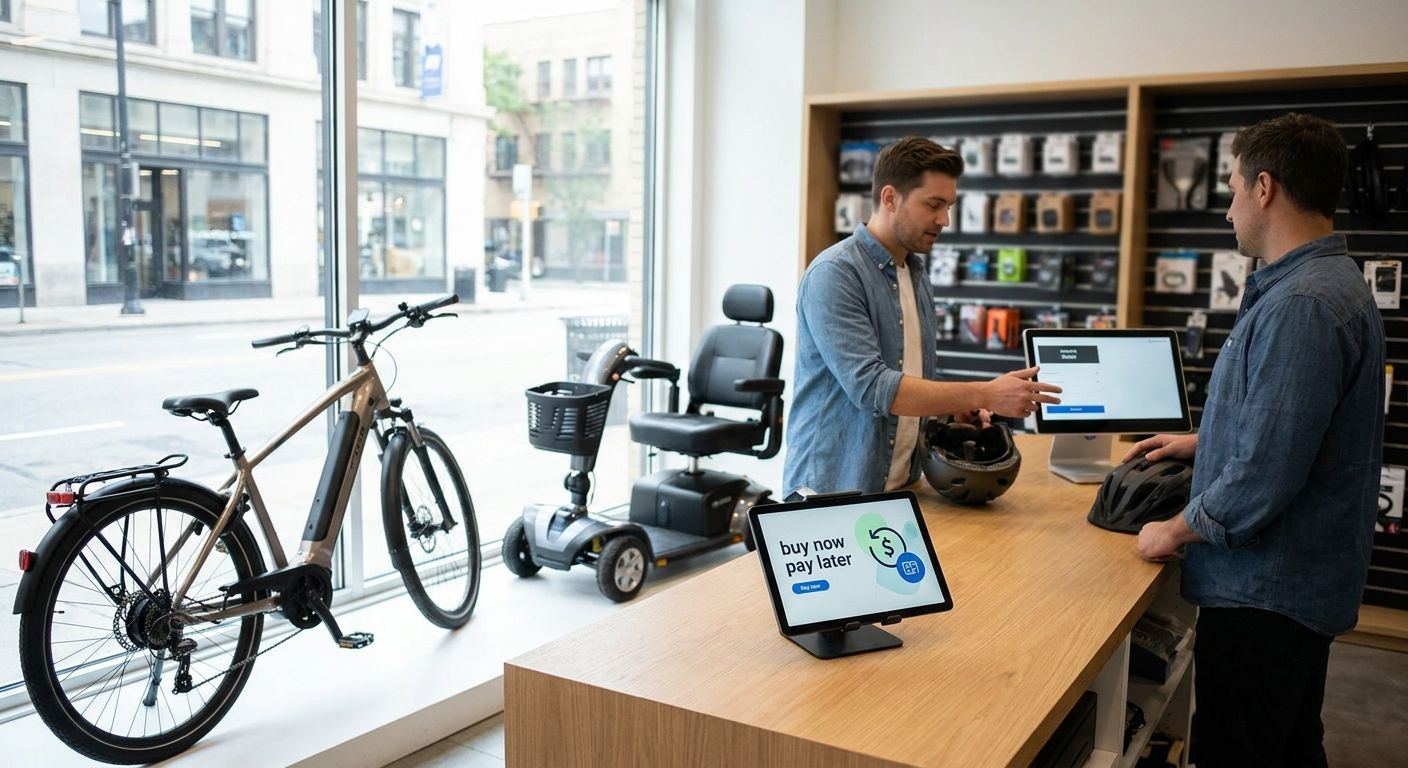
Buy now pay later for e-bike and mobility scooter retailers is instalment finance built into checkout, letting customers split the cost of an e-bike, e-scooter or mobility scooter into equal monthly payments instead of paying the full price in one go. These buyers behave differently to typical shoppers: they research for weeks, compare specs against price, and abandon the basket the moment the total looks steep. That's the exact moment instalment finance changes the outcome.
- Buy now pay later for e-bike retailers turns big-ticket price tags into monthly payments approved at checkout.
- PayItMonthly lets e-bike, e-scooter and mobility scooter shops offer interest-free instalments without extending in-house credit.
- Cart abandonment on high-value bikes and scooters drops when the price line reads per month, not in full.
- Mobility equipment retailers use instalment finance to make big purchases affordable outside grant funding waits.
- Best fit in 2026: independent bike shops and mobility retailers selling above impulse-purchase price points.
Why buy now pay later matters for e-bike and mobility scooter retailers
E-bikes and mobility scooters sit well above the average retail basket. A customer weighing a folding e-bike against a car journey, or a mobility scooter against reduced independence, is making a durable-goods decision, not an impulse buy. That drives specific behaviour: longer consideration windows, cart abandonment the second the full price appears before any finance option, and heavy comparison shopping across bike shops before a single sale closes.
For mobility equipment retailers, the buyer profile skews older and budget-conscious, often familiar with structured payment plans. Instalment finance mirrors that familiar structure without a wait for grant approval, which is why it converts in 2026 where a straight full-price checkout doesn't.
How to add buy now pay later to your e-bike or mobility scooter shop
Map which products actually need instalment finance
Not every SKU in an e-bike or mobility shop needs a monthly-payment option. Start with the products where price is the objection.
- List every SKU above your typical impulse-purchase threshold
- Separate accessories and servicing from the big-ticket bikes and scooters
- Check margin impact per category before rolling instalments out shop-wide
- Flag seasonal demand (e-bikes) versus steady year-round demand (mobility scooters)
Show the monthly price next to the full price
The fix costs nothing and works before any finance platform touches your checkout.
- Add a per-month price line directly under the full price
- Keep the full price visible for transparency, never hide it
- Test the monthly line above the fold on product pages
- Use consistent monthly-price language across every bike and scooter listing
Add a buy now pay later option at checkout
Once the monthly framing works on the product page, the next step is making it selectable at checkout rather than something a customer has to ask about. This is where PayItMonthly enters as the faster path: it plugs instalment finance into the checkout flow so the retailer doesn't carry the credit risk or chase repayments directly.
- Confirm which payment gateway or POS system the store already runs
- Add the instalment option as a visible checkout choice, not a hidden link
- Test the flow on a high-value e-bike and on a low-value accessory bundle
- Check the approval message is instant, not a next-day callback
Reduce abandoned carts on high-ticket bikes and scooters
High-ticket carts abandon at a different rate to low-ticket ones, and the fix isn't discounting.
- Surface the monthly price at the cart stage, not just the product page
- Send a follow-up that repeats the monthly figure, not a generic reminder
- Compare abandonment before and after instalments go live
- Check mobile checkout specifically, where price shock hits hardest
Train staff to lead with the monthly number
In-store sales still lose to price shock if the assistant quotes the full total first.
- Script the opening line around the monthly figure, not the full price
- Role-play the affordability objection before it happens on the shop floor
- Compare how in-store staff quote finance versus how the website presents it
- Align in-store and online messaging so customers don't get two different pitches
Advertise instalment plans within the rules
Finance advertising for retail is regulated. Any interest-free claim needs a representative example and can't mislead on eligibility.
- Check every ad and in-store poster carries the required finance wording
- Avoid implying every customer is automatically approved
- Keep monthly-price claims consistent between website, email and in-store signage
- Review copy whenever a new e-bike model or scooter range launches
Track approval rates and repeat purchases
The number that tells you whether instalment finance is working isn't traffic, it's approvals and returning customers.
- Track approval rate by product category, not just overall
- Compare average order value before and after instalments launch
- Watch whether e-bike buyers return for accessories, batteries or servicing
- Flag any category where approval rates drag conversion down
Finance options for e-bike and mobility scooter retailers
| Option | Best for | Key limitation |
|---|---|---|
| Buy now pay later (PayItMonthly) | Retailers wanting instant checkout approval without carrying credit risk | Requires integration into online or in-store checkout |
| Store credit account | Repeat customers buying accessories and servicing regularly | Slower setup, needs ongoing account management |
| Personal loan arranged by the customer | Buyers who prefer to sort finance independently | Retailer has no control over approval speed or messaging |
| Deposit plus balance on collection | Customers happy to wait before taking the product home | Delays the sale and ties up stock |
| Full price on card | Low-ticket accessories and consumables | Doesn't solve abandonment on high-ticket bikes or scooters |
Verdict: buy now pay later suits e-bike and mobility scooter retailers better than store credit or deposit plans because the customer gets an instant decision at the moment they're already deciding to buy.
“If the price only appears in full, high-ticket shoppers abandon before they scroll to checkout.”
Common mistakes e-bike and mobility scooter retailers make
- Hiding the finance option until the basket page — by then, many high-ticket shoppers have already left the site
- Advertising interest-free finance without the required representative example, which risks an ASA complaint
- Not training floor staff to quote a monthly figure for scooters and bikes sold in-store
- Treating e-bike and mobility scooter buyers identically, when the two groups need different messaging and different urgency
- Sizing the instalment term to the price alone — a bike bought for daily commuting and a scooter bought for mobility support don't warrant the same repayment length
Add instalment finance to your shop
See how PayItMonthly fits your checkout, online or in-store.
FAQ
What is buy now pay later for e-bike retailers?
It's an instalment finance option added to checkout that lets a customer split the cost of an e-bike into equal monthly payments instead of paying the full price upfront. The retailer is paid for the sale while the customer repays the finance provider over time.
Can mobility scooter shops offer instalment finance without their own credit licence?
Retailers partner with a regulated buy now pay later provider rather than applying for their own consumer credit permissions. The provider handles the lending and compliance side; the retailer integrates the checkout option.
Is buy now pay later better than a personal loan for a mobility scooter?
For the retailer, yes. A personal loan is arranged independently by the customer and gives the shop no control over approval speed, while buy now pay later approves at checkout so the sale doesn't stall.
Do e-bike shops need to become the lender to offer monthly payments?
No. The finance provider holds the regulatory permissions and carries the credit relationship, and the retailer offers the option as a checkout feature.
What happens if a customer misses a monthly instalment payment?
The finance provider manages repayment collection and any missed-payment process directly with the customer, not the retailer. That separation is the main reason shops use a provider rather than in-house credit.
Can buy now pay later work for mobility scooters bought online and in-store?
Yes. Instalment finance can be added to an online checkout and to in-store point-of-sale, so the customer sees the same monthly-payment option in both channels.
Does offering instalment finance affect ASA advertising rules?
Any advert mentioning interest-free finance must include a representative example and can't overstate approval odds. This applies whether the ad promotes an e-bike, a mobility scooter or any other product.
Do e-bike and mobility scooter customers need different finance messaging?
Yes. E-bike buyers respond to commuting cost comparisons, while mobility scooter buyers respond to messaging that mirrors familiar structured payment plans. The finance product can be identical; the pitch shouldn't be.
One last thing
The biggest lever isn't adding instalment finance — it's where you show the monthly price. Retailers that put the monthly figure on the product page, not only at checkout, handle the affordability objection before the customer ever reaches the basket. In 2026, that's the difference between a shopper who bookmarks the page and one who buys. Apply the same logic to your pricing of monthly instalments and the finance option starts pulling its weight across every product line.


