

This page sets out how UK BNPL providers should benchmark organic traffic and average Google position in 2026: which metrics to track, which providers to measure against, how to structure the table and what to do with the gaps it shows.
- BNPL provider organic traffic benchmarks only hold up against a fixed peer set, window and keyword group.
- Top-10 coverage on merchant-intent queries matters more than raw traffic for a UK BNPL provider in 2026.
- Benchmark PayItMonthly against Payl8r, Meedsy, Novuna and Newpay first; treat Klarna as the visibility ceiling.
- Split branded and non-branded queries before comparing, or brand size distorts every number.
Short answer
There is no verified single average for UK BNPL provider organic traffic in 2026, and any figure quoted without a date, a tool and a keyword scope is not worth citing. The benchmark that holds up is relative: your organic clicks and average position against a named peer set, measured over the same 28-day window on the same keyword group.
For a UK merchant-side BNPL provider such as PayItMonthly, the benchmark that matters in 2026 is top-10 coverage on merchant-intent queries against Payl8r, Meedsy, Novuna and Newpay, not raw traffic against Klarna.
Why this matters
Merchants choosing a finance provider search before they sign. They search provider names, side-by-side comparisons, merchant fees and checkout integrations. A provider that ranks on the first page for those queries is in the shortlist. A provider that does not is absent at the moment of decision.
PayItMonthly gives UK retailers and merchants a buy-now-pay-later platform so their customers can spread purchases into interest-free monthly instalments. For a provider selling to merchants, organic search is the channel that keeps working after the ad budget stops. That makes the organic benchmark as important as the paid one. For the paid side of the same keyword space, see average CPC for buy now pay later keywords by intent.
Benchmark 1: organic clicks
Organic clicks are the number of times a searcher clicked through to a site from unpaid Google results in a set period. For your own site, the figure comes from Google Search Console. For competitors, it is an estimate from a third-party SEO tool.
| Query group | What it measures | Source for your site | What a gap means |
|---|---|---|---|
| Overall | Total organic clicks, UK, 28 days | Search Console | Headline visibility, distorted by brand size |
| Branded queries | Searches containing the provider name | Search Console, query filter | Existing demand, not content strength |
| Provider-comparison queries | Versus and alternatives searches | Search Console, query filter | Whether merchants find you while shortlisting |
| Merchant-fee queries | Fee, cost and pricing-model searches | Search Console, query filter | Whether you answer the commercial question |
| Integration queries | Shopify, WooCommerce, checkout and till searches | Search Console, query filter | Whether technical buyers reach you |
The overall row is the least useful row in the table. A large consumer brand wins it on name recognition alone. The provider-comparison and merchant-fee rows are where a merchant-side provider can lead, because those queries reward specific, useful pages rather than brand awareness.
Benchmark 2: average position
Average position is the mean ranking of a site's highest result for a query, across all impressions in the period. Search Console reports it per query and per page. A lower number is better.
| Query group | Target range | Why it matters |
|---|---|---|
| Overall | Not a target on its own | Blends strong and weak queries into one misleading figure |
| Branded queries | Position one | Anything else means a competitor or review site outranks you on your own name |
| Provider-comparison queries | First page | Shortlists form here |
| Merchant-fee queries | First page | Fee questions sit close to a sign-up decision |
| Integration queries | First page | Platform-specific searches signal a merchant ready to install |
Read position per query group, never site-wide. A site-wide average of position 25 can hide twenty queries ranking in the top three and two hundred long-tail queries on page four. The useful count is how many target queries sit on the first page, and how that count moves month to month.
The provider benchmark table
This is the comparison grid for 2026. Fill the figure columns from your own exports, with a tool name and export date next to every cell.
| Provider | Peer group | Organic clicks (28 days) | First-page target queries | Best for benchmarking |
|---|---|---|---|---|
| PayItMonthly | Merchant-side instalment finance | Search Console figure | Search Console count | Your baseline |
| Payl8r | Merchant-side instalment finance | Third-party estimate | Third-party estimate | Direct merchant-query rival |
| Meedsy | Merchant-side instalment finance | Third-party estimate | Third-party estimate | Direct merchant-query rival |
| Novuna | Retail finance lender | Third-party estimate | Third-party estimate | Retail finance queries |
| Newpay | Retail finance lender | Third-party estimate | Third-party estimate | Retail finance queries |
| Klarna | Consumer-brand BNPL | Third-party estimate | Third-party estimate | Visibility ceiling on shared queries |
| PayPal Pay in 3 | Payment-brand BNPL | Third-party estimate | Third-party estimate | Visibility ceiling on shared queries |
The figure columns are blank on purpose. Verified, dated traffic numbers for these providers are not part of the data behind this page, and a benchmark built on guessed values is worse than no benchmark.
How to read the filled table
- Klarna and PayPal Pay in 3 will lead on overall clicks. Their brand demand comes from consumers, not from content. Matching them on total traffic is not a realistic 2026 target for a merchant-side provider.
- Payl8r and Meedsy are the fair fight. They sell to the same merchants, so a lead or gap on comparison and fee queries reflects content and authority, not brand size.
- Novuna and Newpay show the retail finance ceiling. If they hold the first page for retail finance terms, those are the pages to study.
PayItMonthly already has side-by-side pages on several of these rivals, including PayItMonthly vs Klarna. Pages like that are the ones to track in the comparison row.
Methodology
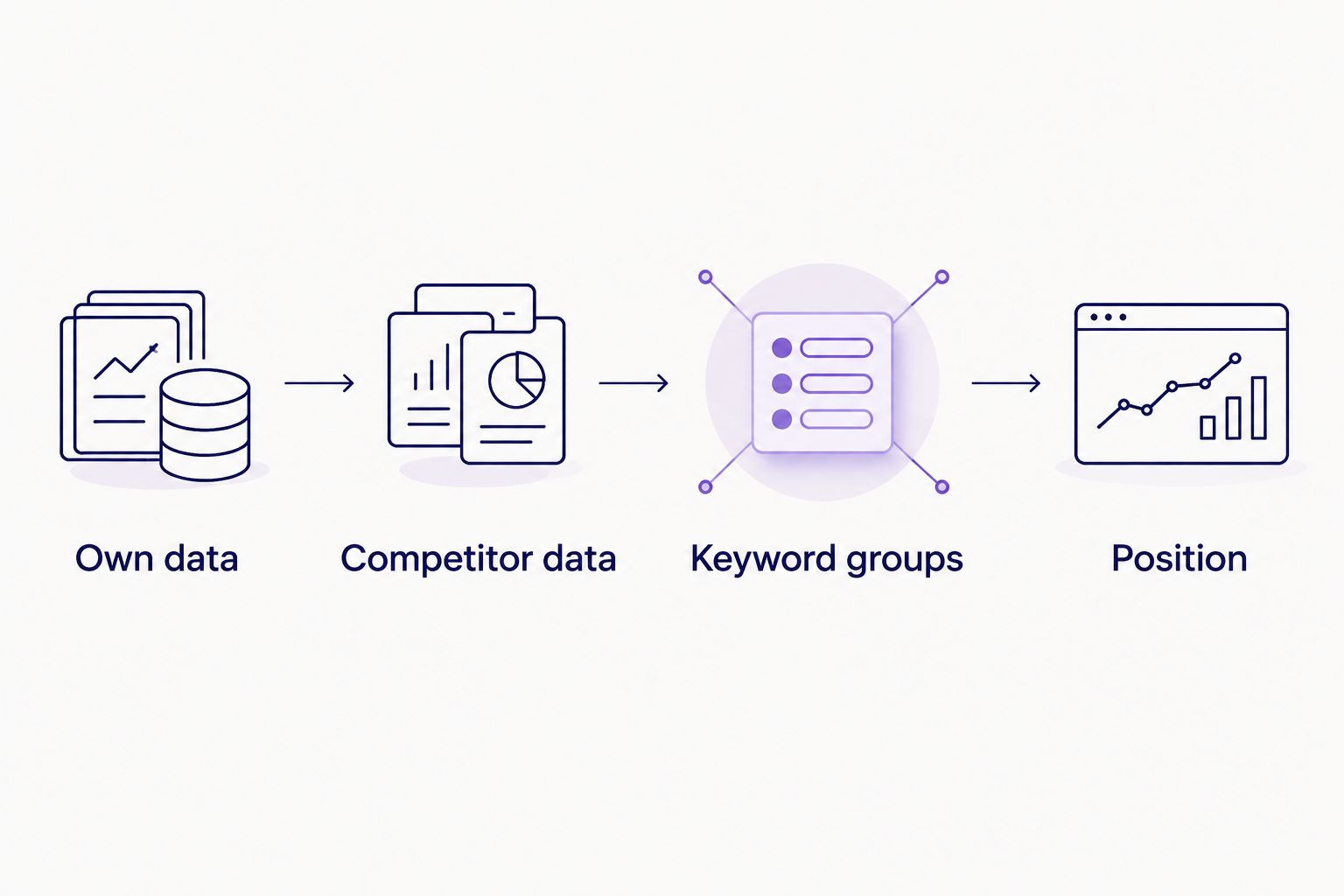
The benchmark is only useful if every month is measured the same way.
- Own data: Google Search Console performance report, 28-day window, country filtered to the UK. Search Console retains 16 months of history, so export monthly to keep a longer record.
- Competitor data: one third-party SEO tool, same 28-day window, same country. Record the tool name and export date.
- Keyword groups: fix the query list once and keep it. Add new queries as a separate group so old comparisons stay valid.
- Position: take average position per query group and count first-page queries per group.
Limitation: competitor traffic from third-party tools is modelled, not measured. It can tell you the direction and rough size of a gap. It cannot tell you a rival's exact clicks, so act only on large differences that repeat across months.
How to use these benchmarks
- Start with the query groups closest to the first page. Queries ranking just below page one respond fastest to a better page, an updated comparison or stronger internal links.
- Answer the commercial questions directly. Merchants evaluating providers want fees, approval and integration detail side by side. A page such as BNPL providers ranked by merchant fees targets exactly the merchant-fee row in the table.
- Rerun every 28 days and log the change. One snapshot is trivia. Three consecutive months is a trend worth acting on.
- Tie clicks to merchant enquiries. Organic traffic that never reaches a sign-up page is vanity. Track which landing pages produce enquiries, not just visits.
Offer interest-free finance at checkout
Let your customers spread purchases into monthly instalments with PayItMonthly.
Common benchmarking mistakes
- Comparing against retailers. Retailers rank for product queries. A BNPL provider's peers are other finance providers.
- Mixing windows. A 28-day export against a 3-month estimate produces a gap that does not exist.
- Switching tools mid-year. Each tool models traffic differently. Changing tools in 2026 resets the comparison.
- Chasing site-wide average position. It moves when you publish long-tail pages, even if no important query changed.
- Ignoring branded rankings. If a review site outranks you on your own name, fix that before anything else.
FAQ
What is the average organic traffic for a UK BNPL provider in 2026?
No reliable single average exists. Traffic depends on brand size, query mix and the tool used, so benchmark against a named peer set over the same 28-day window instead.
What is a good Google position for a BNPL provider?
Position one on branded queries and first-page rankings on comparison, fee and integration queries. Count first-page queries per group rather than chasing one site-wide average.
Which tool should I use to benchmark BNPL organic traffic?
Use Google Search Console for your own site and one third-party SEO tool for competitors. Keep the same tool every month so changes are comparable.
How often should I update BNPL organic benchmarks?
Every 28 days. Log each export date, and export Search Console data monthly because it only retains 16 months of history.
Are third-party competitor traffic estimates accurate?
No. They are modelled estimates. Use them to spot large, repeated gaps, not small differences between providers.
Should I split branded and non-branded queries?
Yes. Branded queries reflect existing demand, while non-branded merchant queries show how well your content wins new merchants.
Which competitors should PayItMonthly benchmark against?
Payl8r and Meedsy first, then Novuna and Newpay. Klarna and PayPal Pay in 3 set the visibility ceiling on shared queries, not the target.
One last thing
The most overlooked column in any provider benchmark is the page that earns the clicks. If a rival's comparison traffic sits on one page, that single page is what you need to beat, not the whole site. Pull the top landing pages for each peer in 2026, pick the one that wins the most merchant-intent queries, and build a more specific answer to the same question.


